What determines whether freshly produced organic carbon is stored in Arctic fjord sediments or quickly returned to the atmosphere as CO₂? While bacteria have long been considered the dominant microbial players in this process, the role of marine fungi has remained largely unexplored.
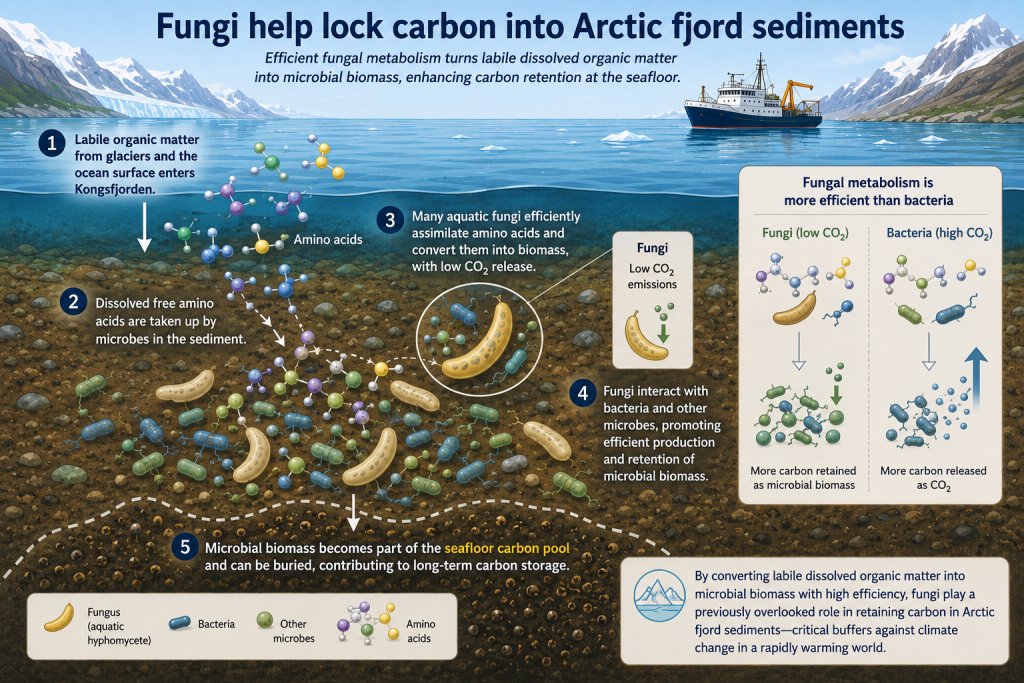
Figure caption: In Arctic fjords, fungi living in the sediments promote retention of labile dissolved organic matter that exists as free amino acids. This is made possible by a high metabolic efficiency, whereby the fungi assimilate more amino acids into their biomass compared to bacteria. When bacteria dominate the amino acid assimilation, they produce more CO2 from respiration compared to fungi and less carbon is stored in the sediments. (Created with AI)
We investigated microbial carbon cycling across Kongsfjorden, Svalbard, an arctic fjord that is considered a sentinel ecosystem for arctic change. Using quantitative stable isotope probing with ¹³C- and ¹⁵N-labeled amino acids, we tracked which microbes incorporated labile dissolved organic matter. Within the arctic fjord sediments, fungi actively assimilated this carbon with relatively high metabolic efficiency. In other words, greater fungal activity resulted in lower carbon remineralization to CO2. This coincided with higher fungi-to-prokaryote biomass ratios, indicating that efficient fungal metabolism promotes carbon retention in the sediments as microbial biomass. This process was dominated by diverse fungal taxa in the aquatic hyphomycetes genus Alatospora, which was distinct from the terrestrial fungal community surrounding the fjord. Fungi have long been known to promote carbon retention in soils as biomass, and our findings show that fungal activity and metabolism also helps stabilize organic carbon before it is buried in Arctic fjord sediments.
As Arctic fjords undergo rapid warming and glacial change, understanding how microbial communities regulate carbon storage becomes increasingly important for predicting future carbon sequestration in these globally significant coastal ecosystems.
Authors
Juan Carlos Trejos-Espeleta (Ludwig-Maximilians-Universität München)
James A. Bradley (Aix Marseille University; University of Toulon; Centre national de la recherche scientifique; Institut de Recherche pour le Développement; Mediterranean Institute of Oceanography)
Ömer K. Coskun (Ludwig-Maximilians-Universität München)
Laura M. Wehrmann (Stony Brook University)
Gonzalo V. Gomez-Saez (Ludwig-Maximilians-Universität München)
William D. Orsi (Ludwig-Maximilians-Universität München; Aix Marseille University; Queen Mary University of London; Stony Brook University)
Citation: Trejos-Espeleta JC, Bradley JA, Coskun ÖK, Wehrmann LM, Gomez-Saez GV, Orsi WD (2026) Fungi enhance microbial carbon retention in high Arctic fjord sediment. PLoS Biol 24(6): e3003783. https://doi.org/10.1371/journal.pbio.3003783