Surprise giant phytoplankton revealed by in situ imaging
The size distribution of diatoms and other phytoplankton is a key variable that influences their accessibility to planktonic grazers, sinking velocities, and contributions to vertical export of biogenic elements. However, conventional sampling methods remove phytoplankton from the ocean and lakes for measurement, often disrupting fragile chains and altering their natural morphology, thus introducing biased size metrics.
We deployed an autonomous Zooglider in the northwestern Mediterranean Sea in order to image undisturbed planktonic organisms in their natural environment (paper). This was a component of the BioSWOT-Med program (link) linked to the ‘crossover’ phase of the SWOT satellite altimetry mission. The shadowgraph imaging Zoocam on Zooglider resolved surprisingly long chains of diatoms (Guinardia, Proboscia, and other morphologies), and elongate filaments of the cyanobacteria Trichodesmium. Imaged in situ, these chains reached maximum lengths of 6.4-10.4 mm. Shipboard collections made in the same water parcels showed phytoplankton with markedly smaller length distributions, apparently a consequence of breakage, which confirms the advantage of in situ imaging for unbiased measurements.
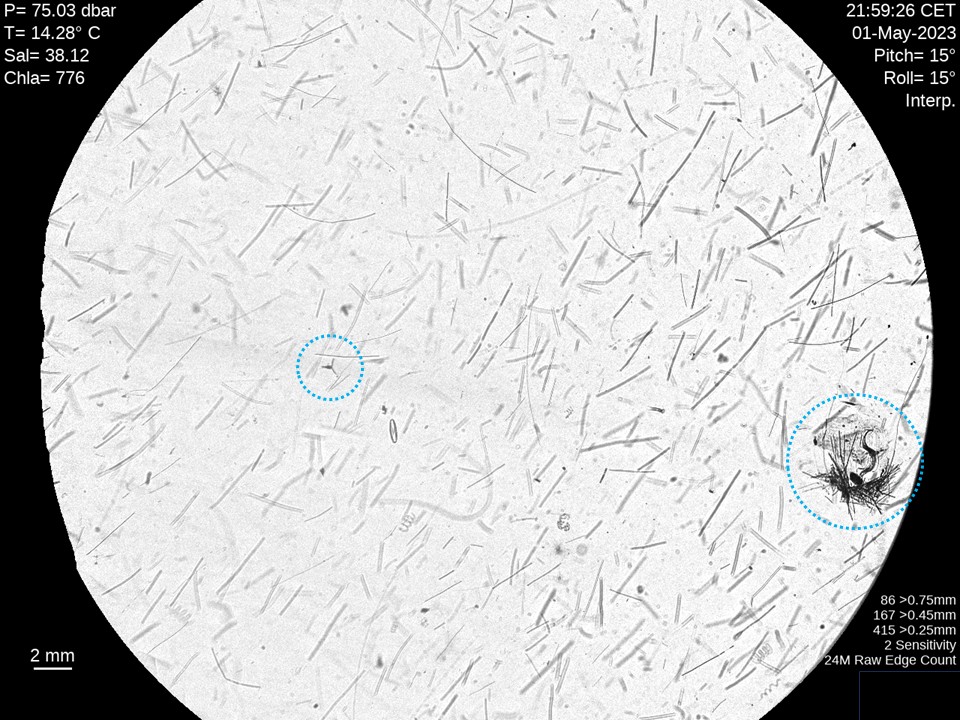
Figure caption: Zoocam image in the NW Mediterranean Sea at a pressure of 75.03 dBar. In addition to elongate phytoplankton chains, note the encircled Oithona (copepod) at left and Oikopleura sp. (appendicularian) at right with incurrent filters of mucus house clogged with diatom chains. Such long chains appear to be inedible to most suspension-feeding zooplankton.
Common members of the zooplankton grazing community, including planktonic copepods and appendicularians, appear unable to ingest these elongate chains. These results call into question the common assumption that diatoms are always readily accessible to grazing mesozooplankton and facilitate efficient trophic transfer, secondary production, and grazer-mediated particle export. While most elongate chains were found in the euphotic zone, suspended chains were detected to depths of 400 m inside an eddy, suggesting occasional direct export via sinking.
The size composition of naturally occurring phytoplankton may historically have been severely biased because of artifacts associated with collecting, filtering, and preserving these fragile cells and chains. Elongate chains have implications for grazer deterrence, the size spectral composition of pelagic food webs, and vertical export potential.
Authors:
Mark Ohman (Scripps Institution of Oceanography)
Karine Leblanc (Aix-Marseille Université and Université de Toulon)
Jeffrey Ellen (Ulysses Maritime Technologies)
Sven Gastauer (Thünen Institute of Sea Fisheries)
https://www.mio.osupytheas.fr/en/
MDO: https://mohman.scrippsprofiles.ucsd.edu/
KL: https://plankton.mio.osupytheas.fr/
Some additional background:
BioSWOT-Med was one of the ‘Adopt-a-Crossover’ research sites around the world occupied in Spring 2023 in synchrony with the early low-earth orbit phase of the SWOT (Surface Water and Ocean Topography) satellite mission. SWOT is jointly sponsored by NASA in the U.S. and CNES in France. The objectives of BioSWOT-Med were to test the hypothesis that fine-scale physical processes are a driver of plankton biodiversity. Zooglider was one of several gliders deployed, together with extensive shipboard sampling and experiments from R/V L’Atalante. Our Zooglider sensors include a shadowgraph imaging Zoocam, active dual-frequency bioacoustics, passive hydrophone, CTD, and phytoplankton Chl-a sensors. Finding remarkably long phytoplankton chains was serendipitous because the Zoocam used on Zooglider was designed to image mesozooplankton, not phytoplankton cells. We did not expect such long chains, although they have been detected in the California Current System and elsewhere. Many other contributions from the BioSWOT-Med program may be found at BioSWOT-Med cruise.