Ocean Carbon & Biogeochemistry
Studying marine ecosystems and biogeochemical cycles in the face of environmental change
  • Home
  • About OCB
    • About Us
    • Scientific Breadth
      • Biological Pump
      • Changing Marine Ecosystems
      • Changing Ocean Chemistry
      • Estuarine and Coastal Carbon Fluxes
      • Ocean Carbon Uptake and Storage
      • Ocean Observatories
    • Code of Conduct
    • Get Involved
    • Project Office
    • Scientific Steering Committee
    • OCB committees
      • OCSIF – Ocean Carbonate System Intercomparison
      • Ocean-Atmosphere Interaction
      • Ocean Time-series
      • US Biogeochemical-Argo
  • Activities
    • Summer Workshop
    • OCB Webinars
    • Guidelines for OCB Workshops & Activities
    • Topical Workshops
      • CMIP6 Models Workshop
      • Coastal BGS Obs with Fisheries
      • C-saw extreme events workshop
      • 7th DMS(P) Symposium
      • Expansion of BGC-Argo and Profiling Floats
      • Fish, fisheries and carbon
      • Future BioGeoSCAPES program
      • GO-BCG Scoping Workshop
      • Lateral Carbon Flux in Tidal Wetlands
      • Leaky Deltas Workshop – Spring 2025
      • Marine CDR Workshop
      • Ocean Nucleic Acids ‘Omics
      • Pathways Connecting Climate Changes to the Deep Ocean
    • Small Group Activities
      • Aquatic Continuum OCB-NACP Focus Group
      • Arctic-COLORS Data Synthesis
      • BECS Benthic Ecosystem and Carbon Synthesis WG
      • Carbon Isotopes in the Ocean Workshop
      • CMIP6 WG
      • Filling the gaps air–sea carbon fluxes WG
      • Fish Carbon WG
      • Metabarcoding intercal WG
      • Meta-eukomics WG
      • mCDR
      • Metaproteomic Intercomparison
      • Mixotrophs & Mixotrophy WG
      • N-Fixation WG
      • Ocean Carbonate System Intercomparison Forum
      • Ocean Carbon Uptake WG
      • OOI BGC sensor WG
      • Operational Phytoplankton Observations WG
      • Phytoplankton Taxonomy WG
      • SedMIP
    • Other Workshops
    • Science Planning
      • Coastal CARbon Synthesis (CCARS)
      • North Atlantic-Arctic
    • Ocean Acidification PI Meetings
    • Training Activities
      • PACE Hackweek 2025
      • PACE Hackweek 2024
      • PACE Training Activity 2022
  • Science Support
    • OCB Activity Proposal Solicitation
    • Guidelines for OCB Workshops & Activities
    • Data management and archival
    • Early Career
    • Funding Sources
    • Jobs & Postdocs
    • Meeting List
    • OCB Topical Websites
      • Ocean Fertilization
      • Trace gases
      • US IIOE-2
    • Outreach & Education
    • Promoting your science
    • Student Opportunities
    • Travel Support
  • Publications
    • OCB Workshop Reports
    • Science Planning and Policy
    • Newsletter Archive
  • Science Highlights
  • News

Archive for New OCB Research

Improving our view of particle attenuation in the Southern Ocean with BGC-Argo floats

Posted by mmaheigan 
· Tuesday, March 24th, 2026 

How much organic carbon is actually transported to depth in the Southern Ocean and what are the mechanisms driving seasonal and regional variability? With large-scale remote sensing observations constrained to the surface and the depth-resolved ship-based measurements being scarce, the emergence of the BGC-Argo fleet has opened up a new avenue to explore how carbon is transported from the sunlit surface to the deep ocean.

Figure caption: Conceptual illustration of applying a broken power law to POC concentration profiles measured with BGC-Argo floats in the Southern Ocean. The “steepness” or strength of the attenuation is an indicator for how quickly POC attenuates. With the emergence of the BGC-Argo floats, the authors investigate spatial and temporal patterns and possible drivers.

In a recent study published in Communication Earth & Environment, the authors present an improved model to study particle attenuation and discuss what mechanism could explain it: mineral ballasting, zooplankton processes, temperature and net primary production. The work is based on the optical backscatter and chlorophyll-fluorescence observations from the BGC-Argo fleet that are converted into particulate organic carbon (POC) profiles. The float coverage allows us to investigate seasonal patterns and spatial variability across frontal zones and oceanic basins in attenuation strength by applying a power law to the measurements. The traditional version of the simple power law (“Martin curve”) was not able to capture the large variability in the mesopelagic. Instead, we propose a broken power law to better explain higher, observed attenuation coefficients in the upper water column.

This new empirical model for particle attenuation can help guide the experimental studies and model developments needed to help constrain the biological carbon pump and how it may change future emission scenarios.


Authors
Annika Oetjens (University of Tasmania, IMAS, ACEAS)
Tyler Rohr (University of Tasmania, IMAS, AAPP, ACEAS)
Peter Strutton (University of Tasmania, IMAS, ACEAS)
Zanna Chase (University of Tasmania, IMAS, ACEAS)


New unified interface for existing ocean carbonate chemistry data products

Posted by mmaheigan 
· Tuesday, March 24th, 2026 

The paper provides a comprehensive synthesis of 68 existing ocean carbonate chemistry data products and data product sets, including cruise-based compilations, time-series datasets, gap-filled observational products, and model-based reconstructions. The authors highlight the diversity of available products, noting differences in spatial coverage, temporal resolution, methodologies, and intended scientific applications. By systematically cataloguing and comparing these datasets, the study helps researchers identify which products are most suitable for specific scientific questions related to ocean carbon cycling and ocean acidification.

ESSD Paper

Interface for the most updated list of products

Submission interface


Authors
Li-Qing Jiang (University of Maryland; NOAA National Centers for Environmental Information; Scripps Institution of Oceanography)
Amanda Fay (Columbia University / Lamont-Doherty Earth Observatory)
Jens Daniel Müller (ETH Zürich; Carbon to Sea Initiative)
Luke Gregor (ETH Zürich; Swiss Data Science Center)
Alizée Roobaert (Flanders Marine Institute, VLIZ)
Lydia Keppler (Vycarb Inc.)
Dustin Carroll (Moss Landing Marine Laboratories; NASA Jet Propulsion Laboratory)
Siv K. Lauvset (NORCE Research / Bjerknes Centre for Climate Research)
Tim DeVries (University of California, Santa Barbara)
Judith Hauck (Alfred Wegener Institute, Helmholtz Centre for Polar and Marine Research)
Christian Rödenbeck (Max Planck Institute for Biogeochemistry)
Nicolas Metzl (Sorbonne Université / LOCEAN)
Andrea J. Fassbender (NOAA Pacific Marine Environmental Laboratory)
Jean-Pierre Gattuso (Sorbonne Université / CNRS; Laboratoire d’Océanographie de Villefranche)
Peter Landschützer (Max Planck Institute for Meteorology)
Rik Wanninkhof (NOAA Atlantic Oceanographic and Meteorological Laboratory)
Christopher Sabine (University of Hawaii at Mānoa)
Simone R. Alin (NOAA Pacific Marine Environmental Laboratory)
Mario Hoppema (Alfred Wegener Institute)
Are Olsen (University of Bergen / Bjerknes Centre for Climate Research)
Matthew P. Humphreys (University of East Anglia)
Kunal Chakraborty (National Institute of Oceanography, India)
Ana C. Franco (University of Miami)
Kumiko Azetsu-Scott (Bedford Institute of Oceanography / Fisheries and Oceans Canada)
Dorothee C. E. Bakker (University of East Anglia)
Leticia Barbero (NOAA Atlantic Oceanographic and Meteorological Laboratory)
Nicholas R. Bates (Bermuda Institute of Ocean Sciences / Arizona State University)
Nicole Besemer (University of Natural Resources and Life Sciences Vienna)
Henry C. Bittig (GEOMAR Helmholtz Centre for Ocean Research Kiel)
Albert E. Boyd (University of Tasmania)
Daniel Broullón (Spanish Institute of Oceanography, IEO-CSIC)
Wei-Jun Cai (University of Delaware)
Brendan R. Carter (University of Washington)
Thi-Tuyet-Trang Chau (LSCE, CEA-CNRS-UVSQ)
Chen-Tung Arthur Chen (National Sun Yat-sen University)
Frédéric Cyr (Fisheries and Oceans Canada)
John E. Dore (University of Hawaii)
Ian Enochs (NOAA Atlantic Oceanographic and Meteorological Laboratory)
Richard A. Feely (NOAA Pacific Marine Environmental Laboratory)
Hernan E. Garcia (NOAA National Centers for Environmental Information)
Marion Gehlen (LSCE, CEA-CNRS-UVSQ)
Prasanna Kanti Ghoshal (CSIR-National Institute of Oceanography, India)
Lucas Gloege (Princeton University)
Melchor González-Dávila (University of Las Palmas de Gran Canaria)
Nicolas Gruber (ETH Zürich)
Debby Ianson (Fisheries and Oceans Canada / Institute of Ocean Sciences)
Yosuke Iida (Japan Meteorological Agency)
Masao Ishii (Meteorological Research Institute, Japan)
Apurva Padamnabh Joshi (CSIR-National Institute of Oceanography, India)
Esther Kennedy (NOAA Pacific Marine Environmental Laboratory)
Alex Kozyr (NOAA National Centers for Environmental Information)
Nico Lange (GEOMAR Helmholtz Centre for Ocean Research Kiel)
Claire Lo Monaco (Sorbonne Université / LOCEAN)
Derek P. Manzello (NOAA Atlantic Oceanographic and Meteorological Laboratory)
Galen A. McKinley (Columbia University / Lamont-Doherty Earth Observatory)
Natalie M. Monacci (NOAA Pacific Marine Environmental Laboratory)
Xosé A. Padin (Spanish Institute of Oceanography, IEO-CSIC)
Ana M. Palacio-Castro (Instituto de Investigaciones Marinas, CSIC)
Fiz F. Pérez (Spanish Institute of Oceanography, IEO-CSIC)
J. Magdalena Santana-Casiano (University of Las Palmas de Gran Canaria)
Jonathan Sharp (University of Delaware)
Adrienne Sutton (NOAA Pacific Marine Environmental Laboratory)
Jim Swift (Scripps Institution of Oceanography)
Toste Tanhua (GEOMAR Helmholtz Centre for Ocean Research Kiel)
Maciej Telszewski (International Ocean Carbon Coordination Project, IOCCP)
Jens Terhaar (University of Bern)
Ruben van Hooidonk (University of Miami / NOAA Coral Reef Watch)
Anton Velo (Spanish Institute of Oceanography, IEO-CSIC)
Andrew J. Watson (University of Exeter)
Angelicque E. White (Oregon State University)
Zelun Wu (University of Delaware)
Liang Xue (Xiamen University)
Hyelim Yoo (University of Maryland / NOAA NCEI)
Jiye Zeng (National Institute for Environmental Studies, Japan)
Guorong Zhong (Xiamen University)

How much carbon do fish move towards the seafloor as they feed and migrate in the water column?

Posted by mmaheigan 
· Tuesday, March 24th, 2026 

Ocean organisms transfer carbon via many natural processes from surface to seafloor. These include the passive sinking of carbon-rich particles and the active transport of carbon as animals swim downward. A recent study in GBC modeled how carbon stored in fish biomass moves from the sea surface to the seafloor in shelf–slope–abyssal systems through feeding interactions alone. This transport occurs as large fish eat smaller fish while occupying different vertical habitats in the water column. On average, this process delivers an amount equivalent to 5% of all carbon that reaches the seafloor—through sinking organic particles from phytoplankton and zooplankton. Yet, this can be as high as 20% in some shelf areas. On continental slopes, midwater fishes play a key role as a stepping-stone for carbon transfer (up to 50%) to the seafloor. Overall, the study reveals that the vertical movement of fish is an important pathway for delivering carbon to groundfish species, particularly on shelf areas where most commercially valuable fisheries operate.

Caption: Schematic of a shelf-slope-abyssal system with hypothesized fluxes of carbon among major functional groups (top panel); and model-estimated fluxes of carbon from functional groups to demersal fishes (bottom panel). Solid and dotted lines are mean fluxes for Eastern and Western North Atlantic systems, respectively, and shaded areas are standard deviations. Values are proportional.


Authors

Daniel Ottmann (Technical University of Denmark (DTU-Aqua); Institute of Marine Sciences of Andalusia)
Ken H. Andersen (Technical University of Denmark (DTU-Aqua))
Yixin Zhao (Technical University of Denmark (DTU-Aqua))
Colleen M. Petrik (Scripps Institution of Oceanography)
Charles A. Stock (Scripps Institution of Oceanography)
Clive Trueman (University of Southampton)
P. Daniël van Denderen (Technical University of Denmark (DTU-Aqua))


Follow the authors:
bluesky: @danielottmann.bsky.social; @kenandersen.bsky.social
LinkedIn accounts: Ottman; Andersen; Truman
X: @daniel_ottmann; @69kno; @OceanLifeCenter; @van_denderen; @clivetrue;


Active Transport of Carbon to Demersal Fish Communities in Shelf-Slope-Abyssal Systems of the North Atlantic Ocean
Global Biogeochemical Cycles, Vol 40:2, e2025GB008861. https://doi.org/10.1029/2025GB008861

The ocean is the largest natural carbon sink for atmospheric CO2

Posted by mmaheigan 
· Friday, January 23rd, 2026 

Only about half of human-made CO2 emissions remain in the atmosphere and drive global warming. The other half has so far been said to be taken up in roughly equal amounts by the biosphere on land and by physical-chemical processes in the ocean. In equal amounts?

In a new assessment, Friedlingstein et al. reassess the various components of the Global Carbon Budget. Major changes were suggested for the land and ocean sinks. For the land, the prior assumption of a preindustrial land-cover in the Dynamic Global Vegetation Models (DGVM) led to an overestimation of the natural land sink in previous studies. The land sink is further revised downwards by accounting for an anthropogenic perturbation of lateral carbon export to the ocean. For the ocean, adjustments were made for the known underestimation of the ocean sink from Global Ocean Biogeochemical Models and the cool and salty skin effect in surface fCO2-observation-based estimates. As a result, the ocean is now estimated to have taken up 29% of anthropogenic CO2 emissions in the last decade 2015-2024, while the land sink has taken up 21%. In this revised estimate with virtually no budget imbalance over the last decade and no significant trend in the budget imbalance since 1960, climate-driven impacts on the natural sinks are quantified: Land and ocean sinks would be 25% and 7% higher, respectively, without this carbon-climate feedback. Since 1960, the carbon-climate feedback has already contributed 8 ppm (8%) to the rise in atmospheric CO2 concentration.

The negative imprints of earth system changes (e.g., warming, droughts, changes in wind patterns and ocean circulation, etc.) on these important carbon sinks is worrisome and is expected to intensify as warming continues. The most effective way to protect these sinks is to drastically reduce CO2 emissions from fossil fuels and land-use changes, ultimately to net zero.


Authors
Judith Hauck (Alfred Wegener Institute Helmholtz Centre for Polar and Marine Research, University of Bremen)
Peter Landschützer (VLIZ)
Corinne Le Quéré (University of East Anglia)
Pierre Friedlingstein (University of Exeter)

Bluesky: @pfriedling @jhauck @clequere

A heat burp breaks the assumed relationship of cumulative CO2 emissions and warming

Posted by mmaheigan 
· Friday, January 23rd, 2026 

The ocean stores vast amounts of heat and carbon under anthropogenic CO₂ emissions, but its behavior under net-negative emission scenarios remains poorly understood. Here we use an Earth System Model of intermediate complexity and show results of an idealized future climate scenario that includes sustained net-negative emissions over centuries. After gradual global cooling, the model produces an abrupt “heat burp,” in which heat previously stored in the deep Southern Ocean resurfaces through deep convection, temporarily reversing the cooling and causing renewed warming. The release of heat is not accompanied by a comparable release of CO₂. The heat burp represents a breakdown of the assumed linear relationship between cumulative CO₂ emissions and warming, a metric that is used to calculate the remaining carbon budget. We call for assessing the robustness of how models forced with net-negative CO₂ emissions simulate durability of ocean storage of heat and CO₂, and pathways and time scales of loss to the atmosphere.


Fig caption: The temporal evolution of (a) global heat and carbon uptake and release; (b) surface air temperature (SAT) anomaly relative to preindustrial conditions; (c) Southern Ocean temperature anomaly relative to preindustrial conditions; gray shading/black bar indicate the period of comparatively abrupt ocean heat release that warms SAT, representing a climate feedback.


Authors
(all at GEOMAR)

Ivy Frenger
Svenja Frey (and Univ Copenhagen)
Andreas Oschlies
Julia Getzlaff
Torge Martin
Wolfgang Koeve


Frenger, I., Frey, S., Oschlies, A., Getzlaff, J., Martin, T., & Koeve, W. (2025). Southern Ocean heat burp in a cooling world. AGU Advances, 6, e2025AV001700. https://doi.org/10.1029/2025AV001700

A Microbial Conveyor Belt Beneath the South Pacific

Posted by mmaheigan 
· Friday, October 17th, 2025 

Global overturning circulation is a planetary conveyor belt: dense waters sink around Antarctica, spread through the deep ocean for centuries, and eventually rise elsewhere, redistributing heat, nutrients, and carbon. But how does this slow, pervasive movement of water impact marine microbes?


To find out, researchers collected over 300 water samples spanning the full depth of the ocean along the GO-SHIP P18 line in the South Pacific. They found that microbial genomes cluster into six spatial cohorts that are not only delineated by depth, but also circulatory features, like Antarctic Bottom Water formation, and ventilation age. Distinct functional signatures also emerged across these circulation-driven zones. For example, genes for light harvesting and iron uptake dominate in surface waters, while adaptations for cold, high pressure, or anaerobic metabolism characterize deep and ancient waters. Antarctic Bottom Water communities also carry hallmarks of rapid genetic exchange, suggesting horizontal gene transfer may help microbes adapt as they sink into the deep ocean. Even in waters isolated from the atmosphere for over a thousand years, many microbial genomes have coverage patterns that imply active replication, demonstrating that long-isolated water masses still support active microbial populations. In considering patterns of microbial diversity, researchers also identified a pervasive “prokaryotic phylocline” in which richness spikes just below the surface mixed layer and remains high to full ocean depth, only dipping slightly in very old water.

These results demonstrate that physical circulation, not just temperature or nutrients, partitions the ocean into microbial biomes. Understanding this linkage is critical because microbes determine the amount of carbon that is recycled or stored long-term in the deep ocean. As climate change alters overturning circulation, the functioning of these hidden microbial ecosystems and their role in regulating atmospheric CO₂ may shift in unexpected ways.

Authors
Bethany C. Kolody (University of California San Diego; UC Berkeley; J. Craig Venter Institute)
Rohan Sachdeva (UC Berkeley)
Hong Zheng (J. Craig Venter Institute)
Zoltán Füssy (UC San Diego; J. Craig Venter Institute)
Eunice Tsang (UC Berkeley)
Rolf E. Sonnerup (University of Washington)
Sarah G. Purkey (UC San Diego)
Eric E. Allen (UC San Diego)
Jillian F. Banfield (UC Berkeley; Lawrence Berkeley National Laboratory; Monash University)
Andrew E. Allen (UC San Diego; JCVI)

Social media
Twitter/X: @science_doodles, @Scripps_Ocean, @JCVenterInst
Bluesky: @banfieldlab.bsky.social, @bethanykolody.bsky.social, @scrippsocean.bsky.social, @jcvi.org


https://www.science.org/doi/10.1126/science.adv6903
Overturning circulation structures the microbial functional seascape of the South Pacific
Science

Marine plant metabolites give marine microbes gas

Posted by mmaheigan 
· Friday, October 17th, 2025 

A recent study in Nature Geosciences observed high concentrations of methane overlying permeable (sand) sand sediments in bays in Denmark and Australia. These environments are not one would expect to see methane because they are highly oxygenated and the high concentrations of sulfate in seawater typically inhibit methanogenesis. The authors showed that the methane was not being imported from local groundwater using geochemical methods. Using a combination of biogeochemical, microbial isolation, culturing and genomic approaches, revealed that methane was being produced by fast growing microbes resistant to oxygen exposure using plant produced substrates such as dimethylsulfide and amines. This work shows that where marine plants such as seaweed and seagrass grow and accumulate there may be high and sporadic production of methane. This has implications for how we account for the carbon sequestering capacity of coastal environments and the climate impact of increasing algal blooms such as coastal Ulva and the great sargassum bloom.

Authors
Perran Cook (Monash University)
Ning Hall (University of free spirit)


From smoke to sea, how wildfire ash reshapes ocean microbial life

Posted by mmaheigan 
· Friday, September 26th, 2025 

When wildfire smoke drifts over the ocean, what happens beneath the waves? As wildfires change in nature and become more frequent, it’s increasingly important to understand how ash deposition affects the ocean’s smallest, yet most essential, inhabitants.

Figure 1. Conceptual illustration of coastal wildfires. Coarse-mode smoke including ash, rich in organic matter and low in minerals, is likely to settle near the fire source. Fine-mode smoke, with lower organic content and higher mineral composition, disperses farther. Wildfire smoke deposition can introduce both fertilizing nutrients, such as inorganic nitrogen and iron, and more toxic compounds, including dissolved organic matter (DOM) species like aromatic hydrocarbons, affecting marine trophic levels. Additionally, wildfire smoke on the ocean surface may alter sunlight penetration, impacting phytoplankton photosynthesis.

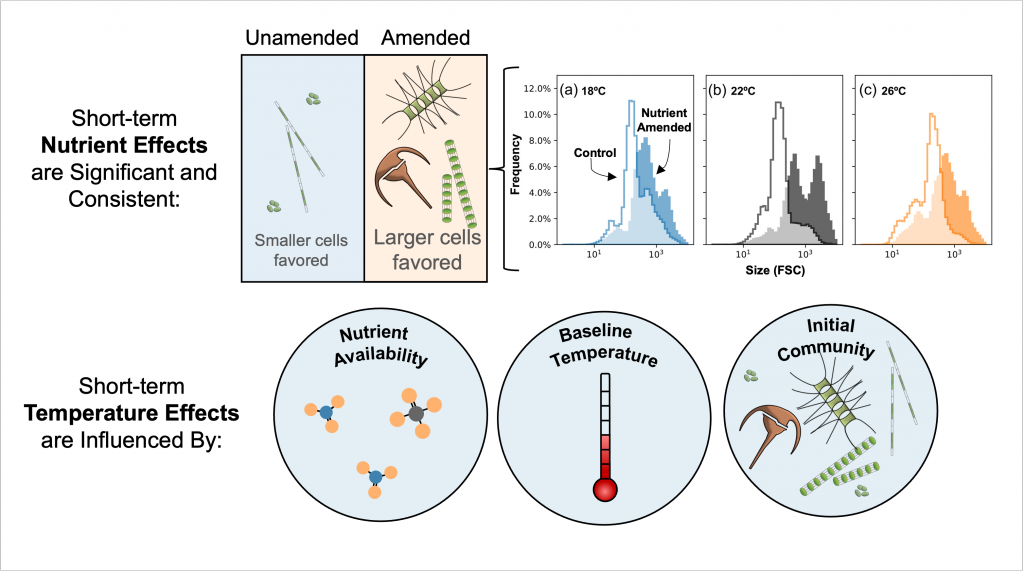
In a recent study, the authors investigated how wildfire ash leachate influences coastal microbial communities. Through field incubations along the California coast, we found that ash-derived dissolved organic matter (DOM) increased bacterioplankton specific growth rates and organic matter remineralization, while leaving bacterial growth efficiency unchanged. This suggests that the added DOM was primarily used to fuel basic cellular functions rather than biomass production. Meanwhile, microzooplankton grazing declined, even as phytoplankton division rates remained stable, hinting at a decoupling of predator-prey dynamics that could promote phytoplankton accumulation.

Pre-existing phytoplankton biomass had a greater influence on microbial responses than the chemical composition of the ash itself. In low-biomass waters, bacteria more readily consumed the ash-derived DOM. In contrast, in high-biomass waters, the leachate was less bioavailable, potentially allowing more refractory ash-derived carbon to accumulate. These baseline differences appeared to influence phytoplankton size structure: smaller cells increased in high-biomass settings, while larger cells became more prevalent in low-biomass waters. These shifts may have implications for nutrient cycling, food web structure, and carbon export pathways, depending on how microbial activity and community composition respond in situ.


Authors
Nicholas Baetge (Oregon State University)
Kimberly Halsey (Oregon State University)
Erin Hanan (University of Nevada, Reno)
Michael Behrenfeld (Oregon State University)
Allen Milligan (Oregon State University)
Jason Graff (Oregon State University)
Parker Hansen (Oregon State University)
Craig Carlson (University of California, Santa Barbara)
Rene Boiteau (University of Minnesota)
Eleanor Arrington (University of California, Santa Barbara)
Jacqueline Comstock (University of California, Santa Barbara)
Elisa Halewood (University of California, Santa Barbara)
Elizabeth Harvey (University of New Hampshire)
Norm Nelson (University of California, Santa Barbara)
Keri Opalk (University of California, Santa Barbara)
Brian Ver Wey (Oregon State University)

How does a persistent eddy impact the biological carbon pump?

Posted by mmaheigan 
· Friday, September 26th, 2025 

The Lofoten Basin Eddy (LBE) is a unique and persistent anticyclonic feature of the Norwegian Sea that stirs the water column year-round. However, its impact on biogeochemical processes that influence region carbon storage, including carbon fixation, particle aggregation and fragmentation, and remineralization, has remained largely unknown.

Figure caption: (a) Map of the Lofoten Basin Eddy study region including locations of 1886 profiles from 22 Biogeochemical-Argo floats (2010–2022) and a heatmap showing the relative extent of the LBE influence zone over the timeseries. (b–d) Mean monthly profiles and the difference (Δ) determined as inside minus outside the LBE influence zone of the mass concentration of particulate organic carbon in small particles (POCs). Arrows indicate key mechanisms regulating the regional biological carbon.

Using 12 years of data from Biogeochemical-Argo floats and satellite altimetry to track eddy movements, Koestner et al. (2025) examined how the LBE influences the seasonal transport of organic carbon from surface waters to the deep ocean. While the LBE can enhance carbon export during certain months, like during spring shoaling and late autumn subduction, it generally reduces the efficiency of the biological carbon pump. Inside the eddy, warmer subsurface waters and slower-sinking particles often lead to more respiration and remineralization, meaning less carbon reached the deep sea.

The LBE’s persistent influence on organic carbon cycling could affect regional climate feedbacks and marine ecosystems, including key fisheries in Norway. Understanding how features like the LBE modulate carbon sequestration is vital for improving climate models and managing ocean resources in a warming Arctic.


Authors
Daniel Koestner (University of Bergen)
Sophie Clayton (National Oceanography Centre)
Paul Lerner (Columbia University)
Alexandra E. Jones-Kellett (MIT & WHOI)
Stevie L. Walker (University of Washington)

New software enables global ocean biogeochemical modeling in Python

Posted by mmaheigan 
· Friday, September 5th, 2025 

Have you ever wondered what life would be like if you could write and run complex biogeochemical models easily and conveniently in Python? Wonder no more. In a paper published in J. Adv. Model. Earth Syst., Samar Khatiwala (2025; see reference below) describes tmm4py, a new software to enable efficient, global scale biogeochemical modelling in Python.

tmm4py is based on the Transport Matrix Method (TMM), an efficient numerical scheme for “offline” simulation of tracers driven by circulations from state-of-the-art physical models and state estimates. tmm4py exposes this functionality in Python, providing the tools needed to implement complex models in pure Python using standard modules such as NumPy, and run them interactively on hardware ranging from laptops to supercomputers. No knowledge of parallel computing required! tmm4py even extends the interactivity to models written in Fortran, allowing the many existing models coupled to the TMM, e.g., MITgcm, to be used from the familiar comfort of Python. Whether you’re a seasoned modeler, just want to try out an idea, or illustrate a concept in your teaching, tmm4py is designed to make biogeochemical modeling more widely accessible.

Download the code from: https://github.com/samarkhatiwala/tmm

Figure: Schematic illustrating the structure of tmm4py and its relationship with the various libraries and components it is built on or interacts with. Outlined boxes represent user‐supplied code (such as the “Hello World” example of the ideal age tracer shown on the left). Other low-level libraries on which tmm4py depends, for example, BLAS and LAPACK for linear algebra, MPI for parallel communication, and CUDA for GPUs, are not shown.


Author
Samar Khatiwala (Waseda Univ)

Joint Science Highlight with GEOTRACES.

Next Page »

FilterbyKeyword

abundance acidification additionality advection africa air-sea air-sea interactions algae alkalinity allometry ammonium AMO AMOC anoxic Antarctic Antarctica anthro impacts anthropogenic carbon anthropogenic impacts appendicularia aquaculture aquatic continuum aragonite saturation arctic Argo argon arsenic artificial seawater AT Atlantic atmospheric CO2 atmospheric nitrogen deposition authigenic carbonates autonomous platforms AUVs awb bacteria bathypelagic BATS BCG Argo benthic bgc argo bio-go-ship bio-optical bioavailability biogeochemical cycles biogeochemical models biogeochemistry Biological Essential Ocean Variables biological pump biomass biophysics bloom blue carbon bottom water boundary layer buffer capacity C14 CaCO3 calcification calcite carbon carbon-climate feedback carbon-sulfur coupling carbonate carbonate chemistry carbonate system carbon budget carbon cycle carbon dioxide carbon export carbon fluxes carbon sequestration carbon storage Caribbean CCA CCS changing marine chemistry changing marine ecosystems changing marine environments changing ocean chemistry chemical oceanographic data chemical speciation chemoautotroph chesapeake bay chl a chlorophyll circulation clouds CO2 CO3 coastal and estuarine coastal darkening coastal ocean cobalt Coccolithophores commercial community composition competition conservation cooling effect copepod copepods coral reefs cruise CTD currents cyclone daily cycles data data access data assimilation database data management data product data sets Data standards DCM dead zone decadal trends decomposers decomposition deep convection deep ocean deep sea coral denitrification dense water deoxygenation depth diatoms DIC diel migration diffusion dimethylsulfide dinoflagellate dinoflagellates discrete measurements distribution DOC DOM domoic acid DOP dust DVM ecology economics ecosystem management ecosystems eddy Education EEZ Ekman transport emissions ENSO enzyme equatorial current equatorial regions ESM estuarine and coastal carbon fluxes estuary euphotic zone eutrophication evolution export export fluxes export production extreme events faecal pellets fecal pellets filter feeders filtration rates fire fish Fish carbon fisheries fishing floats fluid dynamics fluorescence food webs forage fish forams freshening freshwater frontal zone functional role future oceans gelatinous zooplankton gene transfer geochemistry geoengineering geologic time GEOTRACES glaciers gliders global carbon budget global ocean global ocean models global overturning circulation global warming go-ship grazing greenhouse gas greenhouse gases Greenland ground truthing groundwater Gulf of Maine Gulf of Mexico Gulf Stream gyre harmful algal bloom high latitude human food human impact human well-being hurricane hydrogen hydrothermal hypoxia ice age iceberg ice cores ice cover industrial onset inland waters in situ inverse circulation ions iron iron fertilization iron limitation isotopes jellies katabatic winds kelvin waves krill kuroshio lab vs field land land-ocean continuum larvaceans lateral transport LGM lidar ligands light light attenuation lineage lipids low nutrient machine learning mangroves marine carbon cycle marine heatwave marine particles marine snowfall marshes mCDR mechanisms Mediterranean meltwater mesopelagic mesoscale mesoscale processes metagenome metals methane methods microbes microlayer microorganisms microplankton microscale microzooplankton midwater migration minerals mitigation mixed layer mixed layers mixing mixotrophs mixotrophy model modeling model validation mode water molecular diffusion MPT MRV multi-decade N2 n2o NAAMES NCP nearshore net community production net primary productivity new ocean state new technology Niskin bottle nitrate nitrogen nitrogen cycle nitrogen fixation nitrous oxide north atlantic north pacific North Sea NPP nuclear war nutricline nutrient budget nutrient cycles nutrient cycling nutrient limitation nutrients OA observations ocean-atmosphere ocean acidification ocean acidification data ocean alkalinity enhancement ocean carbon uptake and storage ocean color ocean modeling ocean observatories ocean warming ODZ oligotrophic omics OMZ open ocean optics organic particles oscillation outwelling overturning circulation oxygen pacific paleoceanography PAR parameter optimization parasite particle flux particles partnerships pCO2 PDO peat pelagic PETM pH phenology phosphate phosphorus photosynthesis physical processes physiology phytoplankton PIC piezophilic piezotolerant plankton POC polar polar regions policy pollutants precipitation predation predator-prey predators prediction pressure primary productivity Prochlorococcus productivity prokaryotes proteins pteropods pycnocline python radioisotopes remineralization remote sensing repeat hydrography residence time resource management respiration resuspension rivers rocky shore Rossby waves Ross Sea ROV salinity salt marsh satellite scale seafloor seagrass sea ice sea level rise seasonal seasonal effects seasonality seasonal patterns seasonal trends sea spray seawater collection seaweed secchi sediments sensors sequestration shelf ocean shelf system shells ship-based observations shorelines siderophore silica silicate silicon cycle sinking sinking particles size SOCCOM soil carbon solubility pump southern ocean south pacific spatial covariations speciation SST state estimation stoichiometry subduction submesoscale subpolar subtropical sulfate surf surface surface ocean surface waters Synechococcus technology teleconnections temperate temperature temporal covariations thermocline thermodynamics thermohaline thorium tidal time time-series time of emergence titration top predators total alkalinity trace elements trace metals trait-based transfer efficiency transient features trawling Tris trophic transfer tropical turbulence twilight zone upper ocean upper water column upwelling US CLIVAR validation velocity gradient ventilation vertical flux vertical migration vertical transport warming water clarity water column water mass water quality waves weathering western boundary currents wetlands winter mixing zooplankton

Copyright © 2026 - OCB Project Office, Woods Hole Oceanographic Institution, 266 Woods Hole Rd, MS #25, Woods Hole, MA 02543 USA Phone: 508-289-2838  •  Fax: 508-457-2193  •  Email: ocb_news@us-ocb.org

link to nsflink to noaalink to WHOI

Funding for the Ocean Carbon & Biogeochemistry Project Office is provided by the National Science Foundation (NSF) and the National Aeronautics and Space Administration (NASA). The OCB Project Office is housed at the Woods Hole Oceanographic Institution.