Ocean Carbon & Biogeochemistry
Studying marine ecosystems and biogeochemical cycles in the face of environmental change
  • Home
  • About OCB
    • About Us
    • Scientific Breadth
      • Biological Pump
      • Changing Marine Ecosystems
      • Changing Ocean Chemistry
      • Estuarine and Coastal Carbon Fluxes
      • Ocean Carbon Uptake and Storage
      • Ocean Observatories
    • Code of Conduct
    • Get Involved
    • Project Office
    • Scientific Steering Committee
    • OCB committees
      • OCSIF – Ocean Carbonate System Intercomparison
      • Ocean-Atmosphere Interaction
      • Ocean Time-series
      • US Biogeochemical-Argo
  • Activities
    • Summer Workshop
    • OCB Webinars
    • Guidelines for OCB Workshops & Activities
    • Topical Workshops
      • CMIP6 Models Workshop
      • Coastal BGS Obs with Fisheries
      • C-saw extreme events workshop
      • 7th DMS(P) Symposium
      • Expansion of BGC-Argo and Profiling Floats
      • Fish, fisheries and carbon
      • Future BioGeoSCAPES program
      • GO-BCG Scoping Workshop
      • Lateral Carbon Flux in Tidal Wetlands
      • Leaky Deltas Workshop – Spring 2025
      • Marine CDR Workshop
      • Ocean Nucleic Acids ‘Omics
      • Pathways Connecting Climate Changes to the Deep Ocean
    • Small Group Activities
      • Aquatic Continuum OCB-NACP Focus Group
      • Arctic-COLORS Data Synthesis
      • BECS Benthic Ecosystem and Carbon Synthesis WG
      • Carbon Isotopes in the Ocean Workshop
      • CMIP6 WG
      • Filling the gaps air–sea carbon fluxes WG
      • Fish Carbon WG
      • Metabarcoding intercal WG
      • Meta-eukomics WG
      • mCDR
      • Metaproteomic Intercomparison
      • Mixotrophs & Mixotrophy WG
      • N-Fixation WG
      • Ocean Carbonate System Intercomparison Forum
      • Ocean Carbon Uptake WG
      • OOI BGC sensor WG
      • Operational Phytoplankton Observations WG
      • Phytoplankton Taxonomy WG
      • SedMIP
    • Other Workshops
    • Science Planning
      • Coastal CARbon Synthesis (CCARS)
      • North Atlantic-Arctic
    • Ocean Acidification PI Meetings
    • Training Activities
      • PACE Hackweek 2025
      • PACE Hackweek 2024
      • PACE Training Activity 2022
  • Science Support
    • OCB Activity Proposal Solicitation
    • Guidelines for OCB Workshops & Activities
    • Data management and archival
    • Early Career
    • Funding Sources
    • Jobs & Postdocs
    • Meeting List
    • OCB Topical Websites
      • Ocean Fertilization
      • Trace gases
      • US IIOE-2
    • Outreach & Education
    • Promoting your science
    • Student Opportunities
    • Travel Support
  • Publications
    • OCB Workshop Reports
    • Science Planning and Policy
    • Newsletter Archive
  • Science Highlights
  • News

El Niño-driven changes in the tropical Pacific O2 content and structure

Posted by mmaheigan 
· Wednesday, April 29th, 2026 

What drives the year-to-year variability of dissolved oxygen (O2) in the tropical Pacific? A recent study explored this question using a global high-resolution model with active ocean biogeochemistry along with a machine learning based estimate of dissolved oxygen from Argo floats. El Niño and La Niña events play a major role in regulating the O2 content and distribution in the tropical Pacific. El Niño events result in excess O2 in the eastern tropical Pacific and reduced O2 in the west. La Niña yields opposite patterns. In contrast to previous speculations that lower model resolution leads to an underestimate of observed O2 variability in this region, we find little difference in the amplitude of the O2 content change between models of different resolution (~1º vs 0.1º) and the observations-based machine learning estimate. ENSO-driven variability of O2 in the eastern tropical Pacific is driven by large opposing physical and biological contributions: reduced upwelling of low-O2 waters and weaker O2 consumption at depth due to suppressed biological productivity during El Niño dominate over the reduction in O2 ventilation by vertical turbulent mixing and the Equatorial Undercurrent, and the opposite occurs during La Niña. This subtle balance between competing processes suggests that future changes in O2 in the tropical Pacific are likely to be sensitive to local changes in equatorial Pacific circulation and productivity, in addition to changes in large scale O2 supply from the mid and high latitude basins as the ocean warms and stratifies. These O2 changes have important implications for understanding and predicting marine ecosystem health and fisheries productivity throughout the tropical Pacific.
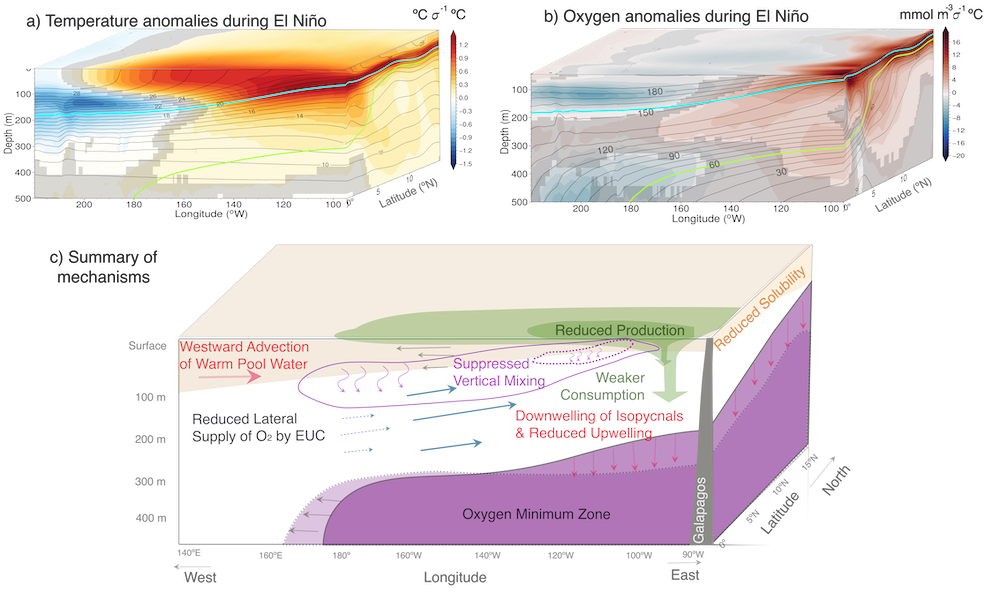
 

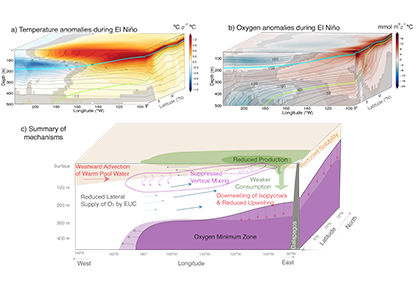
Figure: ENSO impacts on temperature and O2 shown as regression of Nino 3.4 index on a) temperature anomalies, and b) O2 anomalies in a high resolution simulation of CESM. Panel c) illustrates the main mechanisms governing the O2 response to El Niño events.

Authors
Yassir A. Eddebbar (Scripps Institution of Oceanography)
M L. Hoffman (Scripps Institution of Oceanography)
Jonathan D. Sharp (UW/NOAA)
Daniel B. Whitt (NASA Ames)
Aneesh C. Subramanian (CU Boulder)
Sam Stevenson (UC Santa Barbara)

@NCAR_CGD @CUBoulderATOC @Scripps_Ocean @aneeshcs @CLIVAR @USCLIVAR


Citation: Eddebbar, Y. A., Hoffman, E. L., Sharp, J. D., Whitt, D. B., Subramanian, A. C., & Stevenson, S. (2026). ENSO-Driven Variability of Oxygen Content and Distribution in the Tropical Pacific. Journal of Climate, 39(5), 1333-1353. https://doi.org/10.1175/JCLI-D-25-0476.1


Copyright © 2026 - OCB Project Office, Woods Hole Oceanographic Institution, 266 Woods Hole Rd, MS #25, Woods Hole, MA 02543 USA Phone: 508-289-2838  •  Fax: 508-457-2193  •  Email: ocb_news@us-ocb.org

link to nsflink to noaalink to WHOI

Funding for the Ocean Carbon & Biogeochemistry Project Office is provided by the National Science Foundation (NSF) and the National Aeronautics and Space Administration (NASA). The OCB Project Office is housed at the Woods Hole Oceanographic Institution.