Fresh organic particles take a shortcut to the deep ocean
Organic particles produced in surface waters typically take weeks to months to reach the deep ocean, during which much of their carbon is consumed or transformed. But can intense convection rapidly transport fresh organic particles from the surface to the bathypelagic ocean?
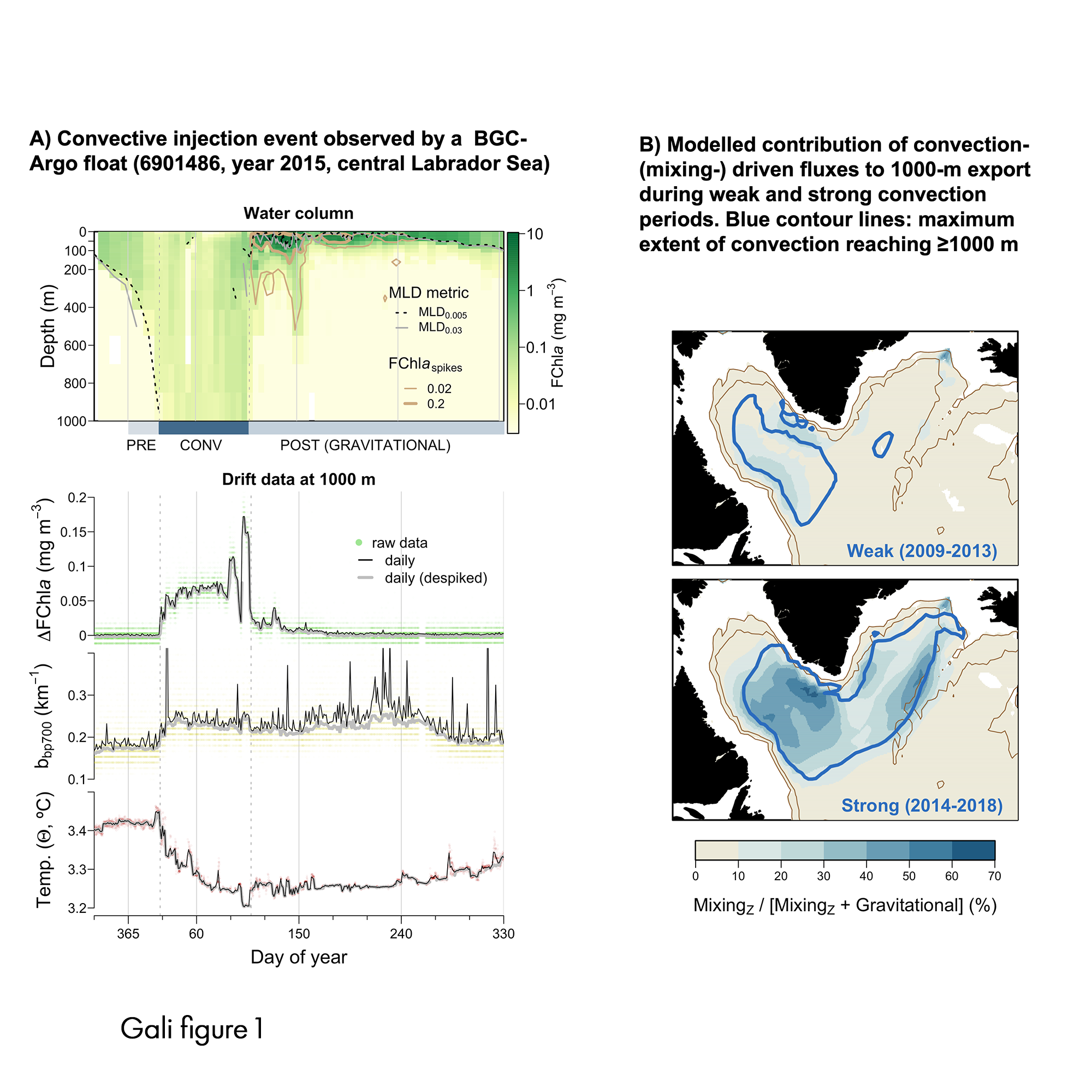
While mining the data collected by biogeochemical Argo floats in the Labrador and Irminger Seas, we observed high levels of chlorophyll-a fluorescence at 1000 m during deep convection events in winter and early spring, which sparked this study. Remarkably, peak magnitudes at 1000 m were comparable to chlorophyll-a concentrations simultaneously retrieved by satellites at the sea surface, indicating the convective injection of suspended particulate organic carbon (POC) from the surface. We then conducted model simulations, which, consistent with observations, showed that the transported POC is dominated by living plankton and increases toward the late convection season, reflecting the interplay between phytoplankton growth and vertical mixing. Over interannual scales, the model reproduces cyclic multiyear periods of intensified convection, during which this mechanism regionally contributes up to half of the annual POC supply between 500 and 2000 m. Although most of the injected POC is biodegraded, a fraction is transported horizontally beyond the convective domain and can therefore contribute to long-term carbon storage in deep waters.
These findings reveal an overlooked pathway linking surface ocean ecosystems to deep ocean metabolism, with marked interannual variability linked to the North Atlantic Oscillation. Accounting for this mechanism may improve our understanding of the ocean’s role in carbon storage and global climate, both historically and under future scenarios of weakened deep convection in the North Atlantic subpolar gyre.
Authors and affiliations
Martí Galí, María Andrea Orihuela-García, María Sánchez-Urrea, Joan Llort (Institut de Ciències del Mar, ICM-CSIC)
Yohan Ruprich-Robert, Vladimir Lapin, Valentina Sicardi, Raffaele Bernardello (Barcelona Supercomputing Center, BSC–CNS)
Marcos Fontela (Instituto de Investigacións Mariñas, IIM-CSIC)
Social network handles:
Martí Galí Tàpias (Bluesky): @martingales84.bsky.social
ICM-CSIC (Bluesky, X/Twitter): @icmcsic.bsky.social, @ICMCSIC
BSC-CNS (Bluesky, X/Twitter): @bsc-cns.bsky.social, @BSC_CNS