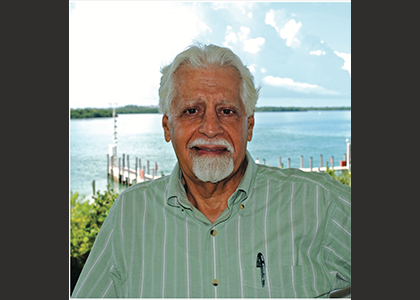
With great sadness, we share the news that Frank J. Millero passed away on December 25, 2025, at the age of 86. Frank was a titan and pioneer of marine chemistry whose foundational work on the physical chemistry of natural waters reshaped our understanding of the ocean, particularly in the areas of carbon and trace metal cycling. After earning his Bachelor’s degree from Ohio State University (1961), Master’s degree and Ph.D. from the Carnegie Institute of Technology (1964 and 1965, respectively), he conducted a short stint in industry studying automobile pollution and catalytic efficiency. He joined the faculty at the University of Miami’s Marine Laboratory (now called the Rosenstiel School of Marine, Atmospheric, and Earth Science) in 1966 and remained there until his retirement in 2015. His early work in the 1960s and 70s refined and improved the definition and measurement of salinity, resulting in the development of the practical salinity scale (1978), used universally by every oceanographer. He famously hated the use of PSU as a unit for salinity (practical salinity is unitless), and as editor-in-chief of Marine Chemistry (1992 – 2017), he maintained a policy that any paper mentioning PSU would be rejected without review. Along with several colleagues, that work culminated with the thermodynamic equation of state 2010 (TEOS-10) and the development of reference and absolute salinities (which do have units). His early work on the speed of sound in seawater is still used daily to determine water depth.
Frank is perhaps most known for his work on the carbonate system and ocean acidification. He dedicated significant efforts to understanding the partitioning of the carbonate species in seawater through measurements of the apparent dissociation constants, providing several formulations that are widely used in the carbon cycling community. He wrote QuickBASIC proto versions of what some of his students would later develop into the widely adopted CO2sys program for carbon dioxide (CO2) system calculations. He was passionate about conducting science through direct observations and field work, and always provided ample opportunities for students to go to sea, which was an unofficial requirement for all his students before they graduated. He published one of the first papers (1979) using direct observations to demonstrate that the CO2 of the oceans was indeed increasing due to uptake of fossil fuel emissions as had been hypothesized. He continued studying this uptake and its impacts (such as ocean acidification) for the remainder of his career.
He received numerous honors and awards, but he once said his proudest accomplishments were his students when they published work done in his lab. Summarizing his amazing 50+ year career and all of the ways his work continues to touch and influence the fields of carbon chemistry and oceanography in general would be impossible. For those who knew him, he was not only a great scientist but a dedicated mentor and a kind and generous man. He always had a story to tell, and often it was on his office balcony overlooking Biscayne Bay with a Corona in hand. He will be sorely missed.
We are collecting memories and stories of Frank to share with his wife Judy and family. Please send any you wish to share to Dennis Hansell (dhansell@miami.edu) and Ryan Woosley (rwoosley@mit.edu)
Photo credit Annual Review of Marine Science (Millero, F.J., 2015) https://doi.org/10.1146/annurev-marine-010814-015946