Skip to content

Ocean Carbon & Biogeochemistry

Studying marine ecosystems and biogeochemical cycles in the face of environmental change

  • Home
  • About OCB
    • About Us
    • Scientific Breadth
      • Biological Pump
      • Changing Marine Ecosystems
      • Changing Ocean Chemistry
      • Estuarine and Coastal Carbon Fluxes
      • Ocean Carbon Uptake and Storage
      • Ocean Observatories
    • Code of Conduct
    • Get Involved
    • Project Office
    • Scientific Steering Committee
    • OCB committees
      • OCSIF – Ocean Carbonate System Intercomparison
      • Ocean-Atmosphere Interaction Committee
      • Ocean Time-series
      • US Biogeochemical-Argo
  • Activities
    • 20 years of OCB Symposium – 18 November 2026
    • OCB Webinars
    • Summer Workshop
    • Guidelines for OCB Workshops & Activities
    • Topical Workshops
      • 7th DMS(P) Symposium
      • Marine Virus Workshop
      • Completed
        • CMIP6 Models Workshop
        • Coastal BGS Obs with Fisheries
        • C-saw extreme events workshop
        • Expansion of BGC-Argo and Profiling Floats
        • Fish, fisheries and carbon
        • Future BioGeoSCAPES program
        • GO-BCG Scoping Workshop
        • Lateral Carbon Flux in Tidal Wetlands
        • Leaky Deltas Workshop
        • Marine CDR Workshop
        • Ocean Nucleic Acids ‘Omics
        • Pathways Connecting Climate Changes to the Deep Ocean
    • Small Group Activities
      • BECS Benthic Ecosystem and Carbon Synthesis WG
      • Metabarcoding intercal WG
      • Meta-eukomics WG
      • Metaproteomic Intercomparison
      • SedMIP
      • Recently completed
        • Aquatic Continuum OCB-NACP Focus Group
        • Arctic-COLORS Data Synthesis
        • Carbon Isotopes in the Ocean Workshop
        • CMIP6 WG
        • Filling the gaps air–sea carbon fluxes WG
        • Fish Carbon WG
        • mCDR
        • Mixotrophs & Mixotrophy WG
        • N-Fixation WG
        • Ocean Carbonate System Intercomparison Forum
        • Ocean Carbon Uptake WG
        • OOI BGC sensor WG
        • Operational Phytoplankton Observations WG
        • Phytoplankton Taxonomy WG
    • Other Workshops
    • Science Planning
      • Coastal CARbon Synthesis (CCARS)
      • North Atlantic-Arctic
    • Ocean Acidification PI Meetings
    • Training Activities
      • PACE Hackweek 2025
      • PACE Hackweek 2024
      • PACE Training Activity 2022
  • Science Support
    • OCB Activity Proposal Solicitations
    • Guidelines for OCB Workshops & Activities
    • Data management and archival
    • Early Career
    • Funding Sources
    • Jobs & Postdocs
    • Meeting List
    • OCB topical websites
      • Ocean Fertilization
      • Trace gases
      • US IIOE-2
    • Outreach & Education
    • Promoting your science
    • Student Opportunities
    • Travel Support
  • Publications
    • OCB Workshop Reports
    • Science Planning and Policy
    • Newsletter Archive
  • Science Highlights
  • News

Posts by chadwick.chinnery

Unexpected DOC additions in the deep Atlantic
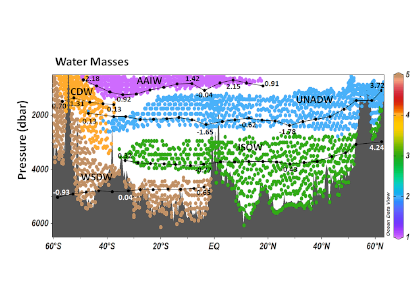
By chadwick.chinnery | January 7, 2020

Oceanic dissolved organic carbon (DOC) ultimately exchanges with atmospheric CO2 and thus represents an important carbon source/sink with consequence for climate. Most of the DOC is recalcitrant to microbial degradation,…

Read More

The ocean’s smallest phytoplankton may be bigger than we thought
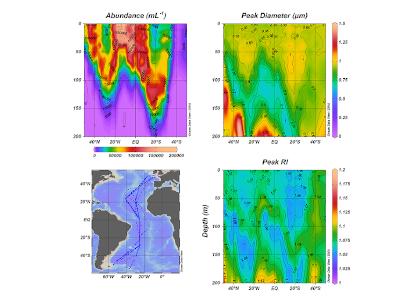
By chadwick.chinnery | December 17, 2019

Flow cytometry can sort hundreds of thousands of phytoplankton cells in minutes, a tool that has been exploited for over thirty years in marine science. However, skilled analysts are still…

Read More

What really controls deep-seafloor calcite dissolution?
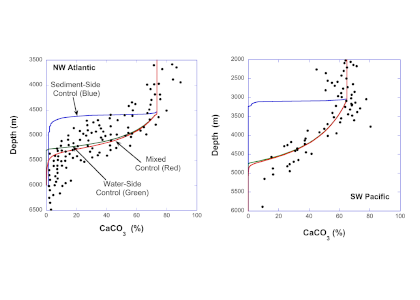
By chadwick.chinnery | December 16, 2019

On time scales of tens to millions of years, seawater acidity is primarily controlled by biogenic calcite (CaCO3) dissolution on the seafloor. Our quantitative understanding of future oceanic pH and…

Read More

Estimating the large-scale biological pump: Do eddies matter?
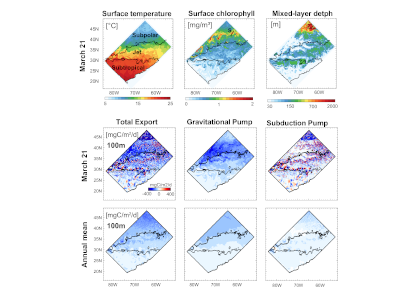
By chadwick.chinnery | December 4, 2019

One factor that limits our capacity to quantify the ocean biological carbon pump is uncertainty associated with the physical injection of particulate (POC) and dissolved (DOC) organic carbon to the…

Read More

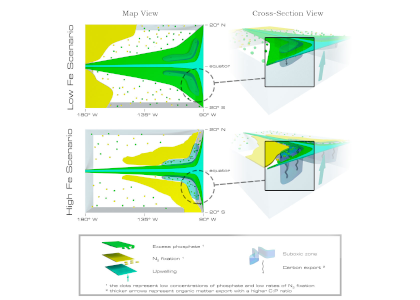
A role for tropical nitrogen fixers in glacial CO2 drawdown
By chadwick.chinnery | December 4, 2019

Iron fertilization of marine phytoplankton by Aeolian dust is a well-established mechanism for atmospheric carbon dioxide (CO2) drawdown by the ocean. When atmospheric CO2 decreased by 90-100 ppm during previous ice…

Read More

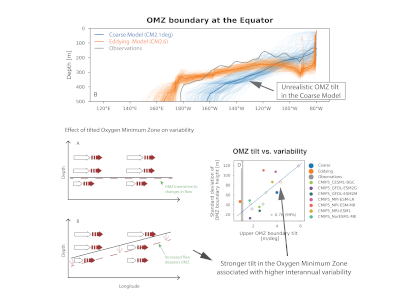
The Equatorial Undercurrent influences the fate of the Oxygen Minimum Zone in the Pacific
By chadwick.chinnery | November 12, 2019

While the ocean as a whole is losing oxygen due to warming, oxygen minimum zones (OMZs) are maintained by a delicate balance of biological and physical processes; it is unclear…

Read More

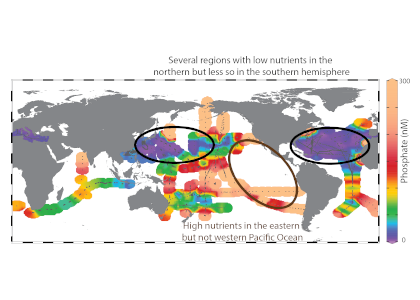
Biogeochemical controls of surface ocean phosphate
By chadwick.chinnery | November 12, 2019

Phosphorus availability is important for phytoplankton growth and more broadly ocean biogeochemical cycles. However, phosphate concentration is often below the analytical detection limit of the standard auto-analyzer technique. Thus, we…

Read More

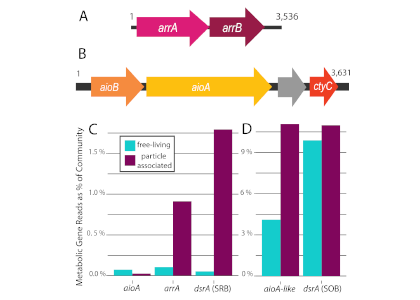
The arsenic respiratory cycle in pelagic waters of Oxygen Deficient Zones
By chadwick.chinnery | October 30, 2019

Oxygen Deficient Zones (ODZs) are naturally occurring functionally anoxic regions of the open ocean which can act as proxies for early Earth’s anoxic ocean. Without free oxygen, microorganisms in these…

Read More

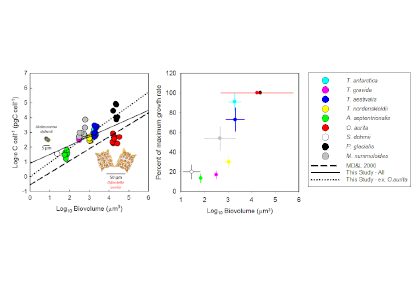
Pumped up by the cold: Increased elemental density in polar diatoms
By chadwick.chinnery | October 28, 2019

Large diatoms are common in polar phytoplankton blooms, contributing significantly to food webs and carbon export, but relatively little is known about their elemental biogeochemistry. A recent study in Frontiers…

Read More

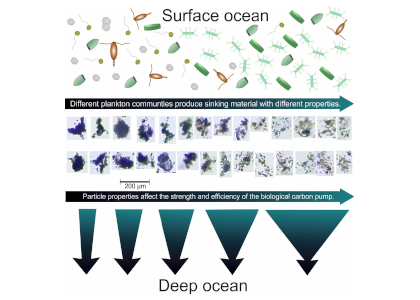
The ecology of the biological carbon pump
By chadwick.chinnery | October 15, 2019

Plankton in the surface ocean convert CO2 into organic biomass thereby fueling marine food webs. Part of this organic biomass sinks down into the deep ocean, where the surface-derived organic…

Read More
« Newer Posts
Older Posts »

Recent Posts

  • Celebrating 20 years of OCB + OCB2027 dates
  • 2026 Call for OCB Scientific Steering Committee (SSC) nominations 
  • Join us for these upcoming OCB webinars
  • Surprise giant phytoplankton revealed by in situ imaging
  • Fresh organic particles take a shortcut to the deep ocean

Copyright © 2026 - OCB Project Office, Woods Hole Oceanographic Institution, 266 Woods Hole Rd, MS #25, Woods Hole, MA 02543 USA Phone: 508-289-2838  •  Fax: 508-457-2193  •  Email: ocb_news@us-ocb.org


Funding for the Ocean Carbon & Biogeochemistry Project Office is provided by the National Science Foundation (NSF) and the National Aeronautics and Space Administration (NASA). The OCB Project Office is housed at the Woods Hole Oceanographic Institution.

Manage Consent
To provide the best experiences, we use technologies like cookies to store and/or access device information. Consenting to these technologies will allow us to process data such as browsing behavior or unique IDs on this site. Not consenting or withdrawing consent, may adversely affect certain features and functions.
Functional Always active
The technical storage or access is strictly necessary for the legitimate purpose of enabling the use of a specific service explicitly requested by the subscriber or user, or for the sole purpose of carrying out the transmission of a communication over an electronic communications network.
Preferences
The technical storage or access is necessary for the legitimate purpose of storing preferences that are not requested by the subscriber or user.
Statistics
The technical storage or access that is used exclusively for statistical purposes. The technical storage or access that is used exclusively for anonymous statistical purposes. Without a subpoena, voluntary compliance on the part of your Internet Service Provider, or additional records from a third party, information stored or retrieved for this purpose alone cannot usually be used to identify you.
Marketing
The technical storage or access is required to create user profiles to send advertising, or to track the user on a website or across several websites for similar marketing purposes.
  • Manage options
  • Manage services
  • Manage {vendor_count} vendors
  • Read more about these purposes
View preferences
  • {title}
  • {title}
  • {title}