SciHigh Slider-Home
Swirling Currents: How Ocean Mesoscale Affects Air-Sea CO2 Exchange
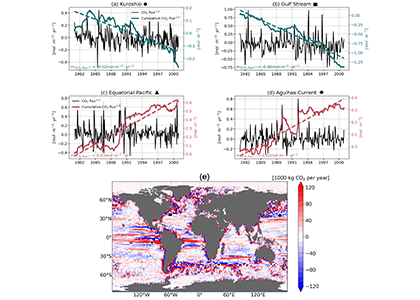
Due to a sparsity of in‐situ observations and the computational burden of eddy‐resolving global simulations, there has been little analysis on how mesoscale processes (e.g., eddies, meanders—lateral scales of 10s…
Read MoreHow tiny teeth and their prey shape ocean ecosystems
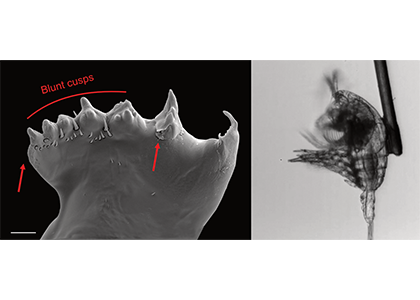
It has long been suggested that diatoms, microscopic algae enclosed in silica-shells, developed these structures to defend against predators like copepods, small crustaceans that graze diatoms. Copepods evolved silica-lined teeth…
Read MoreFast-sinking salp and fish detritus impacts OMZ size and ocean biogeochemical cycles
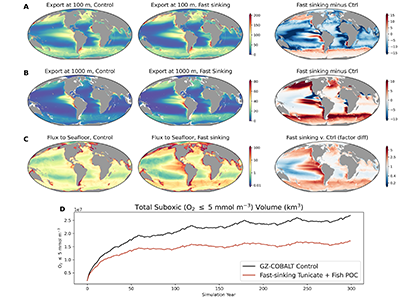
Marine fishes and filter-feeding gelatinous zooplankton such as salps and pyrosomes generate detritus in the form of poop and dead carcasses, which sink ~10 times faster than other oceanic detritus.…
Read MoreThe fate of the 21st century marine carbon cycle could hinge on zooplankton’s appetite
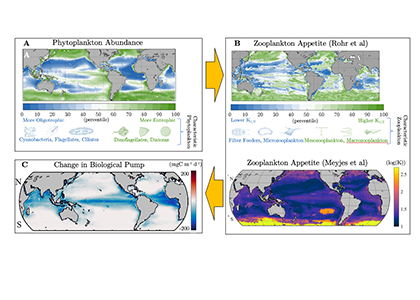
Both climate change and the efforts to abate have the potential to reshape phytoplankton community composition, globally. Shallower mixed layers in a warming ocean and many marine CO2 removal (CDR)…
Read MorePlankton plummet in one of the world’s longest time series
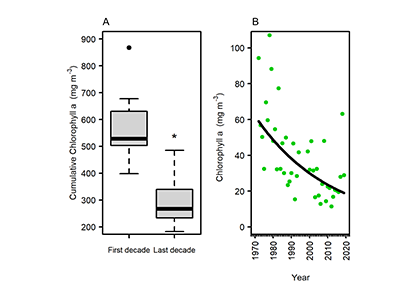
Phytoplankton are the main primary producers in the ocean and fuel marine food webs. Long-term shifts in phytoplankton biomass are useful for understanding the context of short-term changes and for…
Read MoreA New Insight into Ocean Carbon Sequestration
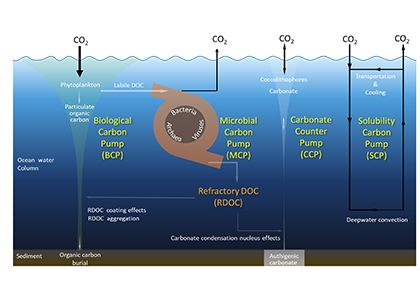
How does the microbial carbon pump (MCP) redefine our understanding of oceanic carbon sequestration and climate change mitigation? A recent study published in Nature Reviews Microbiology reviews the pivotal role…
Read MoreOut of sight, out of mind: extreme signals of ocean acidification hidden in the mesopelagic
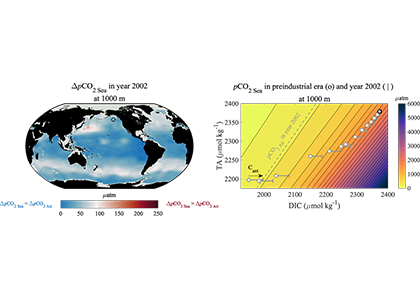
https://www.us-ocb.org/wp-content/uploads/2024/07/Fassbender-Subsurface_OA.mp4 Ocean Acidification (OA), caused by the air-to-sea transfer of anthropogenic carbon (Cant), is intuitively thought to be a surface-intensified process, which makes sense because the concentration of Cant is…
Read MoreAn unexpected shift to a later phytoplankton bloom in the West Antarctic Peninsula
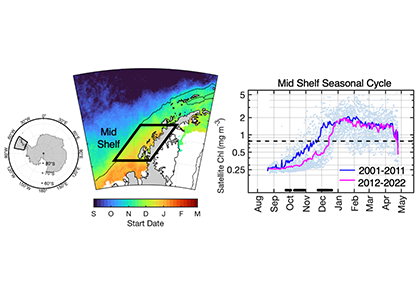
Polar regions are changing: warming, losing sea ice, and experiencing shifts in the phenology of seasonal events. Global models predict that phytoplankton blooms will start earlier in these warming polar…
Read MoreInorganic carbon outwelling as important blue carbon sink
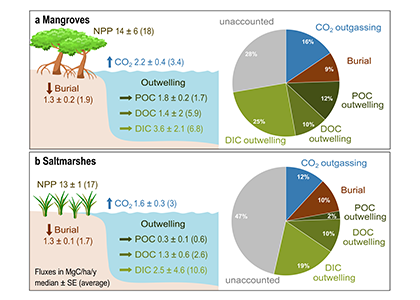
Blue carbon ecosystems—mangroves, saltmarshes, and seagrass meadows—carbon sequestration powerhouses that can help us mitigate climate change. For many years, our community has focused on studying and quantifying organic carbon storage…
Read MoreNew algorithm unclogs major bottleneck in ocean geochemical and biogeochemical modelling
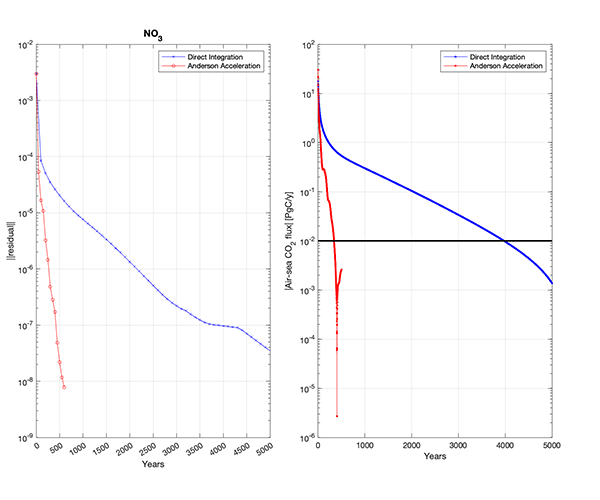
Numerical models are some of the principal tools for understanding the cycling of geochemical and biogeochemical tracers in the ocean, with the latter also being important components of the Earth…
Read More