OceanCarbon&Biogeochemistry
Studyingmarineecosystemsandbiogeochemicalcyclesinthefaceofenvironmentalchange
  • Home
  • About OCB
    • About Us
    • Scientific Breadth
      • Biological Pump
      • Changing Marine Ecosystems
      • Changing Ocean Chemistry
      • Estuarine and Coastal Carbon Fluxes
      • Ocean Carbon Uptake and Storage
      • Ocean Observatories
    • Code of Conduct
    • Get Involved
    • Project Office
    • Scientific Steering Committee
    • OCB committees
      • OCSIF – Ocean Carbonate System Intercomparison
      • Ocean-Atmosphere Interaction
      • Ocean Time-series
      • US Biogeochemical-Argo
  • Activities
    • Summer Workshop
    • OCB Webinars
    • Guidelines for OCB Workshops & Activities
    • Topical Workshops
      • CMIP6 Models Workshop
      • Coastal BGS Obs with Fisheries
      • C-saw extreme events workshop
      • Expansion of BGC-Argo and Profiling Floats
      • Fish, fisheries and carbon
      • Future BioGeoSCAPES program
      • GO-BCG Scoping Workshop
      • Lateral Carbon Flux in Tidal Wetlands
      • Leaky Deltas Workshop – Spring 2025
      • Marine CDR Workshop
      • Ocean Nucleic Acids ‘Omics
      • Pathways Connecting Climate Changes to the Deep Ocean
    • Small Group Activities
      • Aquatic Continuum OCB-NACP Focus Group
      • Arctic-COLORS Data Synthesis
      • BECS Benthic Ecosystem and Carbon Synthesis WG
      • Carbon Isotopes in the Ocean Workshop
      • CMIP6 WG
      • Filling the gaps air–sea carbon fluxes WG
      • Fish Carbon WG
      • Metabarcoding intercal WG
      • Meta-eukomics WG
      • mCDR
      • Metaproteomic Intercomparison
      • Mixotrophs & Mixotrophy WG
      • N-Fixation WG
      • Ocean Carbonate System Intercomparison Forum
      • Ocean Carbon Uptake WG
      • OOI BGC sensor WG
      • Operational Phytoplankton Observations WG
      • Phytoplankton Taxonomy WG
      • SedMIP
    • Other Workshops
    • Science Planning
      • Coastal CARbon Synthesis (CCARS)
      • North Atlantic-Arctic
    • Ocean Acidification PI Meetings
    • Training Activities
      • PACE Hackweek 2025
      • PACE Hackweek 2024
      • PACE Training Activity 2022
  • Science Support
    • OCB Activity Proposal Solicitation
    • Guidelines for OCB Workshops & Activities
    • Data management and archival
    • Early Career
    • Funding Sources
    • Jobs & Postdocs
    • Meeting List
    • OCB Topical Websites
      • Ocean Fertilization
      • Trace gases
      • US IIOE-2
    • Outreach & Education
    • Promoting your science
    • Student Opportunities
    • Travel Support
  • Publications
    • OCB Workshop Reports
    • Science Planning and Policy
    • Newsletter Archive
  • Science Highlights
  • News

How much carbon do fish move towards the seafloor as they feed and migrate in the water column?

Posted by mmaheigan 
· Tuesday, March 24th, 2026 

Ocean organisms transfer carbon via many natural processes from surface to seafloor. These include the passive sinking of carbon-rich particles and the active transport of carbon as animals swim downward. A recent study in GBC modeled how carbon stored in fish biomass moves from the sea surface to the seafloor in shelf–slope–abyssal systems through feeding interactions alone. This transport occurs as large fish eat smaller fish while occupying different vertical habitats in the water column. On average, this process delivers an amount equivalent to 5% of all carbon that reaches the seafloor—through sinking organic particles from phytoplankton and zooplankton. Yet, this can be as high as 20% in some shelf areas. On continental slopes, midwater fishes play a key role as a stepping-stone for carbon transfer (up to 50%) to the seafloor. Overall, the study reveals that the vertical movement of fish is an important pathway for delivering carbon to groundfish species, particularly on shelf areas where most commercially valuable fisheries operate.
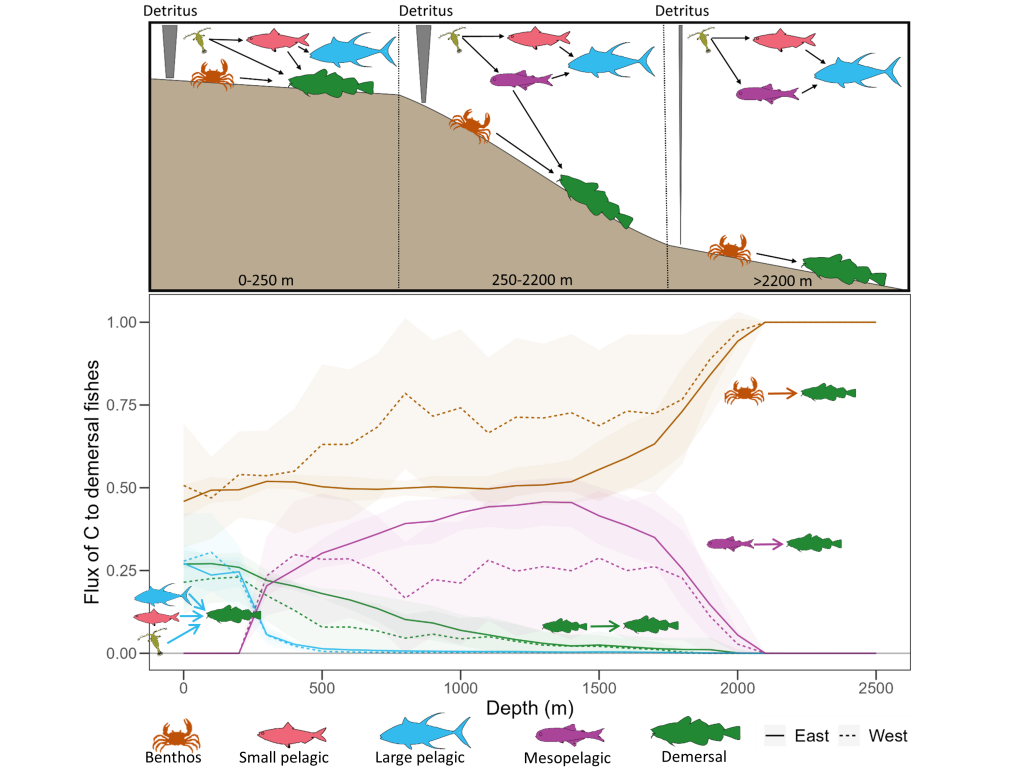
Caption: Schematic of a shelf-slope-abyssal system with hypothesized fluxes of carbon among major functional groups (top panel); and model-estimated fluxes of carbon from functional groups to demersal fishes (bottom panel). Solid and dotted lines are mean fluxes for Eastern and Western North Atlantic systems, respectively, and shaded areas are standard deviations. Values are proportional.


Authors

Daniel Ottmann (Technical University of Denmark (DTU-Aqua); Institute of Marine Sciences of Andalusia)
Ken H. Andersen (Technical University of Denmark (DTU-Aqua))
Yixin Zhao (Technical University of Denmark (DTU-Aqua))
Colleen M. Petrik (Scripps Institution of Oceanography)
Charles A. Stock (Scripps Institution of Oceanography)
Clive Trueman (University of Southampton)
P. Daniël van Denderen (Technical University of Denmark (DTU-Aqua))


Follow the authors:
bluesky: @danielottmann.bsky.social; @kenandersen.bsky.social
LinkedIn accounts: Ottman; Andersen; Truman
X: @daniel_ottmann; @69kno; @OceanLifeCenter; @van_denderen; @clivetrue;


Active Transport of Carbon to Demersal Fish Communities in Shelf-Slope-Abyssal Systems of the North Atlantic Ocean
Global Biogeochemical Cycles, Vol 40:2, e2025GB008861. https://doi.org/10.1029/2025GB008861

Copyright © 2026 - OCB Project Office, Woods Hole Oceanographic Institution, 266 Woods Hole Rd, MS #25, Woods Hole, MA 02543 USA Phone: 508-289-2838  •  Fax: 508-457-2193  •  Email: ocb_news@us-ocb.org

link to nsflink to noaalink to WHOI

Funding for the Ocean Carbon & Biogeochemistry Project Office is provided by the National Science Foundation (NSF) and the National Aeronautics and Space Administration (NASA). The OCB Project Office is housed at the Woods Hole Oceanographic Institution.