Skip to content

Ocean Carbon & Biogeochemistry

Studying marine ecosystems and biogeochemical cycles in the face of environmental change

  • Home
  • About OCB
    • About Us
    • Scientific Breadth
      • Biological Pump
      • Changing Marine Ecosystems
      • Changing Ocean Chemistry
      • Estuarine and Coastal Carbon Fluxes
      • Ocean Carbon Uptake and Storage
      • Ocean Observatories
    • Code of Conduct
    • Get Involved
    • Project Office
    • Scientific Steering Committee
    • OCB committees
      • OCSIF – Ocean Carbonate System Intercomparison
      • Ocean-Atmosphere Interaction Committee
      • Ocean Time-series
      • US Biogeochemical-Argo
  • Activities
    • 20 years of OCB Symposium – 18 November 2026
    • OCB Webinars
    • Summer Workshop
    • Guidelines for OCB Workshops & Activities
    • Topical Workshops
      • 7th DMS(P) Symposium
      • Marine Virus Workshop
      • Completed
        • CMIP6 Models Workshop
        • Coastal BGS Obs with Fisheries
        • C-saw extreme events workshop
        • Expansion of BGC-Argo and Profiling Floats
        • Fish, fisheries and carbon
        • Future BioGeoSCAPES program
        • GO-BCG Scoping Workshop
        • Lateral Carbon Flux in Tidal Wetlands
        • Leaky Deltas Workshop
        • Marine CDR Workshop
        • Ocean Nucleic Acids ‘Omics
        • Pathways Connecting Climate Changes to the Deep Ocean
    • Small Group Activities
      • BECS Benthic Ecosystem and Carbon Synthesis WG
      • Metabarcoding intercal WG
      • Meta-eukomics WG
      • Metaproteomic Intercomparison
      • SedMIP
      • Recently completed
        • Aquatic Continuum OCB-NACP Focus Group
        • Arctic-COLORS Data Synthesis
        • Carbon Isotopes in the Ocean Workshop
        • CMIP6 WG
        • Filling the gaps air–sea carbon fluxes WG
        • Fish Carbon WG
        • mCDR
        • Mixotrophs & Mixotrophy WG
        • N-Fixation WG
        • Ocean Carbonate System Intercomparison Forum
        • Ocean Carbon Uptake WG
        • OOI BGC sensor WG
        • Operational Phytoplankton Observations WG
        • Phytoplankton Taxonomy WG
    • Other Workshops
    • Science Planning
      • Coastal CARbon Synthesis (CCARS)
      • North Atlantic-Arctic
    • Ocean Acidification PI Meetings
    • Training Activities
      • PACE Hackweek 2025
      • PACE Hackweek 2024
      • PACE Training Activity 2022
  • Science Support
    • OCB Activity Proposal Solicitations
    • Guidelines for OCB Workshops & Activities
    • Data management and archival
    • Early Career
    • Funding Sources
    • Jobs & Postdocs
    • Meeting List
    • OCB topical websites
      • Ocean Fertilization
      • Trace gases
      • US IIOE-2
    • Outreach & Education
    • Promoting your science
    • Student Opportunities
    • Travel Support
  • Publications
    • OCB Workshop Reports
    • Science Planning and Policy
    • Newsletter Archive
  • Science Highlights
  • News

Posts by chadwick.chinnery

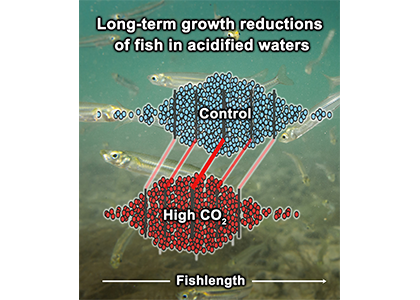
Does ocean acidification make marine fish grow differently? What about sex-specific effects?
By chadwick.chinnery | February 8, 2021

The question of whether ocean acidification (OA) will impact the growth of marine fish remains surprisingly uncertain. The bulk of available evidence in the form of laboratory experiments suggests that…

Read More

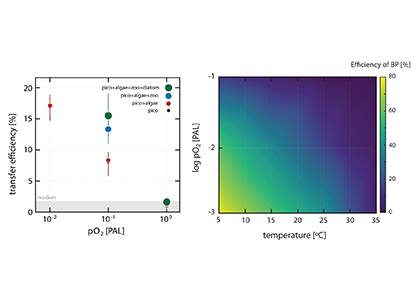
How environmental drivers regulated the long-term evolution of the biological pump
By chadwick.chinnery | January 22, 2021

The marine biological pump (BP) plays a crucial role in regulating earth’s atmospheric oxygen and carbon dioxide levels by transferring carbon fixed by primary producers into the ocean interior and…

Read More

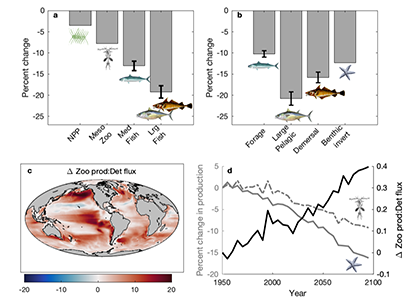
Climate-driven pelagification of marine food webs: Implications for marine fish populations
By chadwick.chinnery | January 22, 2021

Global warming changes the conditions for all ocean life, with wide-ranging consequences. It is particularly difficult to predict the impact of climate change on fish because fish production is conditioned…

Read More

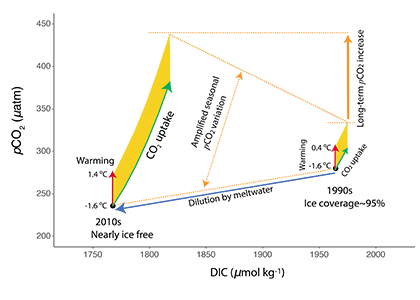
Sea ice loss amplifies CO2 increase in the Arctic
By chadwick.chinnery | January 7, 2021

Warming and sea ice loss over the past few decades have caused major changes in sea surface partial pressure of CO2 (pCO2) of the western Arctic Ocean, but detailed temporal…

Read More

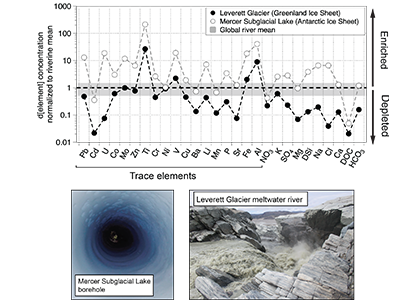
Ice sheets mobilize trace elements for export downstream
By chadwick.chinnery | January 7, 2021

Trace elements are essential micronutrients for life in the ocean and also serve as valuable fingerprints of chemical weathering. The behaviour of trace elements in the ocean has gained interest…

Read More

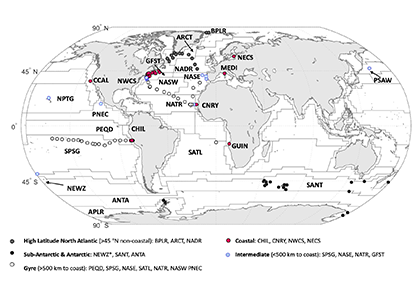
When GEOTRACES‐based synthesis efforts improve global iron-cycling understanding
By chadwick.chinnery | December 18, 2020

Authors of a recent paper published in Global Biogeochemical Cycles conducted a detailed study of the residence times of total and dissolved iron (Fe) in the upper layers (0-250m) of…

Read More

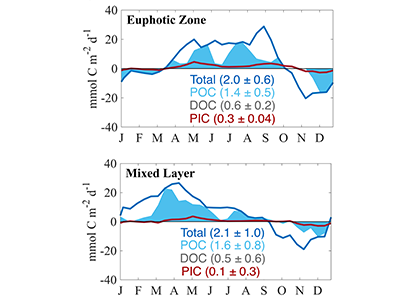
Partitioning carbon export into particulate and dissolved pools from biogeochemical profiling float observations
By chadwick.chinnery | December 17, 2020

Carbon export from the surface into the deep ocean via the biological pump is a significant sink for atmospheric carbon dioxide. The relative contributions of sinking particles—particulate organic carbon (POC)…

Read More

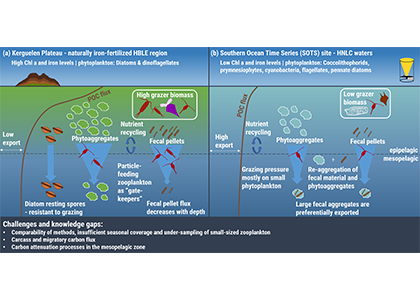
How zooplankton control carbon export in the Southern Ocean
By chadwick.chinnery | December 3, 2020

The Southern Ocean exhibits an inverse relationship between surface primary production and export flux out of the euphotic zone. The causes of this production-export decoupling are still under debate. A…

Read More

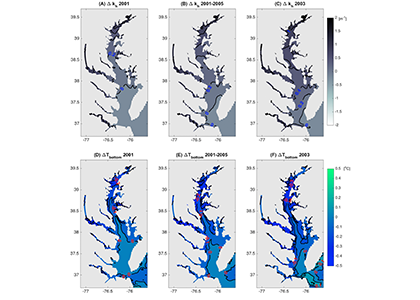
Water clarity impacts temperature and biogeochemistry in Chesapeake Bay
By chadwick.chinnery | December 3, 2020

Estuarine water clarity is determined by suspended materials in the water, including colored dissolved organic matter, phytoplankton, sediment, and detritus. These constituents directly affect temperature because when water is opaque,…

Read More

New Trace Gases Standard Operating Protocols (SOPs) and paper from OCB Workshop
By chadwick.chinnery | December 1, 2020

A number of laboratories throughout the world measure dissolved methane (CH4) and nitrous oxide (N2O) to quantify their spatial and temporal distributions, determine the rates of production and consumption, and…

Read More
« Newer Posts
Older Posts »

Recent Posts

  • Celebrating 20 years of OCB + OCB2027 dates
  • 2026 Call for OCB Scientific Steering Committee (SSC) nominations 
  • Join us for these upcoming OCB webinars
  • Surprise giant phytoplankton revealed by in situ imaging
  • Fresh organic particles take a shortcut to the deep ocean

Copyright © 2026 - OCB Project Office, Woods Hole Oceanographic Institution, 266 Woods Hole Rd, MS #25, Woods Hole, MA 02543 USA Phone: 508-289-2838  •  Fax: 508-457-2193  •  Email: ocb_news@us-ocb.org


Funding for the Ocean Carbon & Biogeochemistry Project Office is provided by the National Science Foundation (NSF) and the National Aeronautics and Space Administration (NASA). The OCB Project Office is housed at the Woods Hole Oceanographic Institution.

Manage Consent
To provide the best experiences, we use technologies like cookies to store and/or access device information. Consenting to these technologies will allow us to process data such as browsing behavior or unique IDs on this site. Not consenting or withdrawing consent, may adversely affect certain features and functions.
Functional Always active
The technical storage or access is strictly necessary for the legitimate purpose of enabling the use of a specific service explicitly requested by the subscriber or user, or for the sole purpose of carrying out the transmission of a communication over an electronic communications network.
Preferences
The technical storage or access is necessary for the legitimate purpose of storing preferences that are not requested by the subscriber or user.
Statistics
The technical storage or access that is used exclusively for statistical purposes. The technical storage or access that is used exclusively for anonymous statistical purposes. Without a subpoena, voluntary compliance on the part of your Internet Service Provider, or additional records from a third party, information stored or retrieved for this purpose alone cannot usually be used to identify you.
Marketing
The technical storage or access is required to create user profiles to send advertising, or to track the user on a website or across several websites for similar marketing purposes.
  • Manage options
  • Manage services
  • Manage {vendor_count} vendors
  • Read more about these purposes
View preferences
  • {title}
  • {title}
  • {title}