Hiding in the dark: why estimates of active carbon transport can’t agree
Every night, the number of zooplankton that swim toward the surface is so great that at one time ships’ sonar mistook them for a rising seafloor. In the world’s largest migration, zooplankton swim hundreds of meters up to the surface ocean to feed, then swim back down before dawn. They also haul carbon away from the sunlit ocean. We have known about this migration for over a century, so why can we still not say how much carbon it moves into the interior ocean, or whether it arrives as respired CO₂, dissolved organic matter, or sinking fecal pellets?
In a recent review, we compared the observational and modeling approaches to migrant carbon flux side by side and explored why and when they disagree. What we found is that the disagreement is often structural. The estimates the community commonly treats as observations are really chains of models: net-caught biomass multiplied by allometric or temperature-dependent rate equations, scaled by a migrating fraction. The more complex models, meanwhile, rarely apply the same functional form or resolve the same set of processes (e.g., respiration, egestion, excretion, mortality, growth) so none of the various methods are estimating the same quantity, and comparing their magnitudes cannot tell us which is closer to the truth. Closing that gap will take laboratory rate measurements and model development pursued together rather than in parallel. Read the full review in Annual Review of Marine Science.
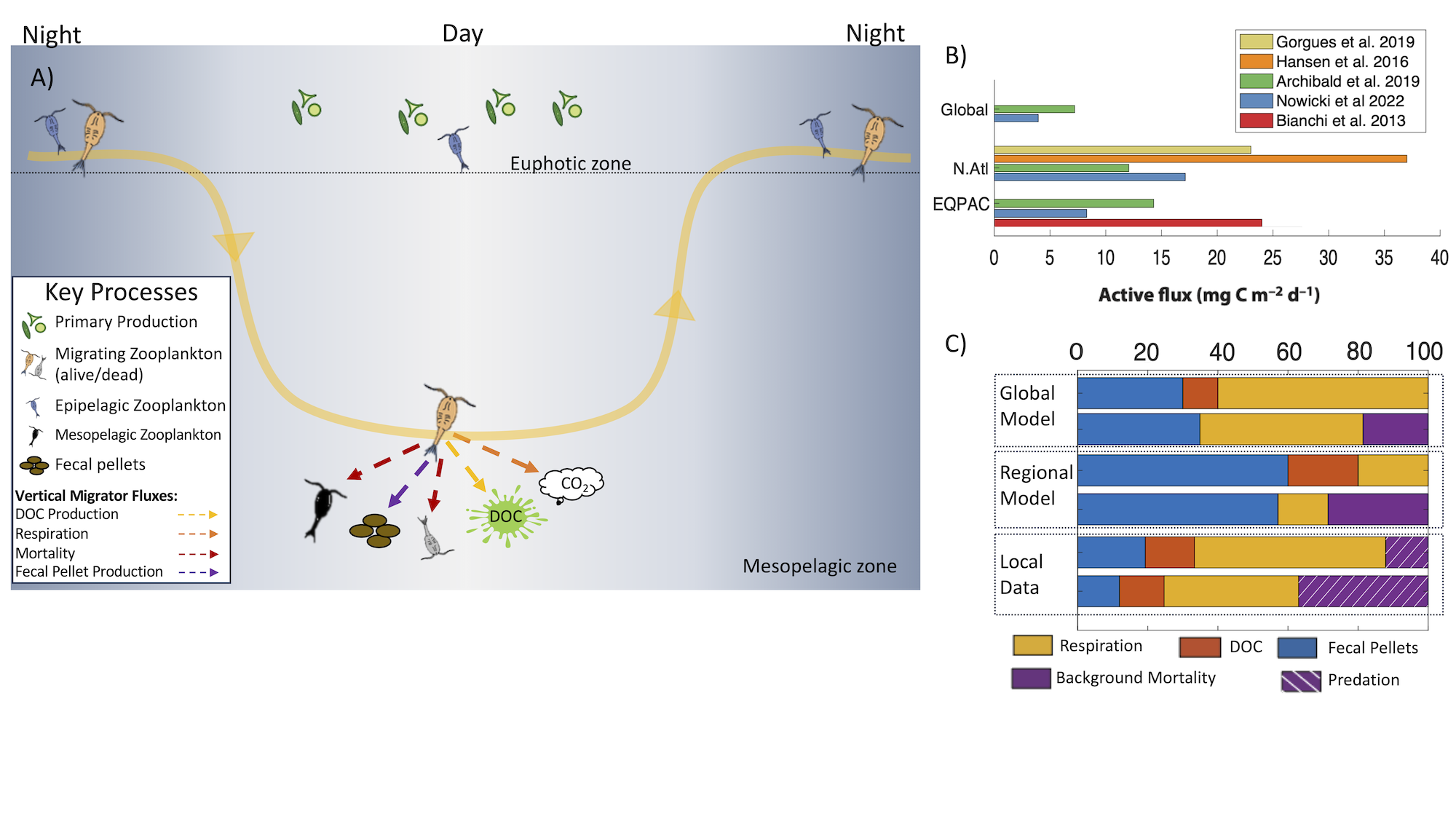
Figure. (A) A schematic representing the diurnal cycle of zooplankton migration (B) Reported active flux at three locations, across model-based approaches: estimates differ several-fold at the same place. (C) The reported relative contribution of various contributors to active flux at three scales, global models, regional models, and two observation-based points. Only pathways the original studies explicitly reported as contributing to active flux are shown, so a missing block means a process was not included in the active transport estimate, not that it was zero. Modified from Clements et al., 2026, Annual Review of Marine Science.
Narrowing our uncertainty on the magnitude of the carbon export pathway is timely, as migrating animals may inject carbon deeper, and thus sequester it from the atmosphere for longer than current carbon budgets credit them for. If we are going to ask the ocean to store more carbon dioxide, we will need to be able to say how much it already stores, and right now we cannot. Accurate modeling of the active carbon pump extends beyond getting a number correct, we must also accurately represent the processes that set it and how they shift with any perturbation.
Social Media:
DJC: @djclements.bsky.social
NRR: @seascapescience.bsky.social
LBB: @blancobercial.bsky.social
BLOS: @bigelowlab.bsky.social
BIOS: @biosstation.bsky.social
Authors: Daniel J. Clements (Bigelow Laboratory for Ocean Sciences), Karen Stamieszkin (Bigelow Laboratory for Ocean Sciences), Daniele Bianchi (University of California, Los Angeles), Leocadio Blanco-Bercial (Bermuda Institute of Ocean Sciences, Arizona State University), Nicholas R. Record (Bigelow Laboratory for Ocean Sciences), Rocio B. Rodriguez-Perez (Bermuda Institute of Ocean Sciences, Arizona State University), Amy E. Maas (Bermuda Institute of Ocean Sciences, Arizona State University)