OCB Science Highlights
If you would like to have your recent publications featured on the OCB website and eNewsletter please contact ocb_news@whoi.edu. View our guidelines for writing a OCB Science Highlight.
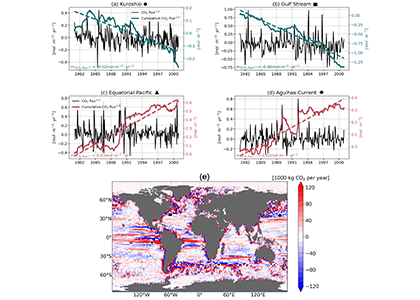
Due to a sparsity of in‐situ observations and the computational burden of eddy‐resolving global simulations, there has been little analysis on how mesoscale processes (e.g., eddies, meanders—lateral scales of 10s…
Read More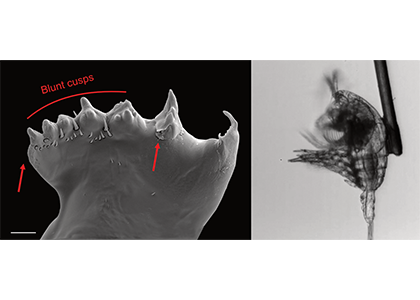
It has long been suggested that diatoms, microscopic algae enclosed in silica-shells, developed these structures to defend against predators like copepods, small crustaceans that graze diatoms. Copepods evolved silica-lined teeth…
Read More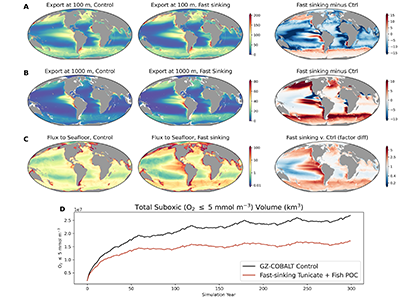
Marine fishes and filter-feeding gelatinous zooplankton such as salps and pyrosomes generate detritus in the form of poop and dead carcasses, which sink ~10 times faster than other oceanic detritus.…
Read More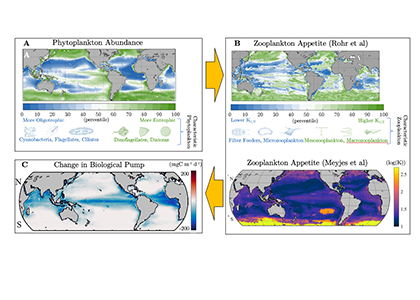
Both climate change and the efforts to abate have the potential to reshape phytoplankton community composition, globally. Shallower mixed layers in a warming ocean and many marine CO2 removal (CDR)…
Read More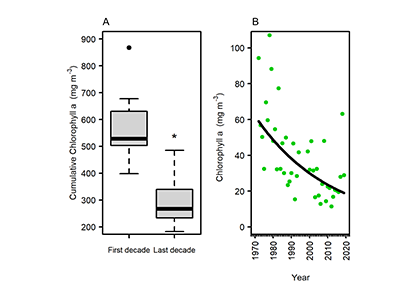
Phytoplankton are the main primary producers in the ocean and fuel marine food webs. Long-term shifts in phytoplankton biomass are useful for understanding the context of short-term changes and for…
Read More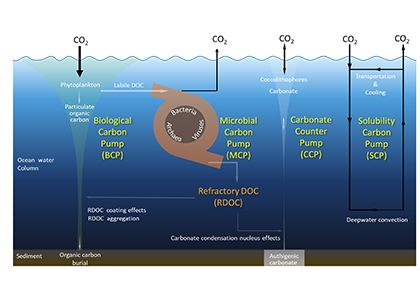
How does the microbial carbon pump (MCP) redefine our understanding of oceanic carbon sequestration and climate change mitigation? A recent study published in Nature Reviews Microbiology reviews the pivotal role…
Read More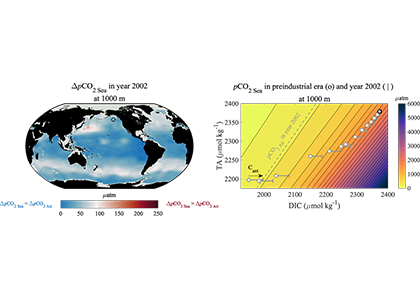
Ocean Acidification (OA), caused by the air-to-sea transfer of anthropogenic carbon (Cant), is intuitively thought to be a surface-intensified process, which makes sense because the concentration of Cant is greatest…
Read More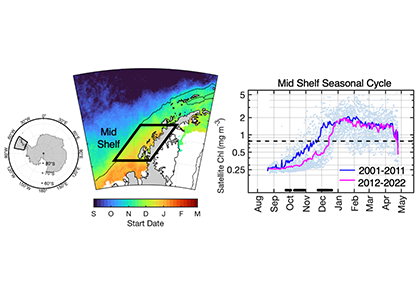
Polar regions are changing: warming, losing sea ice, and experiencing shifts in the phenology of seasonal events. Global models predict that phytoplankton blooms will start earlier in these warming polar…
Read More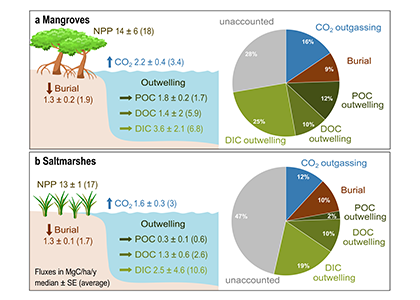
Blue carbon ecosystems—mangroves, saltmarshes, and seagrass meadows—carbon sequestration powerhouses that can help us mitigate climate change. For many years, our community has focused on studying and quantifying organic carbon storage…
Read More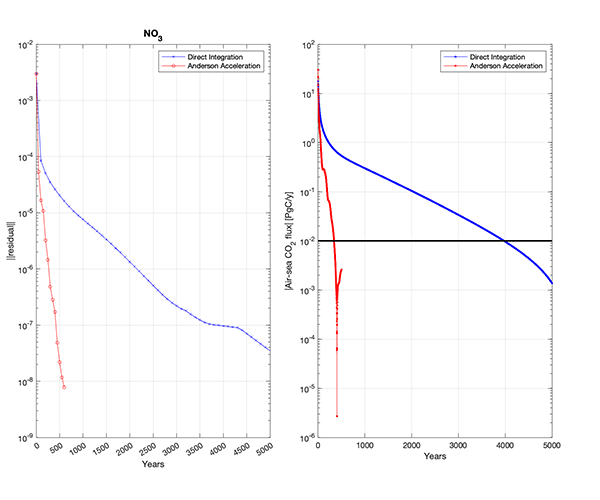
Numerical models are some of the principal tools for understanding the cycling of geochemical and biogeochemical tracers in the ocean, with the latter also being important components of the Earth…
Read More