OCB Science Highlights
If you would like to have your recent publications featured on the OCB website and eNewsletter please contact ocb_news@whoi.edu. View our guidelines for writing a OCB Science Highlight.
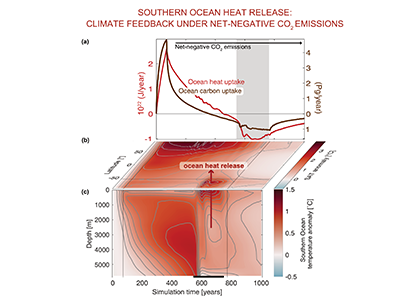
The ocean stores vast amounts of heat and carbon under anthropogenic CO₂ emissions, but its behavior under net-negative emission scenarios remains poorly understood. Here we use an Earth System Model…
Read More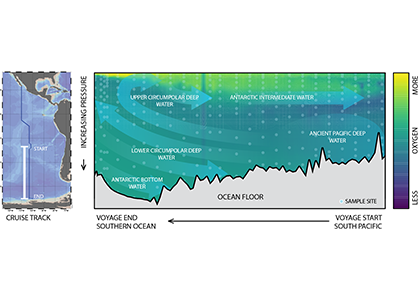
Global overturning circulation is a planetary conveyor belt: dense waters sink around Antarctica, spread through the deep ocean for centuries, and eventually rise elsewhere, redistributing heat, nutrients, and carbon. But…
Read More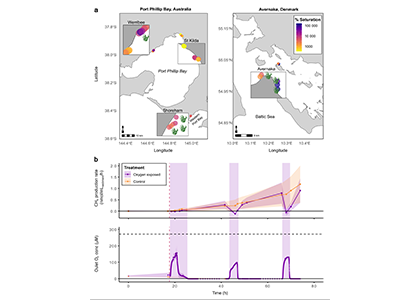
A recent study in Nature Geosciences observed high concentrations of methane overlying permeable (sand) sand sediments in bays in Denmark and Australia. These environments are not one would expect to…
Read More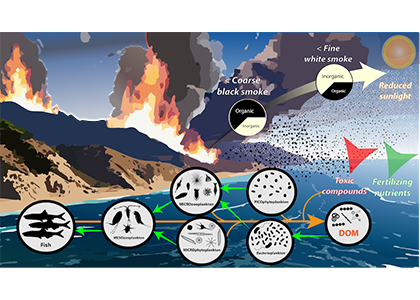
When wildfire smoke drifts over the ocean, what happens beneath the waves? As wildfires change in nature and become more frequent, it’s increasingly important to understand how ash deposition affects…
Read More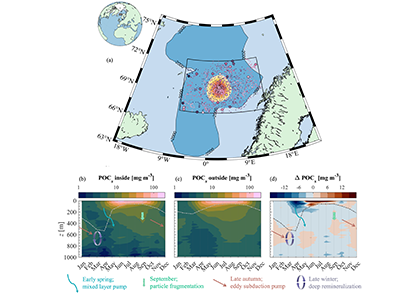
The Lofoten Basin Eddy (LBE) is a unique and persistent anticyclonic feature of the Norwegian Sea that stirs the water column year-round. However, its impact on biogeochemical processes that influence…
Read More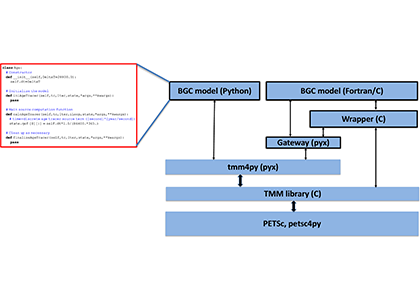
Have you ever wondered what life would be like if you could write and run complex biogeochemical models easily and conveniently in Python? Wonder no more. In a paper published…
Read More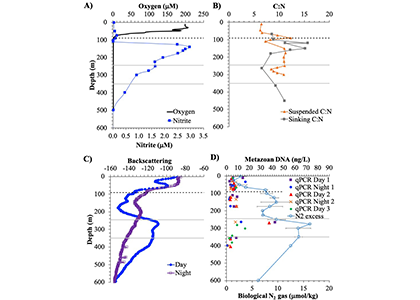
Diel Vertically Migrating Zooplankton that spend their day in an Oxygen Deficient Zone to avoid predators are a previously ignored source of organic matter for N2 producing bacteria. A recent…
Read More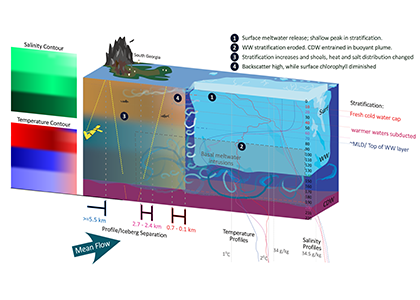
Iceberg meltwater induces mixing which erodes upper-ocean layers. This supplies nutrients, both released from the iceberg and entrained from deeper waters, to surface waters which stimulates phytoplankton growth. Meltwater from…
Read More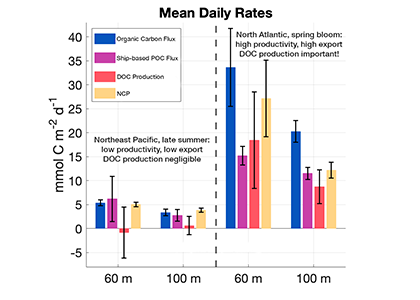
The ocean’s biological carbon pump (BCP) plays a crucial role in regulating Earth’s climate. But how efficiently does it transport carbon to the deep? It has been difficult to answer…
Read More