OCB Science Highlights
If you would like to have your recent publications featured on the OCB website and eNewsletter please contact ocb_news@whoi.edu. View our guidelines for writing a OCB Science Highlight.
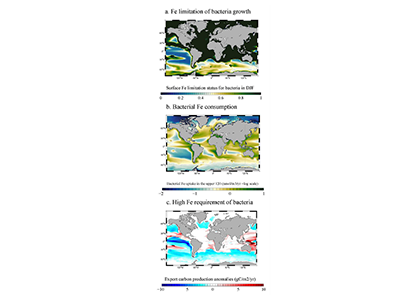
Free-living bacteria play a key role in cycling essential biogeochemical resources in the ocean, including iron, via their uptake, transformation, and release of organic matter throughout the water column. Bacteria…
Read More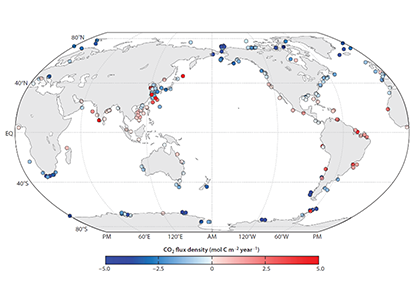
A vital part of mitigating climate change is the coastal and open ocean carbon sink, without this, it is not possible to meet the target set by the Paris Agreement.…
Read More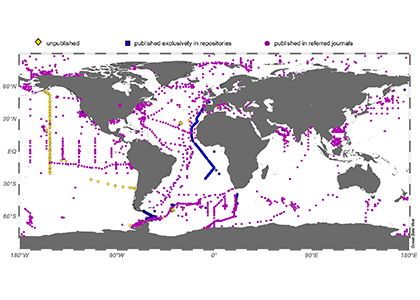
Thorium-234 (234Th), a naturally radioactive element present in nature, is one of the most actively used tracers in oceanography. 234Th is widely used to study the removal rate of material…
Read More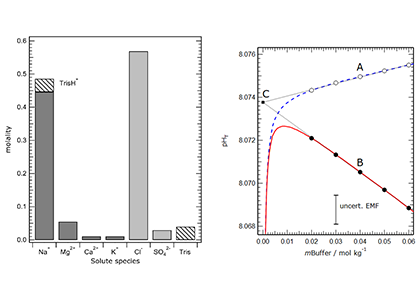
The total pH scale used by oceanographers (for salinities 20 – 40, and temperatures 0 to 45°C) is calibrated from a combination of electromotive force measurements of artificial seawaters containing…
Read More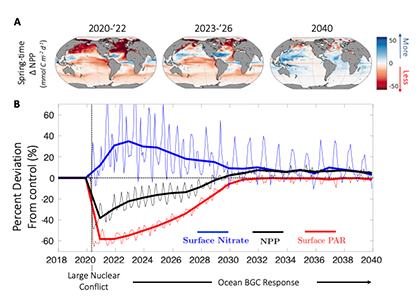
Russia’s invasion of Ukraine brings the threat of nuclear warfare to the forefront. But how would modern nuclear detonations impact the world today? If used accidentally or intentionally, nuclear arsenals would…
Read More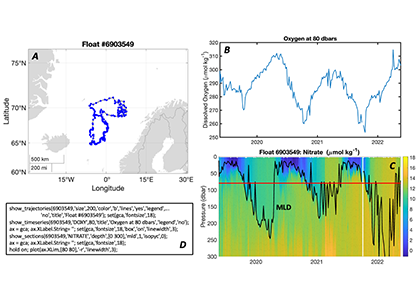
No single program has been as transformative for ocean science over the past two decades as Argo: the fleet of robotic instruments that collect measurements of temperature and salinity in…
Read More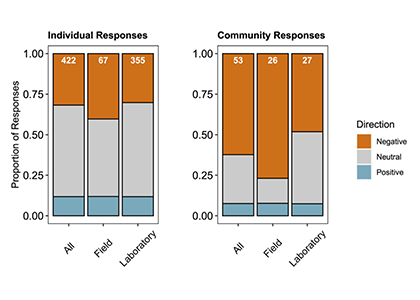
Ocean acidification research has grown over the past few decades. Much of recent research documents negative impacts of changing carbonate chemistry on calcifying marine organisms in laboratory experiments. At the…
Read More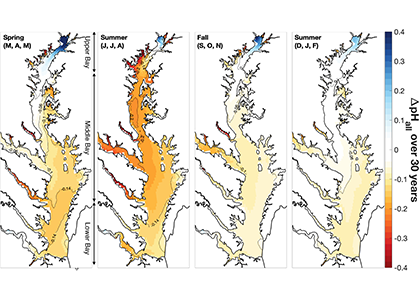
Understanding decadal changes in the coastal carbonate system (CO2-system) is essential for predicting how the health of these waters is affected by anthropogenic drivers, such as changing atmospheric conditions and…
Read More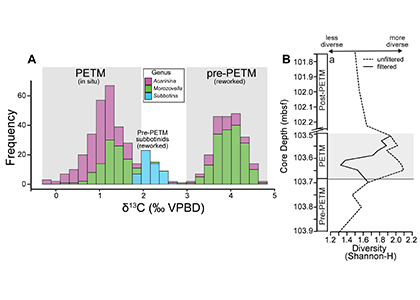
Ocean acidification and rising temperatures have led to concerns about how calcifying organisms foundational to marine ecosystems, will be affected in the near future. We often look to analogous abrupt…
Read More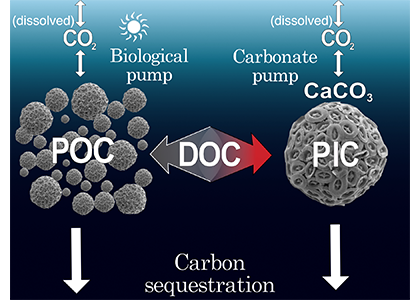
Coccolithophores have survived several major extinction events over geologic time. The most significant was the asteroid impact at the K/T boundary, followed by months of darkness. Additionally, coccolithophores regularly reside…
Read More