OCB Science Highlights
If you would like to have your recent publications featured on the OCB website and eNewsletter please contact ocb_news@whoi.edu. View our guidelines for writing a OCB Science Highlight.
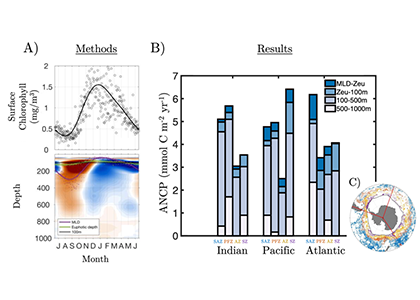
Biology in the Southern Ocean is known to help regulate Earth’s climate by capturing and eventually sequestering carbon from its surface. Unfortunately, accurate estimates of the magnitude of the Southern…
Read More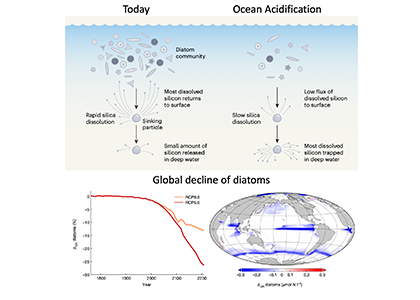
Biological impacts of ocean acidification have been the subject of intense research for more than a decade. While it is known that more acidic seawater will create difficulties for calcifying…
Read More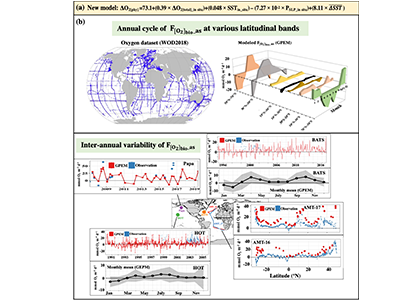
Dissolved oxygen (O2) is a central observation in oceanography with a long history of relatively high precision measurements and increasing coverage over the 21st century. O2 is a powerful tracer…
Read More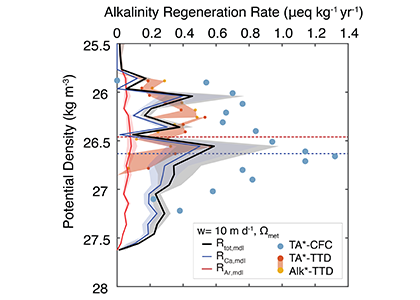
The marine carbon and alkalinity cycles are tightly coupled. Seawater stores so much carbon because of its high alkalinity, or buffering capacity, and the main driver of alkalinity cycling is…
Read More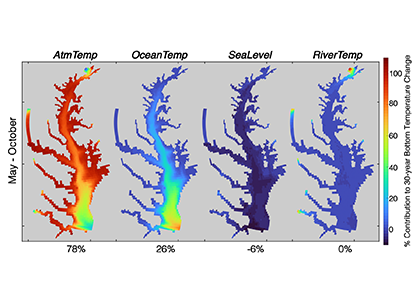
Coastal water temperatures have been increasing globally with more frequent marine heat waves threatening marine life and nearshore communities reliant upon these ecosystems. Often, this warming is assumed to be…
Read More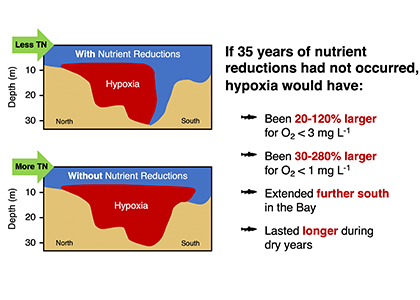
Hypoxia is currently one of the greatest threats to coastal and estuarine ecosystems around the world, and this threat is projected to get worse as waters warm and human populations…
Read More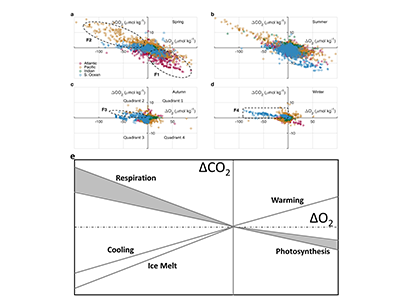
A recent study in Communications Earth & Environment, examined spatiotemporal patterns of the two dissolved gases CO2 and O2 in the surface ocean, using the high-quality global dataset GLODAPv2.2020. We…
Read More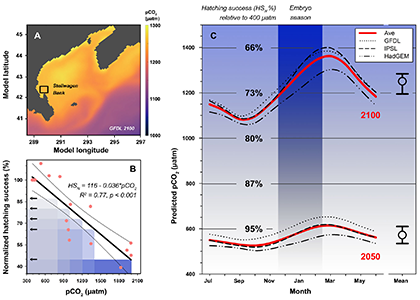
Two decades of ocean acidification experiments have shown that elevated CO2 can affect many traits in fish early life stages. Only few species, however, show direct CO2-induced survival reductions. This…
Read More
Terrestrial forests are well known as major carbon stores and are already used in carbon credit and offset schemes. In the coastal zone, seaweeds have a similar functional role to…
Read More
The eastern North Pacific subtropical gyre (NPSG) ecosystem contains a large proportion of the ocean surface, resulting in a significant impact on the global ocean primary production and export production.…
Read More