OCB Science Highlights
If you would like to have your recent publications featured on the OCB website and eNewsletter please contact ocb_news@whoi.edu. View our guidelines for writing a OCB Science Highlight.
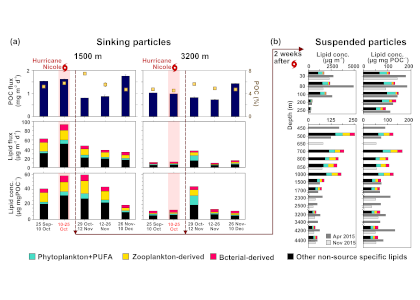
Tropical cyclones (hurricanes and typhoons) are the most extreme episodic weather event affecting subtropical and temperate oceans. Hurricanes generate intense surface cooling and vertical mixing in the upper ocean, resulting…
Read More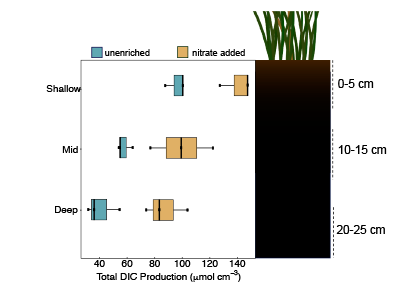
With their high primary productivity and slow decomposition in anoxic soils, salt marshes and other coastal wetlands can store carbon more efficiently than terrestrial uplands. These wetlands also provide critical…
Read More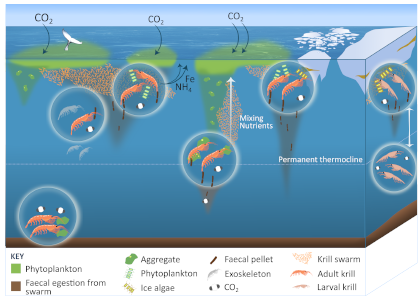
Scientists have long known the role of Antarctic krill (Euphausia superba) in Southern Ocean ecosystems. Evidence is gathering about krill’s biogeochemical importance through releasing millions of faecal pellets in swarms…
Read More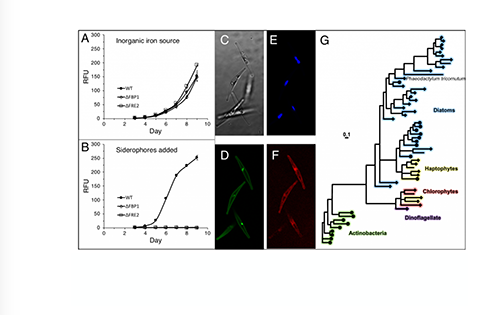
Since diatoms carry out much of the primary production in iron-limited marine environments, constraining the details of how these phytoplankton acquire the iron they need is paramount to our understanding…
Read More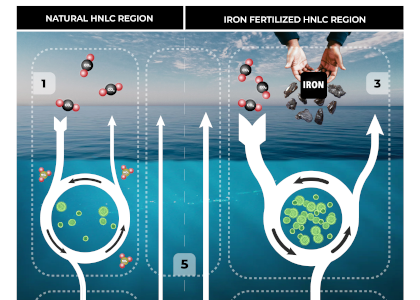
Amidst little to no substantive global action on climate change mitigation, individuals and companies have been exploring various geoengineering strategies as a possible alternative. Ocean Iron Fertilization (OIF) is an…
Read More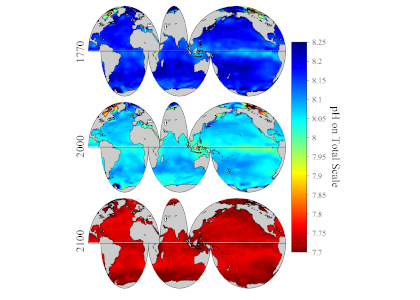
A new study published in Scientific Reports debuts a global data product of ocean acidification (OA) and buffer capacity from the beginning of the Industrial Revolution to the end of…
Read More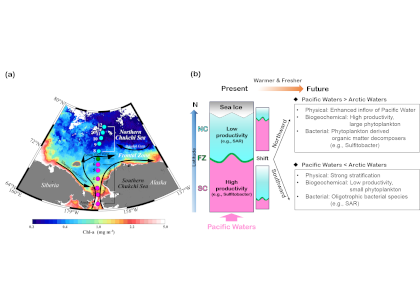
During the western Arctic summer open water season, latitudinal differences in the physical and biogeochemical features of the surface water are apparent from the Bering Strait to the Chukchi Borderland.…
Read More
Oceanic dissolved organic carbon (DOC) ultimately exchanges with atmospheric CO2 and thus represents an important carbon source/sink with consequence for climate. Most of the DOC is recalcitrant to microbial degradation,…
Read More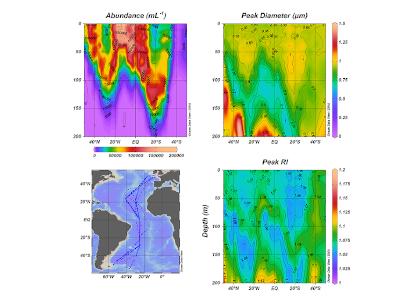
Flow cytometry can sort hundreds of thousands of phytoplankton cells in minutes, a tool that has been exploited for over thirty years in marine science. However, skilled analysts are still…
Read More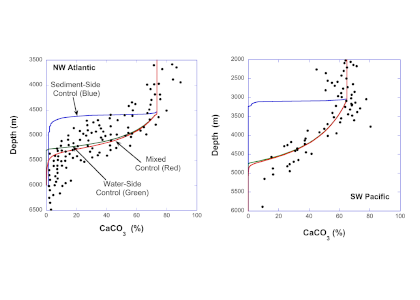
On time scales of tens to millions of years, seawater acidity is primarily controlled by biogenic calcite (CaCO3) dissolution on the seafloor. Our quantitative understanding of future oceanic pH and…
Read More