OCB Science Highlights
If you would like to have your recent publications featured on the OCB website and eNewsletter please contact ocb_news@whoi.edu. View our guidelines for writing a OCB Science Highlight.
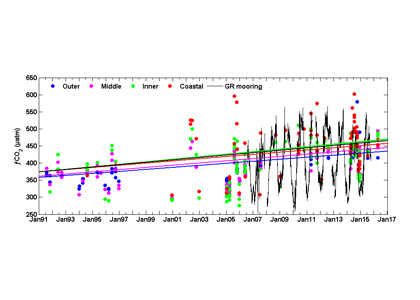
Relative to their surface area, coastal regions represent some of the largest carbon fluxes in the global ocean, driven by numerous physical, chemical and biological processes. Coastal systems also experience…
Read More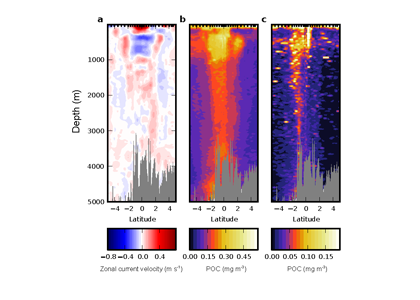
The continual flow of organic particles such as dead organisms and fecal material towards the deep sea is called “marine snow,” and it plays an important role in the ocean…
Read More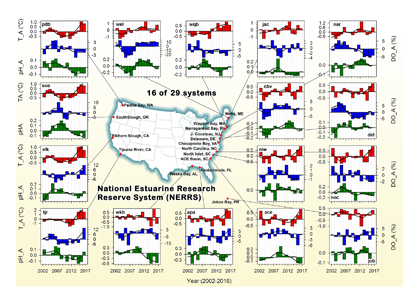
Coastal habitats are critically important to humans, but without consistent and reliable observations we cannot understand the direction and magnitude of unfolding changes in these habitats. Environmental monitoring is therefore…
Read More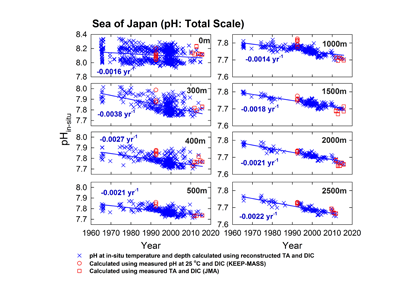
Oceans worldwide are warming up, and thermohaline circulation is expected to slow down. At the same time, ocean acidity is increasing due to the influx of anthropogenic carbon dioxide (CO2)…
Read More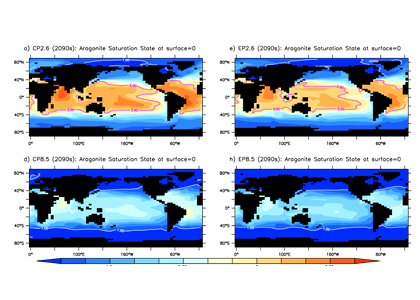
There are vast unknowns about the future oceans, from what species or habitats may be most under threat to the continuity of earth system processes that maintain global climate. Modeling…
Read More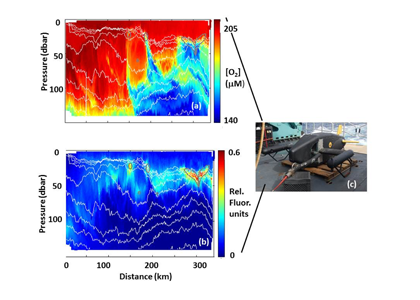
The biological pump is complex and variable. To better understand it, scientists have often focused on variations in biological parameters such as fluorescence and community structure, and have less often…
Read More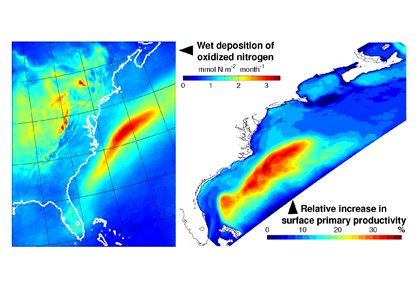
How do phytoplankton respond to atmospheric nitrogen deposition in the western North Atlantic, an area downwind of large agricultural and industrial centers? The biogeochemical impacts of this ‘fertilization’ remain unclear,…
Read More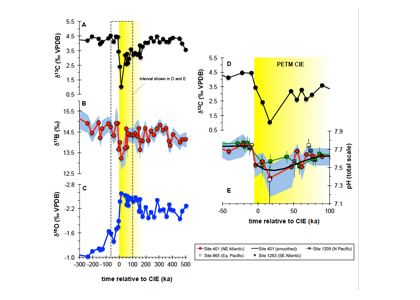
A study recently published in Nature suggests that an extreme global warming event 56 million years ago known as the Palaeocene-Eocene Thermal Maximum (PETM) was driven by massive CO2 emissions…
Read More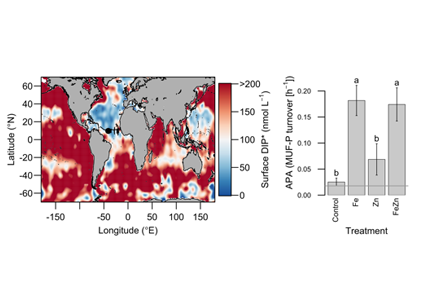
Unicellular photosynthetic microbes—phytoplankton—are responsible for virtually all oceanic primary production, which fuels marine food webs and plays a fundamental role in the global carbon cycle. Experiments to date have suggested…
Read More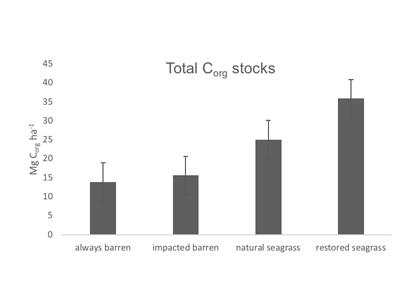
Seagrasses have died-off in great numbers, resulting in the release of stored carbon. Seagrasses represent a substantive and relatively unconstrained North American and Caribbean Sea blue carbon sink in the…
Read More