OCB Science Highlights
If you would like to have your recent publications featured on the OCB website and eNewsletter please contact ocb_news@whoi.edu. View our guidelines for writing a OCB Science Highlight.
“So, in the sea, there are certain objects concerning which one would be at a loss to determine whether they be animal or vegetable.” Aristotle, The History of Animals Our…
Read MoreCoccolithophores and the carbon cycle Increasing atmospheric CO2 concentrations are resulting in both warmer sea surface temperatures due to the greenhouse effect and increasingly carbon-rich surface waters. The ocean has absorbed…
Read MoreAround 662 billion tons of organic carbon are dissolved in the ocean, making the pool one of Earth’s major, exchangeable carbon reservoirs. Dissolved organic carbon (DOC) has many ecological functions.…
Read More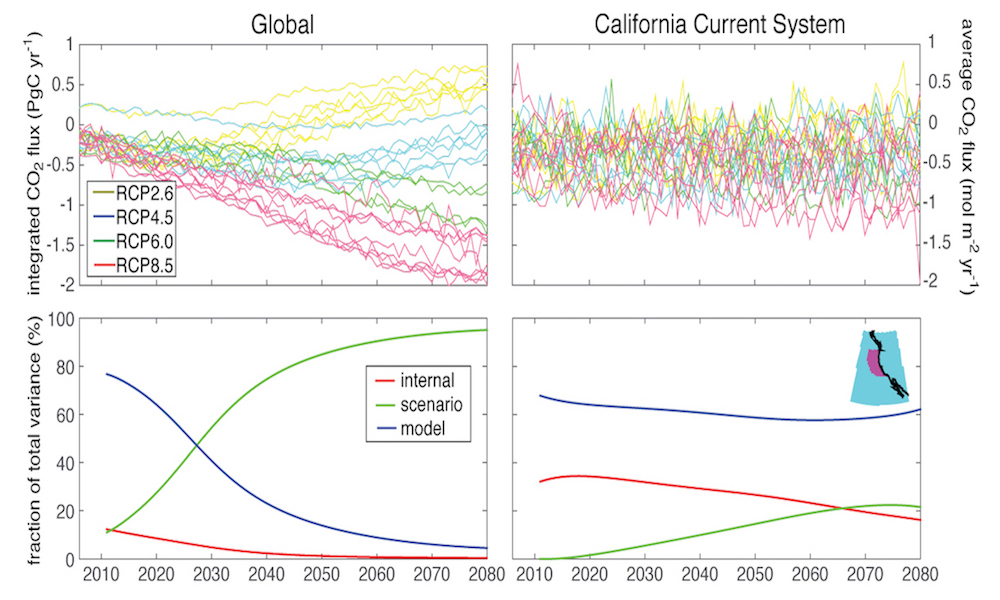
Having absorbed ~30% of the carbon dioxide released to the atmosphere by human activities, the oceans play an important role in mitigating warming and other climate-related impacts of rising carbon…
Read More
GEOTRACES and particles in the ocean GEOTRACES is an international program to study the global marine biogeochemical cycles of trace elements and their isotopes (TEIs). The program’s guiding mission is to “identify processes…
Read MoreWe rely on global ocean models to predict how climate change might affect the evolution of ocean productivity, acidification, and deoxygenation (1). Such platforms are also used to test hypotheses regarding the…
Read MoreThis summer OCB and GEOTRACES are co-sponsoring a synthesis workshop on the biogeochemical cycling of trace elements in the ocean. The overall goal of the workshop is to bring together expertise from across…
Read More
Iron is a limiting nutrient for phytoplankton in nearly half of the global surface ocean, and much attention has been paid to the biogeochemical cycling of iron in seawater since suitable trace metal-clean…
Read MoreBlooms of red water associated with the remarkable ciliate Mesodinium rubrum have been observed at least since Darwin’s time (1). This ciliate retains the chloroplasts from ingested prey and is…
Read More