Ocean Carbon & Biogeochemistry
Studying marine ecosystems and biogeochemical cycles in the face of environmental change
  • Home
  • About OCB
    • About Us
    • Scientific Breadth
      • Biological Pump
      • Changing Marine Ecosystems
      • Changing Ocean Chemistry
      • Estuarine and Coastal Carbon Fluxes
      • Ocean Carbon Uptake and Storage
      • Ocean Observatories
    • Code of Conduct
    • Get Involved
    • Project Office
    • Scientific Steering Committee
    • OCB committees
      • OCSIF – Ocean Carbonate System Intercomparison
      • Ocean-Atmosphere Interaction
      • Ocean Time-series
      • US Biogeochemical-Argo
  • Activities
    • Summer Workshop
    • OCB Webinars
    • Guidelines for OCB Workshops & Activities
    • Topical Workshops
      • CMIP6 Models Workshop
      • Coastal BGS Obs with Fisheries
      • C-saw extreme events workshop
      • Expansion of BGC-Argo and Profiling Floats
      • Fish, fisheries and carbon
      • Future BioGeoSCAPES program
      • GO-BCG Scoping Workshop
      • Lateral Carbon Flux in Tidal Wetlands
      • Leaky Deltas Workshop – Spring 2025
      • Marine CDR Workshop
      • Ocean Nucleic Acids ‘Omics
      • Pathways Connecting Climate Changes to the Deep Ocean
    • Small Group Activities
      • Aquatic Continuum OCB-NACP Focus Group
      • Arctic-COLORS Data Synthesis
      • BECS Benthic Ecosystem and Carbon Synthesis WG
      • Carbon Isotopes in the Ocean Workshop
      • CMIP6 WG
      • Filling the gaps air–sea carbon fluxes WG
      • Fish Carbon WG
      • Metabarcoding intercal WG
      • Meta-eukomics WG
      • mCDR
      • Metaproteomic Intercomparison
      • Mixotrophs & Mixotrophy WG
      • N-Fixation WG
      • Ocean Carbonate System Intercomparison Forum
      • Ocean Carbon Uptake WG
      • OOI BGC sensor WG
      • Operational Phytoplankton Observations WG
      • Phytoplankton Taxonomy WG
    • Other Workshops
    • Science Planning
      • Coastal CARbon Synthesis (CCARS)
      • North Atlantic-Arctic
    • Ocean Acidification PI Meetings
    • Training Activities
      • PACE Hackweek 2025
      • PACE Hackweek 2024
      • PACE Training Activity 2022
  • Science Support
    • OCB Activity Proposal Solicitation
    • Guidelines for OCB Workshops & Activities
    • Data management and archival
    • Early Career
    • Funding Sources
    • Jobs & Postdocs
    • Meeting List
    • OCB Topical Websites
      • Ocean Fertilization
      • Trace gases
      • US IIOE-2
    • Outreach & Education
    • Promoting your science
    • Student Opportunities
    • Travel Support
  • Publications
    • OCB Workshop Reports
    • Science Planning and Policy
    • Newsletter Archive
  • Science Highlights
  • News

A heat burp breaks the assumed relationship of cumulative CO2 emissions and warming

Posted by mmaheigan 
· Friday, January 23rd, 2026 

The ocean stores vast amounts of heat and carbon under anthropogenic CO₂ emissions, but its behavior under net-negative emission scenarios remains poorly understood. Here we use an Earth System Model of intermediate complexity and show results of an idealized future climate scenario that includes sustained net-negative emissions over centuries. After gradual global cooling, the model produces an abrupt “heat burp,” in which heat previously stored in the deep Southern Ocean resurfaces through deep convection, temporarily reversing the cooling and causing renewed warming. The release of heat is not accompanied by a comparable release of CO₂. The heat burp represents a breakdown of the assumed linear relationship between cumulative CO₂ emissions and warming, a metric that is used to calculate the remaining carbon budget. We call for assessing the robustness of how models forced with net-negative CO₂ emissions simulate durability of ocean storage of heat and CO₂, and pathways and time scales of loss to the atmosphere.
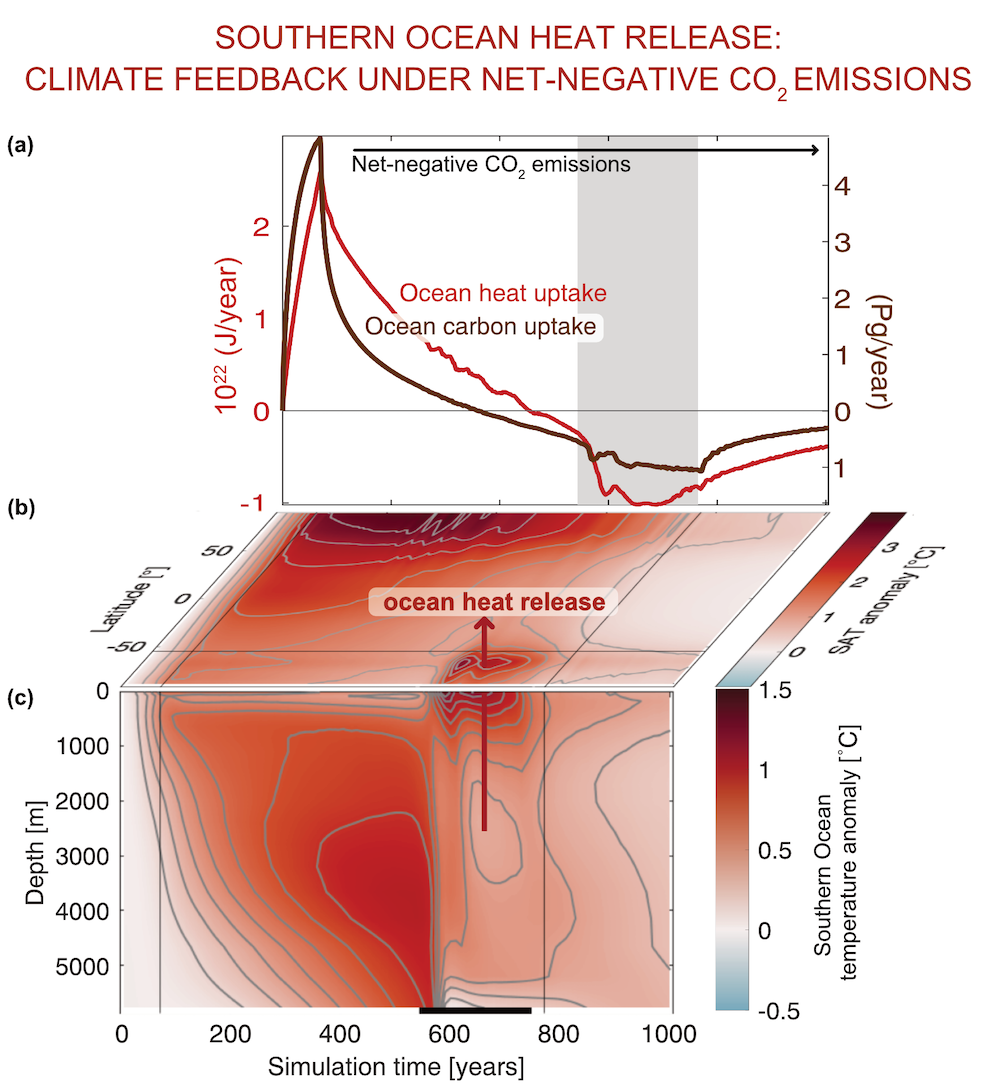
 

Fig caption: The temporal evolution of (a) global heat and carbon uptake and release; (b) surface air temperature (SAT) anomaly relative to preindustrial conditions; (c) Southern Ocean temperature anomaly relative to preindustrial conditions; gray shading/black bar indicate the period of comparatively abrupt ocean heat release that warms SAT, representing a climate feedback.


Authors
(all at GEOMAR)

Ivy Frenger
Svenja Frey (and Univ Copenhagen)
Andreas Oschlies
Julia Getzlaff
Torge Martin
Wolfgang Koeve


Frenger, I., Frey, S., Oschlies, A., Getzlaff, J., Martin, T., & Koeve, W. (2025). Southern Ocean heat burp in a cooling world. AGU Advances, 6, e2025AV001700. https://doi.org/10.1029/2025AV001700


Copyright © 2026 - OCB Project Office, Woods Hole Oceanographic Institution, 266 Woods Hole Rd, MS #25, Woods Hole, MA 02543 USA Phone: 508-289-2838  •  Fax: 508-457-2193  •  Email: ocb_news@us-ocb.org

link to nsflink to noaalink to WHOI

Funding for the Ocean Carbon & Biogeochemistry Project Office is provided by the National Science Foundation (NSF) and the National Aeronautics and Space Administration (NASA). The OCB Project Office is housed at the Woods Hole Oceanographic Institution.