What if a tiny amount of plastic could make the ocean’s carbon appear thousands of years older than it really is?
For decades, oceanographers have relied on routine measurements of particulate organic carbon to understand how carbon moves through the ocean, how long it persists, and how it shapes Earth’s climate. These measurements, based on combusting or oxidizing environmental samples and measuring the carbon released as CO₂, assume that the carbon being measured comes from natural biological sources. But what if that assumption is no longer safe?
Microplastics are now pervasive throughout the ocean, from coastal waters to the open sea. These tiny fragments originate from the breakdown of larger plastic debris or are manufactured directly for commercial and industrial uses. Once they enter marine systems through rivers, wastewater, or runoff, they mix seamlessly with natural particles and are easily captured during routine sampling of particulate organic matter. Critically, the analytical tools used to quantify carbon in these samples cannot distinguish plastic-derived carbon from carbon produced by living organisms.
In our study, we set out to test how much this hidden overlap matters. Using controlled experiments, we demonstrate that even very small amounts of fossil fuel–derived plastic can substantially bias standard measurements of organic matter composition. When microplastics contribute as little as ~1% of a sample’s mass, they introduce large isotopic errors, shifting Δ¹⁴C values by approximately −258‰ and δ¹³C values by −3.65‰. In radiocarbon terms, this translates into organic matter appearing roughly 4,000 years older than it actually is.
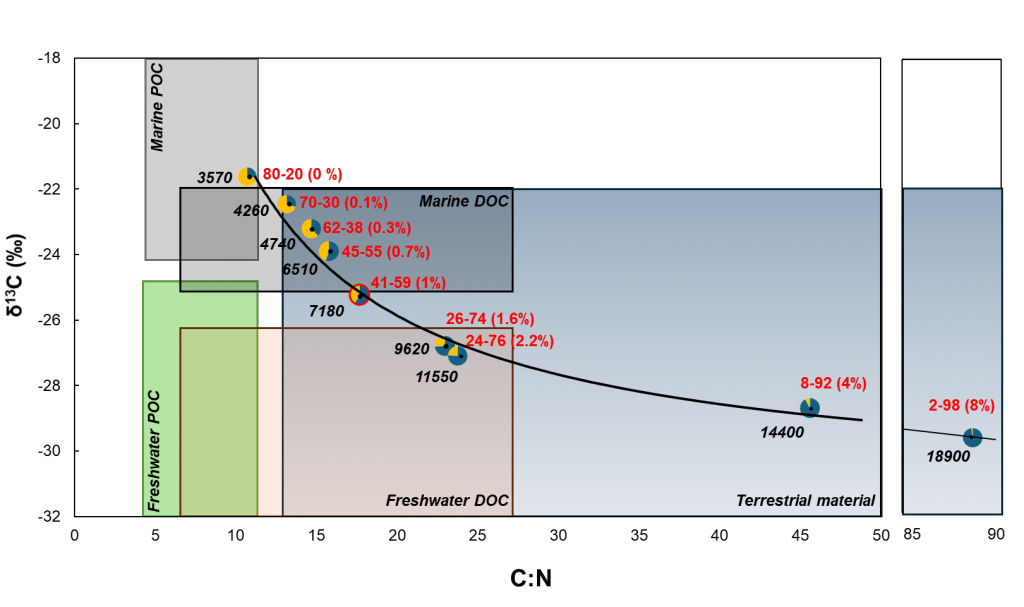
Figure: Relationship between δ¹³C, C:N, and radiocarbon (¹⁴C) age for sedimentary organic matter – polyethylene sediment admixtures. Colored boxes denote typical δ¹³C ranges of major carbon reservoirs (POC, DOC, terrestrial). Pie charts show measured positions of polyethylene admixtures (percent polyethylene by mass in parentheses), with yellow and blue sectors representing apparent marine and terrestrial contributions inferred from a two-endmember mixing model. Even 1% polyethylene contamination (red outline) substantially shifts apparent source attribution and radiocarbon age (red values). The black curve shows the modeled δ¹³C–C:N relationship
These findings reveal a quiet but consequential problem. Radiocarbon measurements are widely used to estimate how long carbon persists in the ocean and how resistant it is to degradation. If microplastics are inadvertently included in samples, natural organic carbon can appear artificially older and more stable than it truly is. Because most carbon biogeochemistry studies do not routinely account for the presence of microplastics, existing datasets and models may already be influenced by this contamination to unknown degrees.
Carbon isotope measurements are crucial for estimates of oceanic carbon budgets, inform climate models, and shape our understanding of how the ocean moderates atmospheric CO₂. If microplastics have been altering these measurements for years, then some interpretations of carbon cycling and climate feedbacks may need to be revisited. Recognizing microplastics not only as pollutants, but also as analytical interlopers, is an essential step toward improving the accuracy of ocean carbon science and ensuring that future observations reflect the ocean’s true biological signal.
Authors
Luis E. Medina Faull
Gordon T. Taylor
Steven R. Beaupré
(all at School of Marine and Atmospheric Sciences, Stony Brook University)
Citation: Medina Faull LE, Taylor GT, Beaupré SR (2025) Microplastic contaminants potentially distort our understanding of the ocean’s carbon cycle. PLoS One 20(10): e0334546. https://doi.org/10.1371/journal.pone.0334546