Ocean Carbon & Biogeochemistry
Studying marine ecosystems and biogeochemical cycles in the face of environmental change
  • Home
  • About OCB
    • About Us
    • Scientific Breadth
      • Biological Pump
      • Changing Marine Ecosystems
      • Changing Ocean Chemistry
      • Estuarine and Coastal Carbon Fluxes
      • Ocean Carbon Uptake and Storage
      • Ocean Observatories
    • Code of Conduct
    • Get Involved
    • Project Office
    • Scientific Steering Committee
    • OCB committees
      • OCSIF – Ocean Carbonate System Intercomparison
      • Ocean-Atmosphere Interaction
      • Ocean Time-series
      • US Biogeochemical-Argo
  • Activities
    • Summer Workshop
    • OCB Webinars
    • Guidelines for OCB Workshops & Activities
    • Topical Workshops
      • CMIP6 Models Workshop
      • Coastal BGS Obs with Fisheries
      • C-saw extreme events workshop
      • Expansion of BGC-Argo and Profiling Floats
      • Fish, fisheries and carbon
      • Future BioGeoSCAPES program
      • GO-BCG Scoping Workshop
      • Lateral Carbon Flux in Tidal Wetlands
      • Leaky Deltas Workshop – Spring 2025
      • Marine CDR Workshop
      • Ocean Nucleic Acids ‘Omics
      • Pathways Connecting Climate Changes to the Deep Ocean
    • Small Group Activities
      • Aquatic Continuum OCB-NACP Focus Group
      • Arctic-COLORS Data Synthesis
      • BECS Benthic Ecosystem and Carbon Synthesis WG
      • Carbon Isotopes in the Ocean Workshop
      • CMIP6 WG
      • Filling the gaps air–sea carbon fluxes WG
      • Fish Carbon WG
      • Metabarcoding intercal WG
      • Meta-eukomics WG
      • mCDR
      • Metaproteomic Intercomparison
      • Mixotrophs & Mixotrophy WG
      • N-Fixation WG
      • Ocean Carbonate System Intercomparison Forum
      • Ocean Carbon Uptake WG
      • OOI BGC sensor WG
      • Operational Phytoplankton Observations WG
      • Phytoplankton Taxonomy WG
    • Other Workshops
    • Science Planning
      • Coastal CARbon Synthesis (CCARS)
      • North Atlantic-Arctic
    • Ocean Acidification PI Meetings
    • Training Activities
      • PACE Hackweek 2025
      • PACE Hackweek 2024
      • PACE Training Activity 2022
  • Science Support
    • OCB Activity Proposal Solicitation
    • Guidelines for OCB Workshops & Activities
    • Data management and archival
    • Early Career
    • Funding Sources
    • Jobs & Postdocs
    • Meeting List
    • OCB Topical Websites
      • Ocean Fertilization
      • Trace gases
      • US IIOE-2
    • Outreach & Education
    • Promoting your science
    • Student Opportunities
    • Travel Support
  • Publications
    • OCB Workshop Reports
    • Science Planning and Policy
    • Newsletter Archive
  • Science Highlights
  • News

Archive for ocean carbon uptake and storage – Page 2

Carbon sequestration by the biological pump is not exclusive to the deep ocean

Posted by mmaheigan 
· Tuesday, April 16th, 2024 

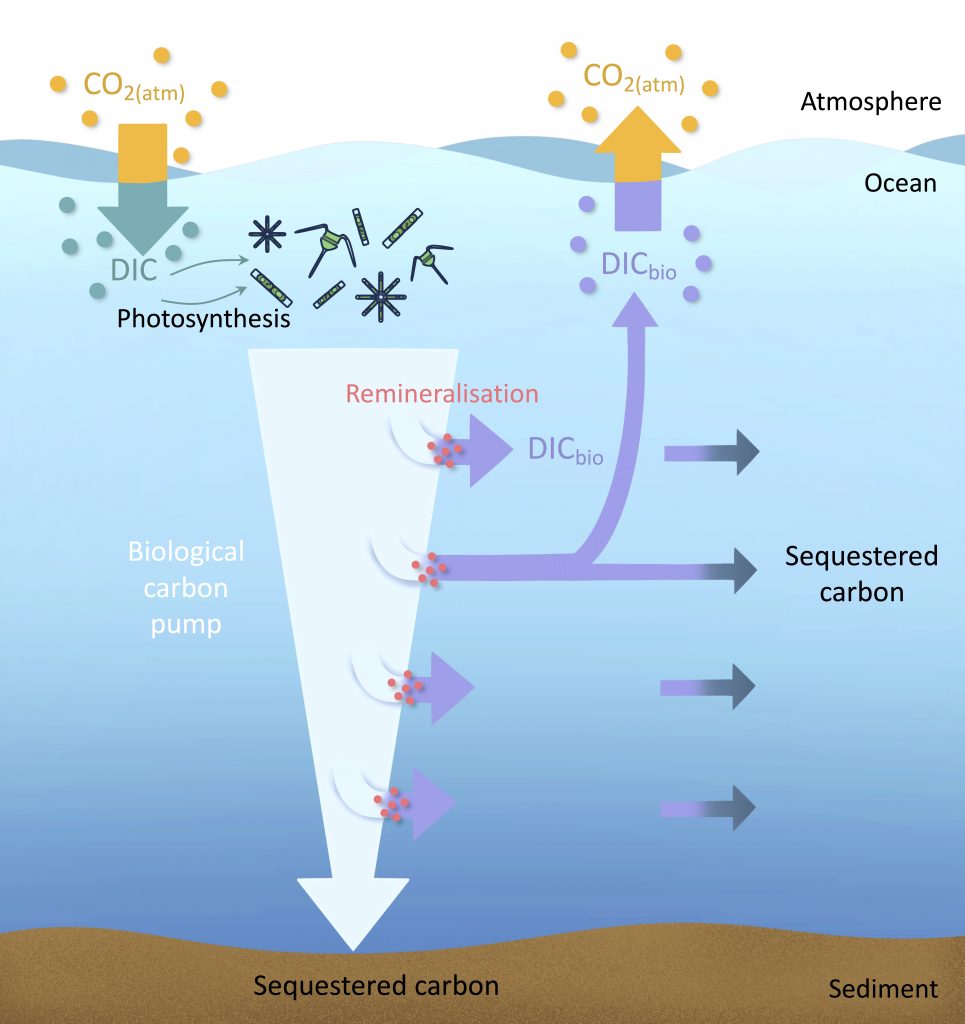
The biological carbon pump plays a key role in ocean carbon sequestration by transporting organic carbon from the upper ocean to deeper waters via three broad processes: the sinking of organic particles, vertical migration of organisms, and physical mixing. Most studies assume that century-scale carbon sequestration occurs only in the deep ocean, thus have missed sequestration that happens in the water column above 1,000m.

A recent publication reassessed the biological pump’s century-scale (≥100 years) carbon sequestration fluxes throughout the water column, by implementing the concept of ‘continuous vertical sequestration’ (CONVERSE). The resulting CONVERSE estimates were up to three times higher than those estimated at 1,000 m. This method shows that not only are these fluxes higher than previously thought, but also that vertical migration and physical mixing, which are generally neglected, make a significant contribution (20-30%) to carbon sequestration.

The CONVERSE method provides a new metric for calculations of the biological pump’s century-scale carbon sequestration flux that can be used to diagnose future changes in carbon sequestration fluxes in prognostic models of ocean biogeochemistry.

Interested in learning more? View more results and figures here.


Authors
Florian Ricour (Institute of Natural Sciences, Belgium)
Lionel Guidi (CNRS and Sorbonne University, France)
Marion Gehlen (CEA, CNRS and Paris-Saclay University, France)
Timothy Devries (University of California at Santa Barbara, USA)
Louis Legendre (Sorbonne University, France)

@LionelGuidi
@ComplexLov
@CNRS_INSU

Tiny parasites, big impact: Species networks and carbon recycling in an oligotrophic ocean

Posted by mmaheigan 
· Tuesday, March 12th, 2024 

Parasites are everywhere in the ocean. Including the microbial realm where a diverse, widespread group of protist parasites (Syndiniales) infect and kill a range of hosts, such as dinoflagellates, radiolarians, and even larger zooplankton. A complete Syndiniales infection cycle is only 2-3 days. First, the parasite is a free-living spore. Once inside a host, the parasite consumes the host’s carbon and becomes a larger multicellular organism (a trophont) eventually causing the host to burst open and release hundreds of new spores.

Like viruses, parasite lysis is expected to reroute organic carbon to the microbial loop, potentially decreasing the amount of carbon available for export to the deep sea. Yet, the role of Syndiniales in carbon cycling has been hard to define, as depth-specific infection dynamics and links to carbon export remain poorly understood.

Parasites are everywhere in the ocean. Including the microbial realm where a diverse, widespread group of protist parasites (Syndiniales) infect and kill a range of hosts, such as dinoflagellates, radiolarians, and even larger zooplankton. A complete Syndiniales infection cycle is only 2-3 days. First, the parasite is a free-living spore. Once inside a host, the parasite consumes the host’s carbon and becomes a larger multicellular organism (a trophont) eventually causing the host to burst open and release hundreds of new spores.

Like viruses, parasite lysis is expected to reroute organic carbon to the microbial loop, potentially decreasing the amount of carbon available for export to the deep sea. Yet, the role of Syndiniales in carbon cycling has been hard to define, as depth-specific infection dynamics and links to carbon export remain poorly understood.

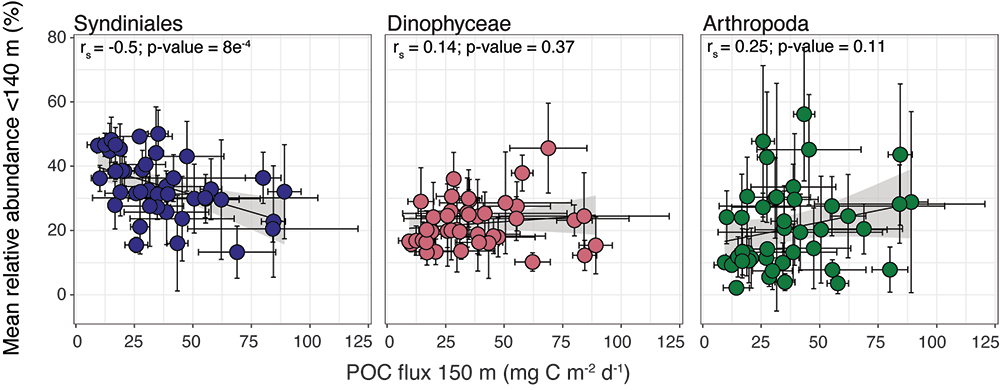
Figure 1. The mean relative abundance of Syndiniales (purple) in the photic zone (<140 m) is negatively correlated with particulate organic carbon (POC) flux at 150 m (p-value < 0.001). Similar correlations are not significant (p-values > 0.05) for other major 18S taxonomic groups, like Dinophyceae (red) and Arthropoda (green).

In a recent study published in ISME Communications, authors analyzed an 18S rRNA gene metabarcoding dataset from the Bermuda Atlantic Time-series Study (BATS) site that included 4 years (2016-2019) and twelve depths (1-1000 m). Syndiniales were the most dominant 18S group at BATS, present throughout the photic and aphotic zones. These parasites were prominent in species networks constructed with 18S sequence data, with significant associations with dinoflagellates and copepods in the surface, and with radiolarians in the aphotic zone. In addition, Syndiniales were the only major 18S group to be significantly (and negatively) correlated to particulate carbon flux (at 150 m), which was estimated from sediment trap data collected concurrently at BATS (Figure 1). This is in situ evidence of flux attenuation among Syndiniales, as they recycle host carbon that would otherwise transfer up to larger organisms (e.g., via grazing). Lastly, authors found 19% of the Syndiniales community is linked between photic and aphotic zones, indicating that parasites are sinking on particles and/or are recirculated via diel vertical migration. Overall, these findings elevate the role of Syndiniales in microbial food webs and further emphasize the importance in quantifying parasite-host dynamics to inform ocean carbon models.


Authors
Sean Anderson (University of New Hampshire / Woods Hole Oceanographic Institution)
Leocadio Blanco-Bercial (Bermuda Institute of Ocean Sciences / Arizona State University)
Craig Carlson (University of California, Santa Barbara)
Elizabeth Harvey (University of New Hampshire)

A suite of CO2 removal approaches modeled for the 1.5 ˚C future

Posted by mmaheigan 
· Thursday, August 31st, 2023 

Carbon dioxide removal (CDR) is “unavoidable” in efforts to limit end-of-century warming to below 1.5 °C. This is because some greenhouse gas emissions sources—non-CO2 from agriculture, and CO2 from shipping, aviation, and industrial processes—will be difficult to avoid, requiring CDR to offset their climate impacts. Policymakers are interested in a wide variety of ways to draw down CO2 from the atmosphere, but to date, the modeling scenarios that inform international climate policies have mostly used biomass energy with carbon capture and storage (BECCS) as a proxy for all CDR. It is critical to understand the potential of a full suite of CDR technologies, to understand their interactions with energy-water-land systems and to begin preparing for these impacts.

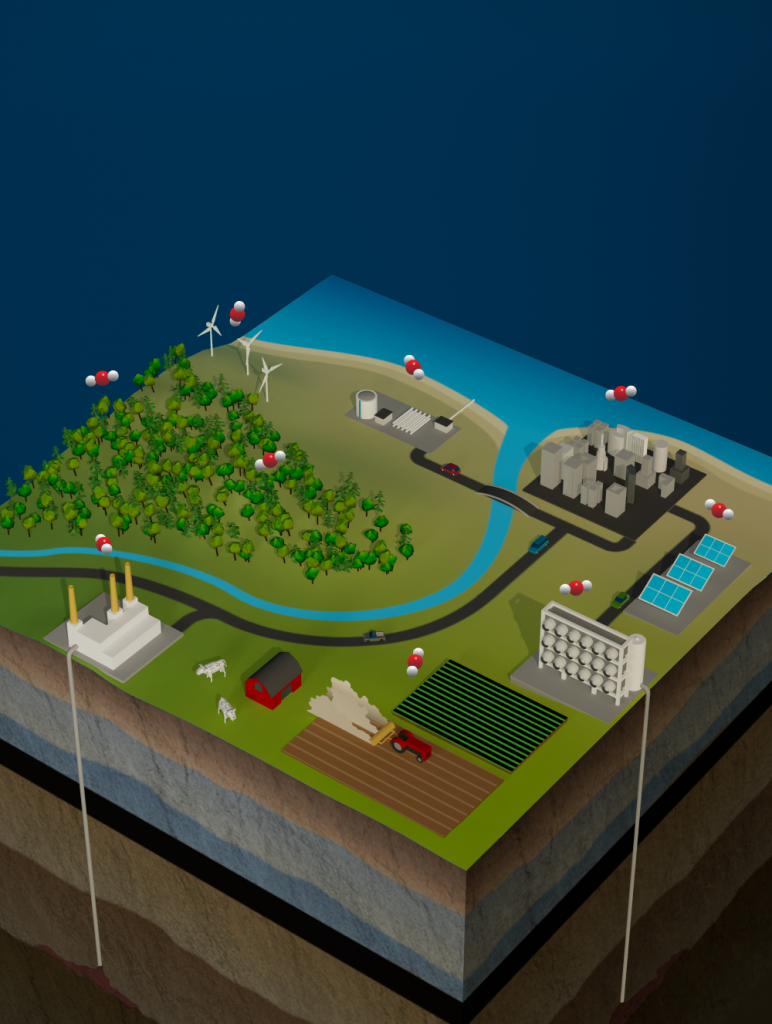
Figure caption: Each of the six carbon dioxide removal approaches identified in recent U.S. legislation and modeled for this study could bring unique benefits and tradeoffs to the energy-water-land system. This image depicts afforestation, direct ocean capture, direct air capture, biochar, enhanced weathering, and bioenergy with carbon capture and storage in clockwise order. Floating carbon dioxide molecules hover above the landscape (image credit: Nathan Johnson, PNNL).

A recent study published in the journal Nature Climate Change was the first to model six major CDR pathways in an integrated assessment model. The modeled pathways range from bioenergy with carbon storage and afforestation (already represented by most models), also direct air capture, biochar and crushed basalt spreading on global croplands, and electrochemical stripping of CO2 from seawater aka direct ocean capture. The removal potential contributed by each of the six pathways varies widely across different regions of the world. Direct ocean capture showed the smallest removal potential but has important potential synergies with water desalination. This method could help arid regions such as the Middle East meet their water needs in a warming world. Enhanced weathering has much larger (GtCO2-yr-1) removal potential and could potentially help ameliorate ocean acidification. Overall, similar total amounts of CO2 are removed compared to other modeling scenarios, but broader set of technologies lessens the risk that any one of them would become politically or environmentally untenable.

Authors:
Jay Fuhrman  (Joint Global Change Research Institute)
Candelaria Bergero (Joint Global Change Research Institute)
Maridee Weber (Joint Global Change Research Institute)
Seth Monteith (ClimateWorks Foundation)
Frances M. Wang (ClimateWorks Foundation)
Andres F. Clarens (University of Virginia)
Scott C. Doney (University of Virginia)
William Shobe (University of Virginia)
Haewon McJeon (Joint Global Change Research Institute )

Twitter: @pnnlab @climateworks @uva

Unveiling the Hidden Secrets of Ancient Carbon Burial

Posted by mmaheigan 
· Thursday, August 31st, 2023 

How much carbon has been buried in the depths of our ancient oceans, and how did it shape our planet’s climate? Unraveling this enigma has long eluded researchers, but a recent groundbreaking “bottom-up” study unveils the surprising history of organic carbon burial in marine sediments during the Neogene period.

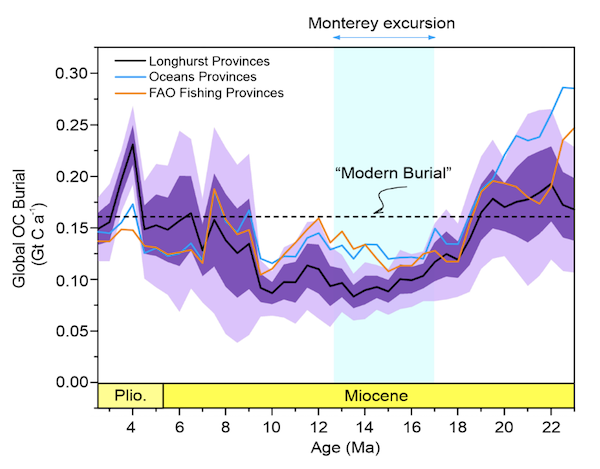
Departing from conventional methods, this study presents an innovative approach to calculating organic carbon burial rates independently. Drawing from data collected from 81 globally distributed sites, the research covers the Neogene era (approximately 23 to 3 million years ago). The results reveal unprecedented spatiotemporal variability in organic carbon burial, challenging previous estimates. Notably, high burial rates were found during the early Miocene and Pliocene, contrasting with a significant decline during the mid-Miocene, marked by the lowest ratio of organic-to-carbonate burial rates. This finding disputes earlier interpretations of enriched carbonate 13C values during the mid-Miocene (so called “Monterey Period” or “Monterey Excursion”) as indicative of massive organic carbon burial.

Figure Caption: Neogene organic carbon (OC) burial in the global ocean. Burial rates calculated using different definitions of provinces, including three approaches: Longhurst (black curve with uncertainty envelope,± 1σ in purple and ± 2σ in pale lilac), Oceans (blue curve), and FAO Fishing (orange curve).

Understanding the complex carbon burial dynamics of ancient oceans holds profound implications for comprehending our planet’s climate evolution. The suppressed organic carbon burial during the warm mid-Miocene, likely driven by temperature-dependent bacterial degradation, suggests the organic carbon cycle acted as a positive feedback mechanism during past global warming events. These findings emphasize the vital role of ocean carbon sequestration, providing stark evidence for policymakers, funding agencies, citizens, and educators to acknowledge its significance in combating modern climate challenges.

Authors
Ziye Li (University of Bremen)
Yi Ge Zhang (Texas A&M University)
Mark Torres (Rice University)
Ben Mills (University of Leeds)

Twitter: @chemclimatology

Backstory
Dr. Zhang, a shipboard organic geochemist during International Ocean Discovery Program Expedition 363, embarked on the legendary drilling ship JOIDES Resolution. While on the journey, Yige spent hours and hours daily crushing samples to measure organic carbon until his palm grew calluses, but the TOC% numbers did not really change. Fueled by sheer determination, Yige’s former student Ziye Li and himself delved into 50 years of IODP data archives to uncover global trends, and with the help of carbon cycle modelers Mark Torres and Ben Mills, leading to the discovery of the history of organic carbon burial.

Unveiling the Past and Future of Ocean Acidification: A Novel Data Product covering 10 Global Surface OA Indicators

Posted by mmaheigan 
· Wednesday, August 23rd, 2023 

Accurately predicting future ocean acidification (OA) conditions is crucial for advancing research at regional and global scales, and guiding society’s mitigation and adaptation efforts.

As an update to Jiang et al. 2019, this new model-data fusion product:
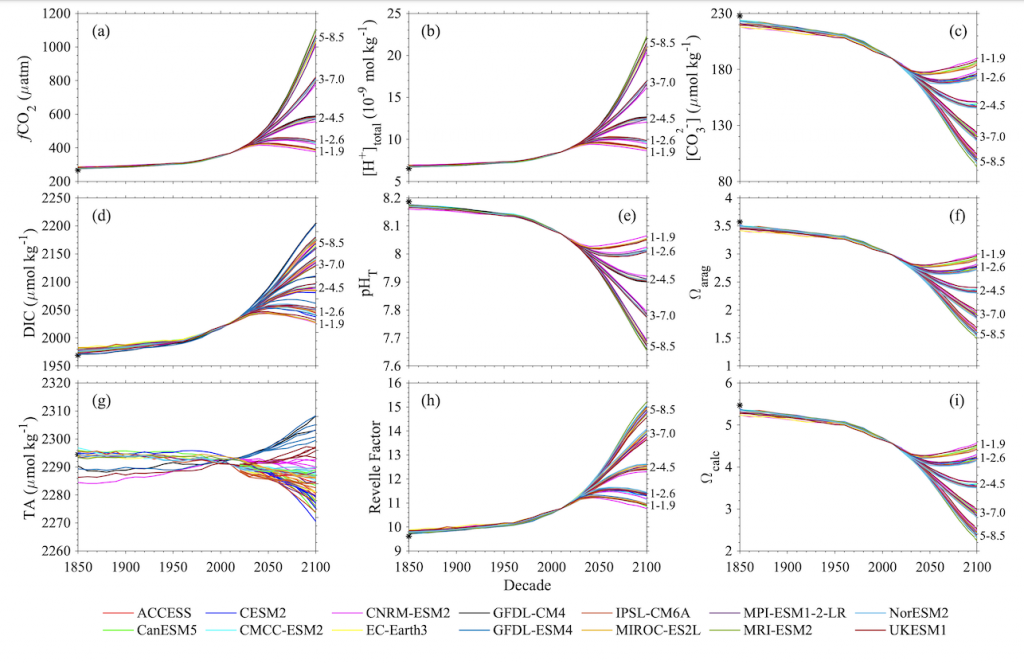
1. Utilizes an ensemble of 14 distinct Earth System Models from the Coupled Model Intercomparison Project Phase 6 (CMIP6) along with three recent observational ocean carbon data products –>instead of relying on just one model (i.e., the GFDL-ESM2M) this approach reduces potential projection biases in OA indicators.
2. Eliminates model biases using observational data, and model drift with pre-Industrial controls.
3. Covers 10 OA indicators, an expansion from the usual pH, acidity, and buffer capacity.
4. Incorporates the new Shared Socioeconomic Pathways (SSPs).

The use of the most recent observational datasets and a large Earth System Model ensemble is a major step forward in the projection of future surface ocean OA indicators and provides critical information to guide OA mitigation and adaptation efforts.

Figure X. Temporal changes of global average surface ocean OA indicators as reconstructed and projected from 14 CMIP6 Earth System Models after applying adjustments with observational data: (a) fugacity of carbon dioxide (fCO2), (b) total hydrogen ion content ([H+]total), (c) carbonate ion content ([CO32-]), (d) total dissolved inorganic carbon content (DIC), (e) pH on total scale (pHT), (f) aragonite saturation state (Ωarag), (g) total alkalinity content (TA), (h) Revelle Factor (RF), and (i) calcite saturation state (Ωcalc). The asterisk signs on the left-side y-axes show the values in 1750. The numbers along right-side y-axes, i.e., 1-1.9, 1-2.6, 2-4.5, 3-7.0, and 5-8.5, indicate the shared socioeconomic pathway SSP1-1.9, SSP1-2.6, SSP2-4.5, SSP3-7.0, and SSP5-8.5, respectively. These are missing from panel g because the trajectories were more dependent on the model than the SSP.

Authors
Li-Qing Jiang (University Maryland)
John Dunne (NOAA/Geophysical Fluid Dynamics Laboratory)
Brendan R. Carter (University of Washington)
Jerry F. Tjiputra (NORCE Norwegian Research Centre Bjerknes)
Jens Terhaar (Woods Hole Oceanographic Institution)
Jonathan D. Sharp (University of Washington)
Are Olsen (University of Bergen and Bjerknes Centre for Climate Research)
Simone Alin (NOAA/Pacific Marine Environmental Laboratory)
Dorothee C. E. Bakker (University of East Anglia)
Richard A. Feely (NOAA/Pacific Marine Environmental Laboratory)
Jean-Pierre Gattuso (Sorbonne Université)
Patrick Hogan (NOAA/National Centers for Environmental Information)
Tatiana Ilyina (Max Planck Institute for Meteorology)
Nico Lange (GEOMAR Helmholtz Centre for Ocean Research)
Siv K. Lauvset (NORCE Norwegian Research Centre)
Ernie R. Lewis (Brookhaven National Laboratory)
Tomas Lovato (Fondazione Centro Euro-Mediterraneo sui Cambiamenti Climatici)
Julien Palmieri (National Oceanography Centre)
Yeray Santana-Falcón (Université de Toulouse)
Jörg Schwinger (NORCE Norwegian Research Centre)
Roland Séférian (Université de Toulouse)
Gary Strand (US National Center for Atmospheric Research)
Neil Swart (Canadian Centre for Climate Modelling and Analysis)
Toste Tanhua (GEOMAR Helmholtz Centre for Ocean Research)
Hiroyuki Tsujino (JMA Meteorological Research Institute)
Rik Wanninkhof (NOAA/Atlantic Oceanographic Meteorological Laboratory)
Michio Watanabe (Japan Agency for Marine-Earth Science and Technology)
Akitomo Yamamoto (Japan Agency for Marine-Earth Science and Technology)
Tilo Ziehn (CSIRO Oceans and Atmosphere)

Twitter:
@JiangLiqing, @JensTerhaar, @jpGattuso, @j_d_sharp, @AreOlsen, @SimoneAlin, @Dorothee_Bakker, @RFeely, @ilitat, @sivlauvset, @yeraysf, @TosteTanhua,

Hydrostatic pressure substantially reduces deep-sea microbial activity

Posted by mmaheigan 
· Thursday, May 11th, 2023 

Deep sea microbial communities are experiencing increasing hydrostatic pressure with depth. It is known that some deep sea microbes require high hydrostatic pressure for growth, but most measurements of deep-sea microbial activity have been performed under atmospheric pressure conditions.

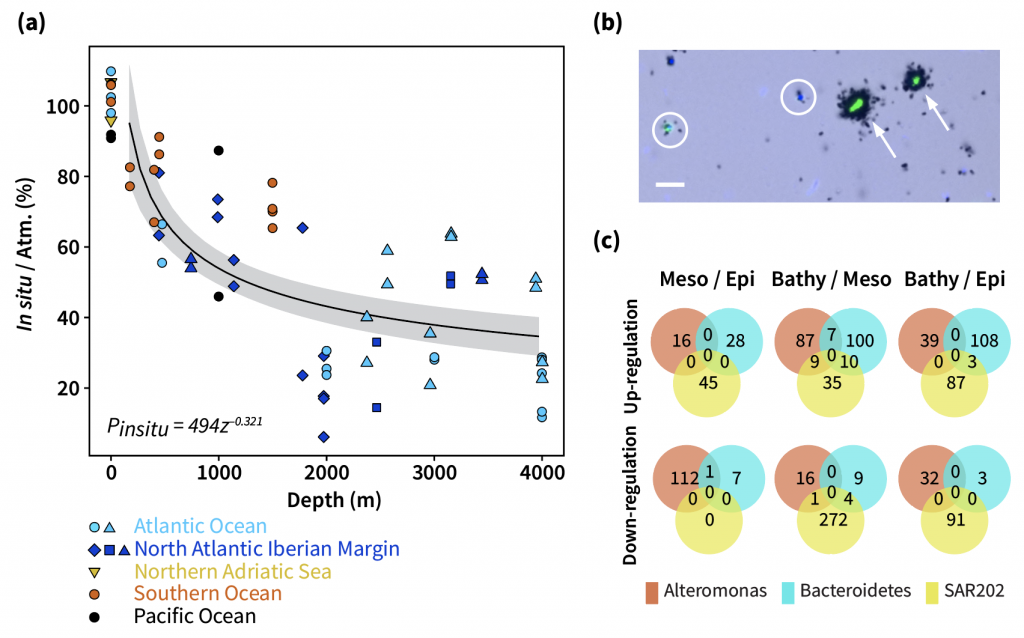
In a recent paper published in Nature Geoscience, the authors used a new device coined ‘In Situ Microbial Incubator’ (ISMI) to determine prokaryotic heterotrophic activity under in situ conditions. They compared microbial activity in situ with activity under atmospheric pressure at 27 stations from 175 to 4000 m depths in the Atlantic, Pacific, and the Southern Ocean. The bulk of heterotrophic activity under in situ pressure is always lower than under atmospheric pressure conditions and is increasingly inhibited with increasing hydrostatic pressure. Single-cell analysis revealed that deep sea prokaryotic communities consist of a small fraction of pressure-loving (piezophilic) microbes while the vast majority is pressure-insensitive (piezotolerant). Surprisingly, the piezosensitive fraction (~10% of the total community) responds with a more than 100-fold increase of activity upon depressurization. In the microbe proteomes, the authors uncovered taxonomically characteristic survival strategies in meso- and bathypelagic waters. These findings indicate that the overall heterotrophic microbial activity in the deep sea is substantially lower than previously assumed, which implies major impacts on the carbon budget of the ocean’s interior.

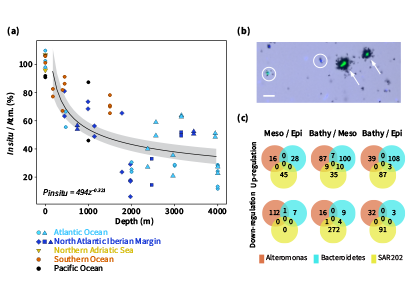
Figure caption: Deep sea microbial activity under varying pressure. (a) In situ bulk leucine incorporation rates normalized to rates obtained at atmospheric pressure conditions. (b) A microscopic view of a 2000 m sample collected in the Atlantic and incubated under atmospheric pressure conditions. The black halos around the cells are silver grains corresponding to their activities. The highly active cells (indicated by arrows) were rarely found in in situ pressure incubations. (c) Depth-related changes in the metaproteome of three abundant deep sea bacterial taxa (Alteromonas, Bacteroidetes, and SAR202). The number indicates shared and unique up- and down-regulated proteins in different depth zones.

Authors
Chie Amano (University of Vienna, Austria)
Zihao Zhao (University of Vienna, Austria)
Eva Sintes (University of Vienna, IEO-CSIC, Spain)
Thomas Reinthaler (University of Vienna, Austria)
Julia Stefanschitz (University of Vienna, Austria)
Murat Kisadur (University of Vienna, Austria)
Motoo Utsumi (University of Tsukuba, Japan)
Gerhard J. Herndl (University of Vienna, Netherlands Institute for Sea Research)

Twitter @microbialoceanW

Unexpected global diatom decline in response to ocean acidification

Posted by mmaheigan 
· Tuesday, December 13th, 2022 

Biological impacts of ocean acidification have been the subject of intense research for more than a decade. While it is known that more acidic seawater will create difficulties for calcifying organisms (e.g. corals or coccolithophores), diatoms have so far been considered to be resilient against, or even benefit from, ocean acidification. But an overlooked biogeochemical feedback mechanism has revealed that diatoms are also under threat from ocean acidification.

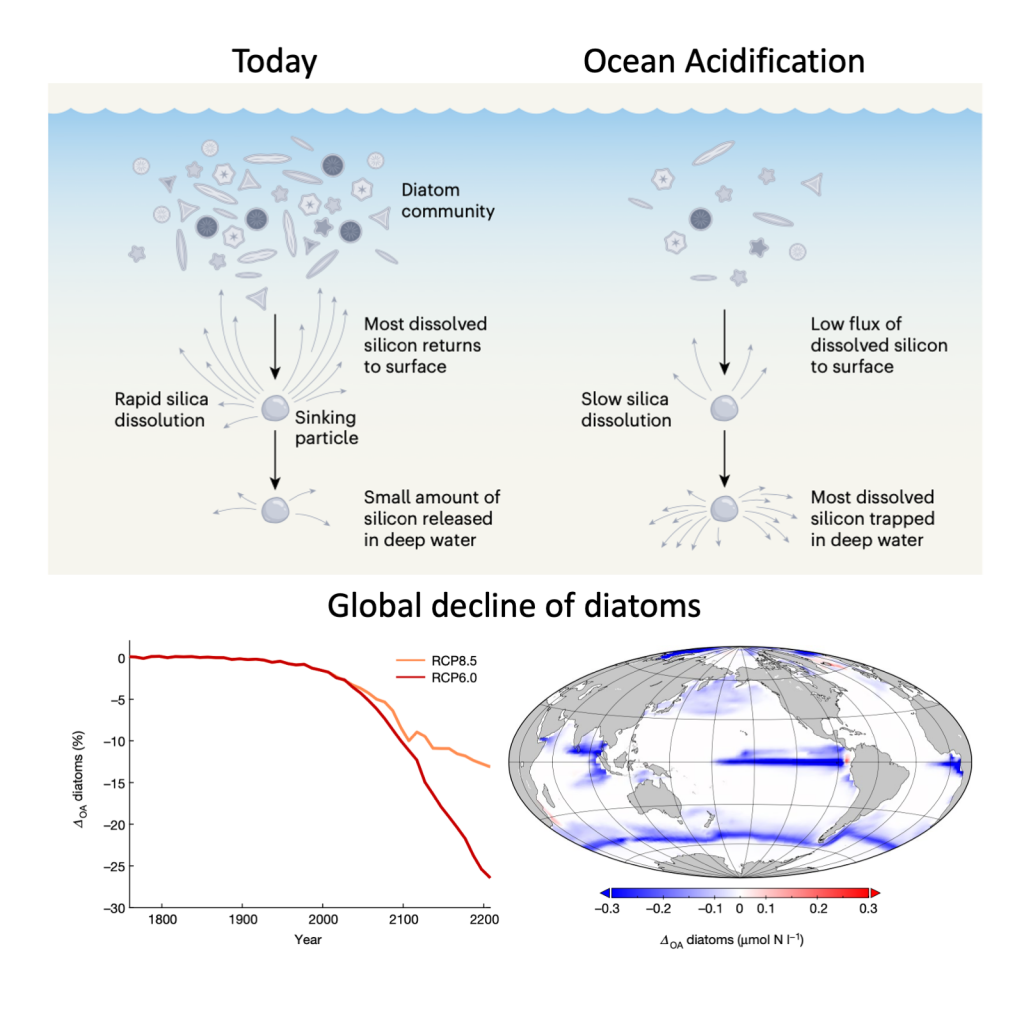
Figure 1: Slower solubility of diatom shells in acidified oceans leads to global diatom decline. Diatoms build silica shells and produce organic carbon at the ocean surface. Today, much of the silica dissolves relatively quickly as the particles consisting of dead diatoms sink (e.g. after blooms). The resulting dissolved silicon is returned to the surface by upwelling waters, where it supports the growth of more diatoms. Under ocean acidification, the silica in sinking particles will dissolve slower, thereby reducing the return flux of dissolved silicon to the ocean surface as much of the marine silicon budget will become trapped in deep water. The result is a substantial global decrease in diatom biomass. (Figure source: Nature, Vol. 605, No. 7911, 26 May 2022, DOI: 10.1038/d41586-022-01365-z and 10.1038/s41586-022-04687-0)

Diatoms are the most important primary producers in the ocean and play an important role in transferring carbon dioxide (CO2) from the atmosphere into the deep ocean. Their most conspicuous feature is a silica shell formed around their cells. A comprehensive study published in Nature dove deep into the impacts of ocean acidification on diatoms and biogeochemical cycling. Their analyses of data from experiments, field observations, and model simulations suggest that ocean acidification could drastically reduce diatom populations. As a result of lower seawater pH, the silica shells of diatoms dissolve more slowly. However, this is not an advantage—it causes diatom shells to sink into deeper water layers before chemically dissolving and being converted back into the inorganic nutrient silicic acid. This means this nutrient is more efficiently exported to the deep ocean and so becomes scarcer in the light-flooded surface layer where diatoms require it to form new shells. Ultimately, this loss of silica from the surface ocean causes a global decline in diatoms, reaching -10% by the year 2100 and -26% by 2200. Since diatoms are one of the most important plankton groups in the ocean, their decline could lead to a significant shift in the marine food web or even a change in the ocean carbon sink.

This finding is in sharp contrast to the previous consensus of ocean research, which sees calcifying organisms as losers, but diatoms being little affected, or even a winner of ocean acidification. This also highlights the uncertainties in predicting ecological impacts of climate change and how small-scale effects can lead to ocean-wide changes with unforeseen and far-reaching consequences for marine ecosystems and matter cycles.


Authors:
Jan Taucher (GEOMAR, Kiel, Germany)
Lennart T. Bach (University of Tasmania, Hobart, Australia)
Friederike Prowe (GEOMAR, Kiel, Germany)
Tim Boxhammer (GEOMAR, Kiel, Germany)
Karin Kvale (GNS Science, Lower Hutt, New Zealand)
Ulf Riebesell (GEOMAR, Kiel, Germany)

Linking the calcium carbonate and alkalinity cycles in the North Pacific ocean

Posted by mmaheigan 
· Tuesday, December 13th, 2022 

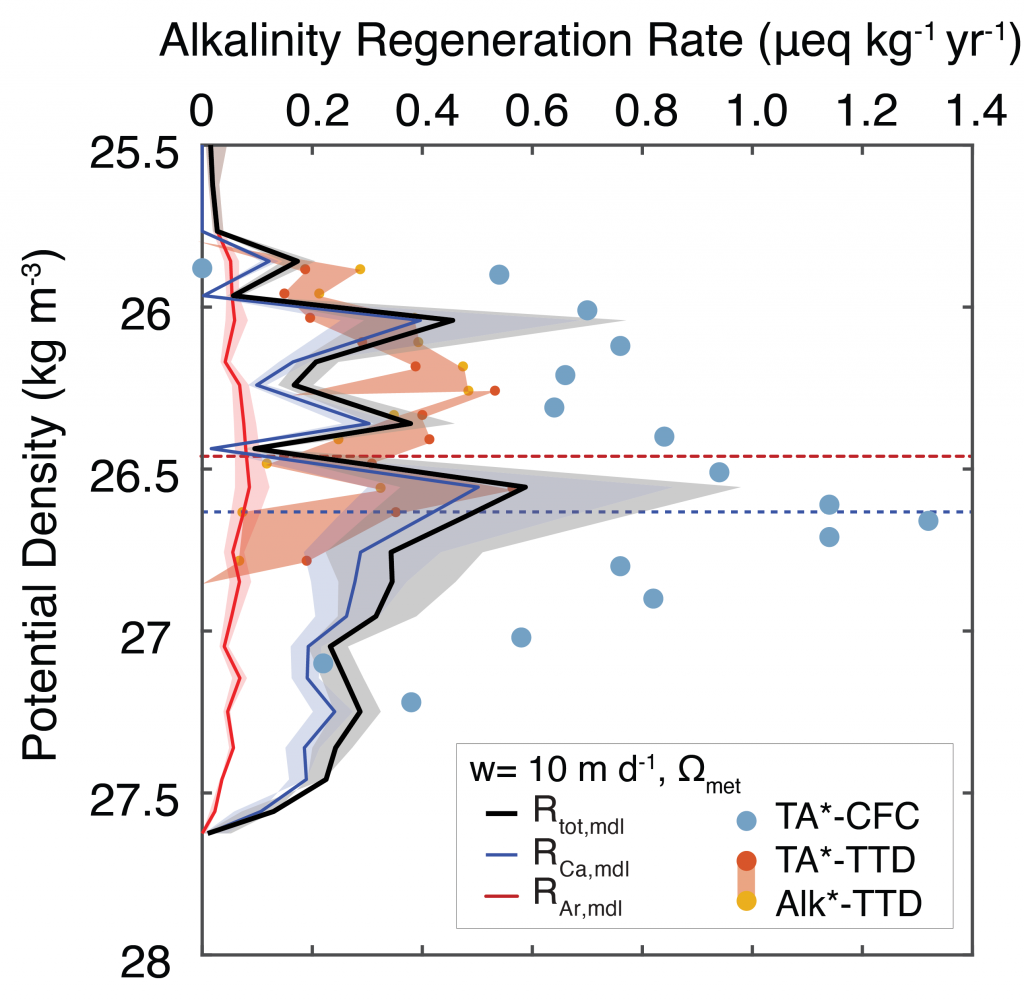
The marine carbon and alkalinity cycles are tightly coupled. Seawater stores so much carbon because of its high alkalinity, or buffering capacity, and the main driver of alkalinity cycling is the formation and dissolution of biologically produced calcium carbonate (CaCO3). In a recent publication in GBC, the authors conducted novel carbon-13 tracer experiments to measure the dissolution rates of biologically produced CaCO3 along a transect in the North Pacific Ocean. They combined these experiment data with shipboard analyses of the dissolved carbonate system, the 13C-content of dissolved inorganic carbon, and CaCO3 fluxes, to constrain the alkalinity cycle in the upper 1000 meters of the water column. Dissolution rates were too slow to explain alkalinity production or CaCO3 loss from the particulate phase. However, driving dissolution with the metabolic consumption of oxygen brings alkalinity production and CaCO3 loss estimates into quantitative agreement (Figure). The authors argue that a majority of CaCO3 production is likely dissolved through metabolic processes in the upper ocean, including zooplankton grazing, digestion, and egestion, and microbial degradation of marine particle aggregates that contain both organic carbon and CaCO3. This hypothesis stems from the basic fact that almost all marine CaCO3 is biologically produced, placing CaCO3 at the source of the acidifying process (metabolic consumption of organic matter). This process is important because it puts an emphasis on biological processing for the cycling of not only carbon, but also alkalinity, the main buffering component in seawater. These results should help both scientists and stakeholders to understand the fundamental controls on calcium carbonate cycling in the ocean, and therefore the processes that distribute alkalinity throughout the world’s oceans.

Figure Caption: Sinking-dissolution model results compared with tracer-based alkalinity regeneration rates (TA*-CFC, Feely et al., 2002). We also plot alkalinity regeneration rates using updated time transit distribution ages (TA*- and Alk*-TTD). The modeled alkalinity regeneration rate uses our measured dissolution rates for biologically produced calcite and aragonite, and is driven by a combination of background saturation state and metabolic oxygen consumption. The dissolution rate is split up into a calcite component (produced mainly by coccolithophores) and an aragonite component (produced mainly by pteropods). Aragonite does not contribute significantly to the overall dissolution rate. Driving dissolution by metabolic oxygen consumption produces alkalinity regeneration rates that are in quantitative agreement with tracer-based estimates.


Authors:
Adam Subhas (Woods Hole Oceanographic Institution) et al.


Also see Eos highlight here

How does the competition between phytoplankton and bacteria for iron alter ocean biogeochemical cycles?

Posted by mmaheigan 
· Friday, August 26th, 2022 

Free-living bacteria play a key role in cycling essential biogeochemical resources in the ocean, including iron, via their uptake, transformation, and release of organic matter throughout the water column. Bacteria process half of the ocean’s primary production, remineralize dissolved organic matter, and re-direct otherwise lost organic matter to higher trophic levels. For these reasons, it is crucial to understand what factors limit the growth of bacteria and how bacteria activities impact global ocean biogeochemical cycles.

In a recent study, Pham and colleagues used a global ocean ecosystem model to dive into how iron limits the growth of free-living marine bacteria, how bacteria modulate ocean iron cycling, and the consequences to marine ecosystems of the competition between bacteria and phytoplankton for iron.

Figure 1: (a) Iron limitation status of bacteria in December, January, and February (DJF) in the surface ocean. Low values (in blue color = close to zero) mean that iron is the limiting factor for the growth of bacteria; (b) Bacterial iron consumption in the upper 120m of the ocean and (c) Changes (anomalies) in export carbon production when bacteria have a high requirement for iron.

Through a series of computer simulations performed in the global ocean ecosystem model, the authors found that iron is a limiting factor for bacterial growth in iron-limited regions in the Southern Ocean, the tropical, and the subarctic Pacific due to the high iron requirement and iron uptake capability of bacteria. Bacteria act as an iron sink in the upper ocean due to their significant iron consumption, a rate comparable to phytoplankton. The competition between bacteria and phytoplankton for iron alters phytoplankton bloom dynamics, ocean carbon export, and the availability of dissolved organic carbon needed for bacterial growth. These results suggest that earth system models that omit bacteria ignore an important organism modulating biogeochemical responses of the ocean to future changes.

Authors: 
Anh Le-Duy Pham (Laboratoire d’Océanographie et de Climatologie: Expérimentation et Approches Numériques (LOCEAN), IPSL, CNRS/UPMC/IRD/MNHN, Paris, France)
Olivier Aumont (Laboratoire d’Océanographie et de Climatologie: Expérimentation et Approches Numériques (LOCEAN), IPSL, CNRS/UPMC/IRD/MNHN, Paris, France)
Lavenia Ratnarajah (University of Liverpool, United Kingdom)
Alessandro Tagliabue (University of Liverpool, United Kingdom)

Carbon fluxes in the coastal ocean: Synthesis, boundary processes and future trends

Posted by mmaheigan 
· Friday, August 26th, 2022 

A vital part of mitigating climate change is the coastal and open ocean carbon sink, without this, it is not possible to meet the target set by the Paris Agreement. More research is needed to better understand the ocean carbon cycle and its future role in the uptake of anthropogenic carbon. A review provides an analysis of the current qualitative and quantitative understanding of the coastal ocean carbon cycle at regional to global scales, with a focus on the air-sea CO2 exchange. It includes novel findings obtained using the full breadth of methodological approaches, from observation-based studies and advanced statistical methods to conceptual and theoretical frameworks, and numerical modeling.

Figure 1: Updated sea-air CO2 flux density (mol C m−2 year−1) in the global coastal oceans that reveals that the global coastal ocean is an integrated CO2 sink with the strongest CO2 uptake at high latitudes. The challenges associated with identifying current and projected responses of the coastal ocean and it source/sink role in the global carbon budget require observational networks that are coordinated and integrated with modeling programs; development of this capability is a priority for the ocean carbon research and management communities.

Based on a new quantitative synthesis of air-sea CO2 exchange, this study yields an estimate for the globally integrated coastal ocean CO2 flux of −0.25 ± 0.05 Pg C year−1, with polar and subpolar regions accounting for most of the CO2 removal (>90%). A framework that classifies river-dominated ocean margin (RiOMar) and ocean-dominated margin (OceMar) systems is used in to conceptualize coastal carbon cycle processes. Ocean carbon models are reviewed in terms of the ability to simulate key processes and project future changes in different continental shelf regions. Concurrent trends and changes in the land-ocean-atmosphere coupled system introduce large uncertainties into projections of ocean carbon fluxes, in particular into defining the role of the coastal carbon sink and its evolution, both of which are of fundamental importance to climate science and climate policies developed before and after achievement of net-zero CO2 emissions. The major gaps and challenges identified for current coastal ocean carbon research have important implications for climate and sustainability policies. This study is a contribution to the Regional Carbon Cycle Assessment and Processes Phase 2 supported by the Global Carbon Project.


Authors:
M. H. Dai, J. Z. Su, Y. Y. Z., E. E. Hofmann, Z. M. Cao, W.-J. Cai, J. P. Gan, F. Lacroix, G. G. Laruelle, F. F. Meng, J. D. Müller, P. A.G. Regnier, G. Z. Wang, and Z. X. Wang

« Previous Page
Next Page »

Filter by Keyword

abundance acidification additionality advection africa air-sea air-sea interactions algae alkalinity allometry ammonium AMO AMOC anoxic Antarctic Antarctica anthro impacts anthropogenic carbon anthropogenic impacts appendicularia aquaculture aquatic continuum aragonite saturation arctic Argo argon arsenic artificial seawater AT Atlantic atmospheric CO2 atmospheric nitrogen deposition authigenic carbonates autonomous platforms AUVs awb bacteria bathypelagic BATS BCG Argo benthic bgc argo bio-go-ship bio-optical bioavailability biogeochemical cycles biogeochemical models biogeochemistry Biological Essential Ocean Variables biological pump biophysics bloom blue carbon bottom water boundary layer buffer capacity C14 CaCO3 calcification calcite carbon carbon-climate feedback carbon-sulfur coupling carbonate carbonate system carbon budget carbon cycle carbon dioxide carbon export carbon fluxes carbon sequestration carbon storage Caribbean CCA CCS changing marine chemistry changing marine ecosystems changing marine environments changing ocean chemistry chemical oceanographic data chemical speciation chemoautotroph chesapeake bay chl a chlorophyll circulation clouds CO2 CO3 coastal and estuarine coastal darkening coastal ocean cobalt Coccolithophores commercial community composition competition conservation cooling effect copepod copepods coral reefs CTD currents cyclone daily cycles data data access data assimilation database data management data product Data standards DCM dead zone decadal trends decomposers decomposition deep convection deep ocean deep sea coral denitrification dense water deoxygenation depth diatoms DIC diel migration diffusion dimethylsulfide dinoflagellate dinoflagellates discrete measurements distribution DOC DOM domoic acid DOP dust DVM ecology economics ecosystem management ecosystems eddy Education EEZ Ekman transport emissions ENSO enzyme equatorial current equatorial regions ESM estuarine and coastal carbon fluxes estuary euphotic zone eutrophication evolution export export fluxes export production extreme events faecal pellets fecal pellets filter feeders filtration rates fire fish Fish carbon fisheries fishing floats fluid dynamics fluorescence food webs forage fish forams freshening freshwater frontal zone functional role future oceans gelatinous zooplankton gene transfer geochemistry geoengineering geologic time GEOTRACES glaciers gliders global carbon budget global ocean global ocean models global overturning circulation global warming go-ship grazing greenhouse gas greenhouse gases Greenland ground truthing groundwater Gulf of Maine Gulf of Mexico Gulf Stream gyre harmful algal bloom high latitude human food human impact human well-being hurricane hydrogen hydrothermal hypoxia ice age iceberg ice cores ice cover industrial onset inland waters in situ inverse circulation ions iron iron fertilization iron limitation isotopes jellies katabatic winds kelvin waves krill kuroshio lab vs field land land-ocean continuum larvaceans lateral transport LGM lidar ligands light light attenuation lineage lipids low nutrient machine learning mangroves marine carbon cycle marine heatwave marine particles marine snowfall marshes mCDR mechanisms Mediterranean meltwater mesopelagic mesoscale mesoscale processes metagenome metals methane methods microbes microlayer microorganisms microplankton microscale microzooplankton midwater migration minerals mitigation mixed layer mixed layers mixing mixotrophs mixotrophy model modeling model validation mode water molecular diffusion MPT MRV multi-decade N2 n2o NAAMES NCP nearshore net community production net primary productivity new ocean state new technology Niskin bottle nitrate nitrogen nitrogen cycle nitrogen fixation nitrous oxide north atlantic north pacific North Sea NPP nuclear war nutricline nutrient budget nutrient cycles nutrient cycling nutrient limitation nutrients OA observations ocean-atmosphere ocean acidification ocean acidification data ocean alkalinity enhancement ocean carbon uptake and storage ocean color ocean modeling ocean observatories ocean warming ODZ oligotrophic omics OMZ open ocean optics organic particles oscillation outwelling overturning circulation oxygen pacific paleoceanography PAR parameter optimization parasite particle flux particles partnerships pCO2 PDO peat pelagic PETM pH phenology phosphate phosphorus photosynthesis physical processes physiology phytoplankton PIC piezophilic piezotolerant plankton POC polar polar regions policy pollutants precipitation predation predator-prey predators prediction pressure primary productivity Prochlorococcus productivity prokaryotes proteins pteropods pycnocline python radioisotopes remineralization remote sensing repeat hydrography residence time resource management respiration resuspension rivers rocky shore Rossby waves Ross Sea ROV salinity salt marsh satellite scale seafloor seagrass sea ice sea level rise seasonal seasonal effects seasonality seasonal patterns seasonal trends sea spray seawater collection seaweed secchi sediments sensors sequestration shelf ocean shelf system shells ship-based observations shorelines siderophore silica silicate silicon cycle sinking sinking particles size SOCCOM soil carbon solubility pump southern ocean south pacific spatial covariations speciation SST state estimation stoichiometry subduction submesoscale subpolar subtropical sulfate surf surface surface ocean surface waters Synechococcus technology teleconnections temperate temperature temporal covariations thermocline thermodynamics thermohaline thorium tidal time time-series time of emergence titration top predators total alkalinity trace elements trace metals trait-based transfer efficiency transient features trawling Tris trophic transfer tropical turbulence twilight zone upper ocean upper water column upwelling US CLIVAR validation velocity gradient ventilation vertical flux vertical migration vertical transport warming water clarity water column water mass water quality waves weathering western boundary currents wetlands winter mixing zooplankton

Copyright © 2026 - OCB Project Office, Woods Hole Oceanographic Institution, 266 Woods Hole Rd, MS #25, Woods Hole, MA 02543 USA Phone: 508-289-2838  •  Fax: 508-457-2193  •  Email: ocb_news@us-ocb.org

link to nsflink to noaalink to WHOI

Funding for the Ocean Carbon & Biogeochemistry Project Office is provided by the National Science Foundation (NSF) and the National Aeronautics and Space Administration (NASA). The OCB Project Office is housed at the Woods Hole Oceanographic Institution.