January 2023: OAIC-hosted SOLAS Seminar IV: The ABC’s of the sea surface microlayer: Aerosols, Bubbles, and Composition Watch the recording (for more related content see more SOLAS Seminars)

January 2023: OAIC-hosted SOLAS Seminar IV: The ABC’s of the sea surface microlayer: Aerosols, Bubbles, and Composition Watch the recording (for more related content see more SOLAS Seminars)
December 14, 2023 at 6:30 pm
OAIC Networking event during Fall AGU immediately following poster session Surface Ocean-Lower Atmosphere Study (SOLAS): 20 Years of Progress and Developments in Ocean-Atmosphere Science
Location: Shelby’s Rooftop Lounge, 250 4th St, San Francisco, CA
With an increasingly wide variety of technology and innovations, from buoys to satellites, we now understand the open ocea n better than ever. Yet, existing technologies cannot cost-effectively provide accurate, up-to-date data on coastal and shelf ocean environments, especially beneath the surface. These dynamic regions impact billions of people in profound and varied ways.

Figure caption: Alongside other major global ocean observing technologies and networks, the Fishing Vessel Ocean Observing Network is built around the concept of “fishing for data” to collect high-quality ocean data such as temperature and salinity profiles. These measurements inform critical policy decisions, are integrated into sustainability efforts for fishers, scientists, and other relevant stakeholders, and can improve climate resiliency while protecting the health, well-being, and livelihoods of coastal communities and participants in the blue economy.

As described in a recent publication, the Fishing Vessel Ocean Observing Network (FVON) is reimagining the global data collection paradigm of coastal and shelf oceans by partnering with fishers and regional observation networks around the world. With more than four million fishing vessels worldwide, fishers cover much of the data-sparse nearshore ocean environments, vitally important regions of the ocean. By outfitting sensors onto vessels and on fishing gear, programs from New Zealand to Japan to New England, including researchers at WHOI, demonstrate that fishers can participate actively in the ongoing data revolution and eliminate critical oceanic data gaps without changing their standard fishing activities. Exponentially increasing the scale of data collection through fishing vessel and gear-based observations in nearshore marine environments has and will continue to democratize ocean observation, improve weather forecasting and ocean monitoring, and promote sustainable fishing while safeguarding lives and livelihoods. Already a proven concept regionally, FVON, alongside fishers and regional observation networks, will expand fishing-based observation to a global initiative.
Authors
Cooper Van Vranken (Ocean Data Network)
Julie Jakoboski (MetOcean Solutions, New Zealand)
John W. Carroll (Ocean Data Network)
Christopher Cusack (Environmental Defense Fund)
Patrick Gorringe (Swedish Meteorological and Hydrological Institute)
Naoki Hirose (Kyushu University, Japan)
James Manning (NOAA Northeast Fisheries Science Center (retired))
Michela Martinelli (National Research Council−Institute of Marine Biological Resources and Biotechnologies, Italy)
Pierluigi Penna (National Research Council−Institute of Marine Biological Resources and Biotechnologies, Italy)
Mathew Pickering (Environmental Defense Fund)
A. Miguel Piecho-Santos (Portuguese Institute for Sea and Atmosphere)
Moninya Roughan (University of New South Wales, Australia)
João de Souza (MetOcean Solutions, New Zealand)
Hassan Moustahfid (NOAA Integrated Ocean Observing System (IOOS))
To maintain marine ecosystem health and human well-being, it is important to understand coastal water quality changes. Water clarity is a key component of water quality, which can be measured in situ by tools such as Secchi disks or by satellites with high spatial and temporal coverage. Coastal environments pose unique challenges to remote sensing, sometimes resulting in inaccurate estimates of water clarity.

Figure caption: Maps of model-corrected Landsat-8 derived Secchi depths from monthly clear sky images (2019–2021).
In this study, we couple low-cost in situ methods (Secchi disk depths) with open-access, high-resolution satellite (Landsat-8 and Sentinel-2) data to improve estimates of water clarity in a shallow, turbid lagoon in Virginia, USA. Our model allows the retrieval of water clarity data across an entire water body and when field measurements are unavailable. This approach can be implemented in dynamic coastal water bodies with limited in situ measurements (e.g., as part of routine water quality monitoring). This can improve our understanding of water clarity changes and their drivers to better predict how water quality may change in the future. Improved water clarity predictions can lead to better coastal ecosystem management and human well-being.

Figure caption: Workflow for obtaining Secchi disk depth with l2gen in NASA SeaDAS, bio-optical algorithms, and empirical adjustments.
Authors
Sarah E. Lang (University of Rhode Island’s Graduate School of Oceanography)
Kelly M.A. Luis (Jet Propulsion Laboratory, California Institute of Technology)
Scott C. Doney (University of Virginia)
Olivia Cronin-Golomb (University of Virginia)
Max C.N. Castorani (University of Virginia)
Twitter / Mastodon
@sarah_langsat8 on Twitter
@kelly_luis1 on Twitter
@scottdoney@universeodon.com on Mastodon
@ocronin_golomb on Twitter
@MaxCastorani on Twitter
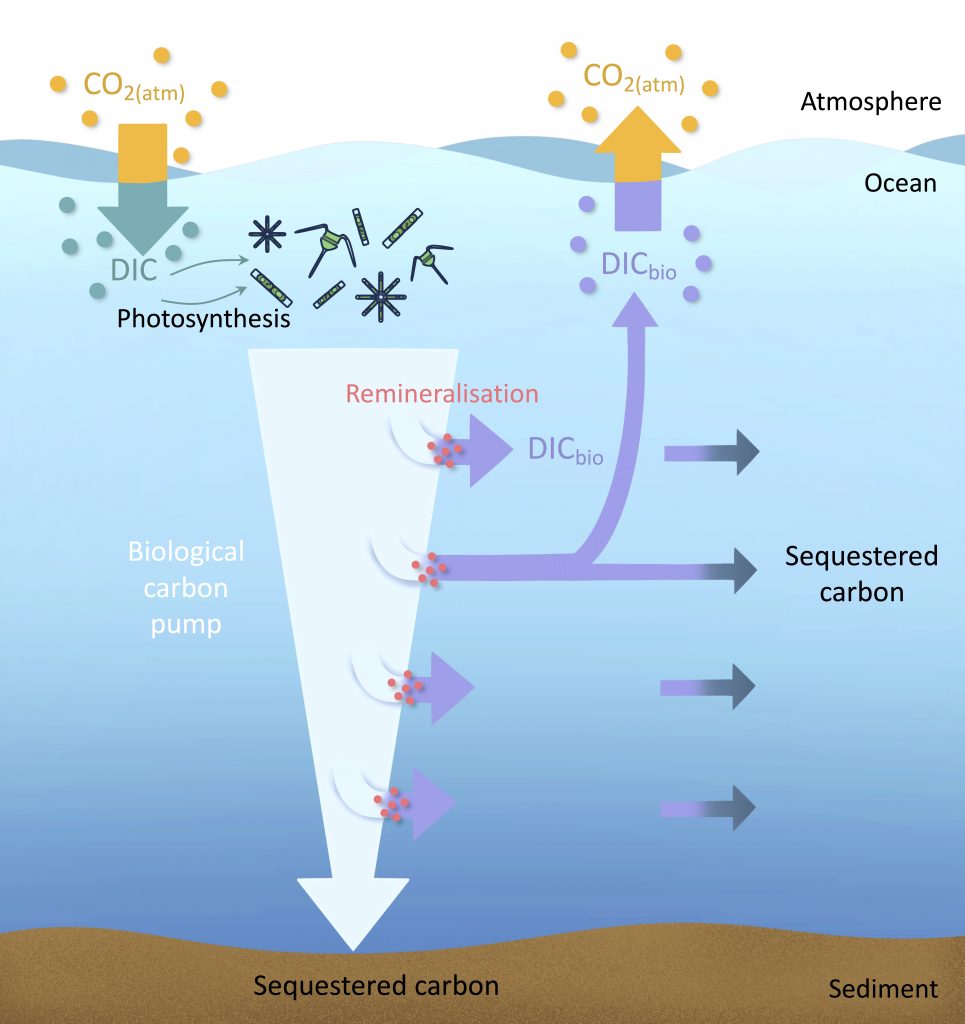
The ocean is the most important sink of anthropogenic emissions and is being considered as a medium to manipulate to draw down even more. Essential in the ocean’s role as a natural carbon-sponge is the net production of organic matter by phytoplankton, some of which sinks and is stored for 100s-1000s of years. Successfully simulating this biological carbon pump is essential for projecting any climate scenario, but it appears that massive uncertainties in the way zooplankton consume phytoplankton are compromising predictions of future climate and our assessment of some strategies to deliberately engineer it.

Figure caption. Grazing pressure is largest source of uncertainty for marine carbon cycling in CMIP6 models a) The global and zonal median winter grazing pressure is shown for all models. b) the coefficient of variation across models (std/mean) is largest for grazing pressure compared 14 major terms in the marine carbon cycle.
A new publication in Communications Earth and Environment explains how our poor understanding of zooplankton biases our best projections of marine carbon sequestration. We compared 11 IPCC climate models and found zooplankton grazing is largest source uncertainty in marine carbon cycling. This uncertainty is over three times larger than that of net primary production and is driven by large differences in different models assumptions about the rate at which zooplankton can consume phytoplankton. Yet, very small changes in zooplankton grazing dynamics (roughly only 5% of the full range used across IPCC models) can increase carbon sequestrations by 2 PgC/yr, which is double the maximum theoretical potential of Southern Ocean Iron Fertilization! Moving forward, to move beyond merely treating zooplankton as a closure term, modelers must look towards novel observational constraints on grazing pressure.
Authors
Tyler Rohr, Anthony J. Richardson, Andrew Lenton, Matthew A. Chamberlain, and Elizabeth H. Shadwick
See also the Conversation article
Despite the importance of particulate organic carbon (POC) export on carbon sequestration and marine ecology, there have been few multi-decade studies in the world’s oceans. A new analysis published in Nature analyzed two decades of POC export data in the West Antarctic Peninsula and found that export oscillates on a 5-year cycle.

Figure caption: A) Particulate organic carbon (POC) export oscillates on a 5-year timescale in sync with the oscillation in the body size of the krill Euphausia superba on the West Antarctic Peninsula. B) POC export is significantly correlated with krill body size (p = 0.01).
Using a unique combination of krill data from penguin diet samples and net tows over two decades, Trinh et al. found that the cycle of POC export is intimately tied to the Antarctic krill (Euphausia superba) life cycle, as the bulk of the POC in their sediment traps was krill fecal pellets. Surprisingly, more krill did not lead to more POC export. Instead, when the krill population size was smaller but dominated by larger, older adults, POC export increased.
E. superba is the longest-lived (5-6 years) and largest krill species. They exhibit continuous annual growth throughout their life cycle. After about five years a krill population reaches its end stage and the population size is at a minimum. This end-stage population is composed of large, 50-60 mm long individuals that produce large, fast-sinking fecal pellets, leading to increased POC export. Increasing temperatures and deterioration of sea ice cover during the winter season due to climate change will likely impact the recruitment of new cohorts of krill and their success in replenishing aging populations. It is unclear how changes in the krill population and life cycle will impact long-term carbon sequestration on the West Antarctic Peninsula and nutrients exported to the benthic ecosystem
Authors:
Rebecca Trinh (Lamont Doherty Earth Observatory, Columbia University)
Hugh Ducklow (Lamont Doherty Earth Observatory, Columbia University)
Deborah Steinberg (Virginia Institute of Marine Science, College of William and Mary)
William Fraser (Polar Oceans Research Group)
Pathways Connecting Climate Changes to the Deep Ocean: Tracing physical, biogeochemical, and ecological signals from the surface to the deep sea (OCB/US CLIVAR joint workshop)
April 23-25, 2024 (University of Delaware, Virden Center)
This workshop will bring together observational oceanographers and modelers across physical, biogeochemical, and ecological communities to assess our understanding of pathways connecting the surface to the seafloor and to develop recommendations for improved detection and attribution of change in the global deep ocean system.
Workshop goals:
The workshop welcomes the participation of scientists from fields across the ocean observing and modeling communities, spanning physics, biogeochemistry, and ecology. We welcome insights from highly localized to global-scale studies as well as efforts focused on individual disciplines, but we strongly encourage all participants to consider how their work can increase opportunities for other disciplines/communities to have a collective impact.
We also encourage participation from relevant oceanographic networks and observing campaigns (e.g., Deep Argo, BGC Argo, GO-SHIP (Global Ocean Shipboard Hydrographic Investigations Program) and Bio-GO-SHIP, JETZON (Joint Exploration of the Twilight Zone Ocean Network), ECCO and ECCO-Darwin (Estimating the Circulation and Climate of the Ocean), DOSI (Deep Ocean Stewardship Initiative), Challenger-150, PICES (North Pacific Marine Science Organization) to ensure broad disciplinary representation and connectivity to established programs.
Scientific Organizing Committee
Xinfeng Liang (Univ. Delaware), Monique Messié (MBARI), Leslie Smith (Your Ocean Consulting LLC, DOOS), Isabela Le Bras (WHOI), Patrick Heimbach (Univ. Texas, Austin), Helen Pillar (Univ. Texas, Austin), Zachary Erickson (NOAA/PMEL), Charlie Stock (NOAA/GFDL)
OVERVIEW: Sustained ocean time series measurements are fundamental to distinguish between natural and human-induced variability in ecosystems and processes required to advance ecological forecasting. The last international ship-based ocean time series workshop, held in November 2012 (Bermuda), focused on recommendations to improve data comparability. Over the past decade (see Fig.) the ocean observing community has contributed to numerous efforts and activities in support of building a global network of ocean time series with the aims of:

This workshop on FAIR Data Practices for Ship-based Ocean Time Series will bring together globally distributed ship-based ocean time series representatives who are interested and committed to FAIR data practices with data managers and experts in semantic web technologies with the following objectives:
Get Involved in OCB Benthic Ecosystem & Carbon Synthesis!
The OCB Benthic Ecosystem and Carbon Synthesis (BECS) Working Group is aimed at understanding the carbon cycle and ecosystems within the land-to-ocean aquatic continuum by improving our understanding of related benthic processes and their representation in ocean and climate models.
The BECS working group is seeking
1) 15 new members - nominate or apply by October 6
2) Give input to guide the working group's activities and focus by October 6
3) Call for speakers for webinar series (ongoing)
Find details on the working group webpage.
These easy-to-use models are for the calculation of:
• Acid-base equilibria, seawater state parameters, and CaCO3 saturation in natural waters containing the ions of seawater
• Inorganic complexation of trace metals Al, Cd, Co, Cu(II), Fe(II), Fe(III), Mn, Ni, Pb and Zn
in natural waters
The natural waters of the world do not just consist of seawater of varying salinity. It is important to be able to estimate the influence of changing natural water composition on equilibria and to understand the effects of anthropogenic change in a range of environments. These models help us to do that.
Please visit marchemspec.org for more information about MarChemSpec, our published papers, and for software downloads.
Watch recorded lectures on the MarChemSpec YouTube playlist.
Copyright © 2026 - OCB Project Office, Woods Hole Oceanographic Institution, 266 Woods Hole Rd, MS #25, Woods Hole, MA 02543 USA Phone: 508-289-2838 • Fax: 508-457-2193 • Email: ocb_news@us-ocb.org
Funding for the Ocean Carbon & Biogeochemistry Project Office is provided by the National Science Foundation (NSF) and the National Aeronautics and Space Administration (NASA). The OCB Project Office is housed at the Woods Hole Oceanographic Institution.