OceanCarbon&Biogeochemistry
Studyingmarineecosystemsandbiogeochemicalcyclesinthefaceofenvironmentalchange
  • Home
  • About OCB
    • About Us
    • Scientific Breadth
      • Biological Pump
      • Changing Marine Ecosystems
      • Changing Ocean Chemistry
      • Estuarine and Coastal Carbon Fluxes
      • Ocean Carbon Uptake and Storage
      • Ocean Observatories
    • Code of Conduct
    • Get Involved
    • Project Office
    • Scientific Steering Committee
    • OCB committees
      • OCSIF – Ocean Carbonate System Intercomparison
      • Ocean-Atmosphere Interaction
      • Ocean Time-series
      • US Biogeochemical-Argo
  • Activities
    • Summer Workshop
    • OCB Webinars
    • Guidelines for OCB Workshops & Activities
    • Topical Workshops
      • CMIP6 Models Workshop
      • Coastal BGS Obs with Fisheries
      • C-saw extreme events workshop
      • Expansion of BGC-Argo and Profiling Floats
      • Fish, fisheries and carbon
      • Future BioGeoSCAPES program
      • GO-BCG Scoping Workshop
      • Lateral Carbon Flux in Tidal Wetlands
      • Leaky Deltas Workshop – Spring 2025
      • Marine CDR Workshop
      • Ocean Nucleic Acids ‘Omics
      • Pathways Connecting Climate Changes to the Deep Ocean
    • Small Group Activities
      • Aquatic Continuum OCB-NACP Focus Group
      • Arctic-COLORS Data Synthesis
      • BECS Benthic Ecosystem and Carbon Synthesis WG
      • Carbon Isotopes in the Ocean Workshop
      • CMIP6 WG
      • Filling the gaps air–sea carbon fluxes WG
      • Fish Carbon WG
      • Metabarcoding intercal WG
      • Meta-eukomics WG
      • mCDR
      • Metaproteomic Intercomparison
      • Mixotrophs & Mixotrophy WG
      • N-Fixation WG
      • Ocean Carbonate System Intercomparison Forum
      • Ocean Carbon Uptake WG
      • OOI BGC sensor WG
      • Operational Phytoplankton Observations WG
      • Phytoplankton Taxonomy WG
      • SedMIP
    • Other Workshops
    • Science Planning
      • Coastal CARbon Synthesis (CCARS)
      • North Atlantic-Arctic
    • Ocean Acidification PI Meetings
    • Training Activities
      • PACE Hackweek 2025
      • PACE Hackweek 2024
      • PACE Training Activity 2022
  • Science Support
    • OCB Activity Proposal Solicitation
    • Guidelines for OCB Workshops & Activities
    • Data management and archival
    • Early Career
    • Funding Sources
    • Jobs & Postdocs
    • Meeting List
    • OCB Topical Websites
      • Ocean Fertilization
      • Trace gases
      • US IIOE-2
    • Outreach & Education
    • Promoting your science
    • Student Opportunities
    • Travel Support
  • Publications
    • OCB Workshop Reports
    • Science Planning and Policy
    • Newsletter Archive
  • Science Highlights
  • News

Archive for ocean carbon uptake and storage – Page 9

Ocean’s heat cycle shows that atmospheric carbon may be headed elsewhere

Posted by hbenway 
· Thursday, August 16th, 2018 

Studies over the past 25 years have supported the existence of a large net land biosphere CO2 sink of 0.5–2 PgC yr-1. Significant uncertainties remain, however, regarding the long-term partitioning between northern, tropical, and southern land sinks, in part connected to the uncertain ocean carbon sink. These uncertainties limit our capacity to predict earth system response to anthropogenic changes and design effective mitigation strategies.

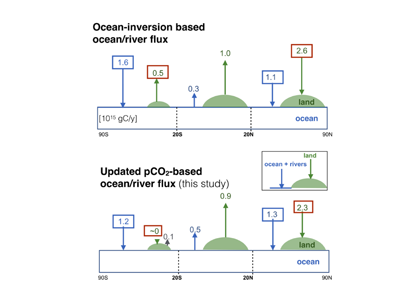
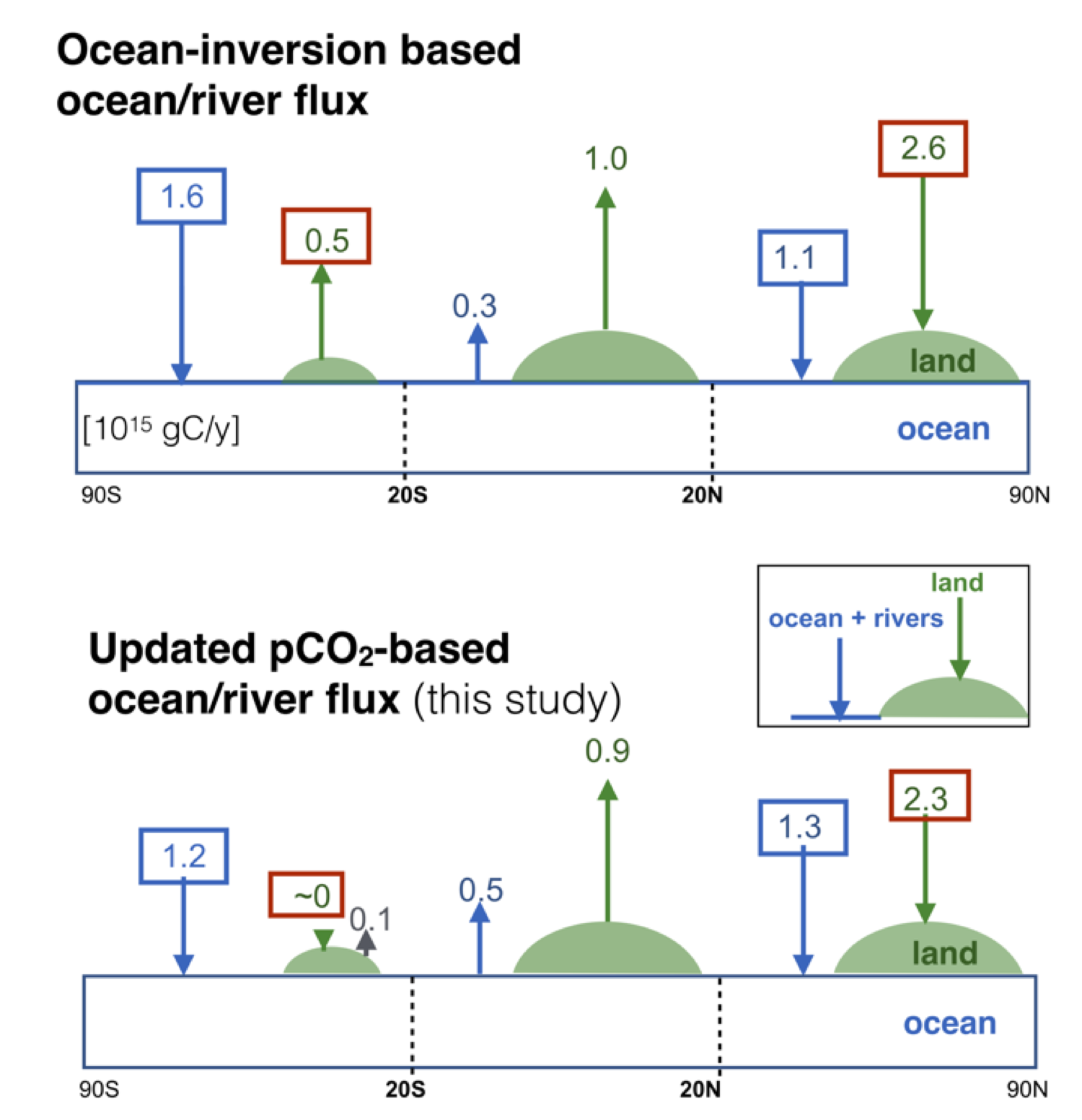
Land sinks from atmospheric inversion (1990-2010 average) with two different ocean/river fluxes: (top) previous ocean inversion-based carbon fluxes; and (bottom) updated pCO2-based air-sea flux with a scaled-up river flux of 0.78 PgC /yr.

In a recent study published in Nature Geoscience, Resplandy et al. (2018) used models and field observations to demonstrate that the world’s oceans transport heat between the northern and southern hemispheres in the same way that carbon is transported. The transport of heat, however, is easier to observe. By tracking this heat, they showed that the Southern Ocean — while still a substantial carbon sink —may not take up as much carbon as previously thought, and that ocean currents might transport 20 to 100% more carbon from the northern to the southern hemisphere. To maintain this additional transport of carbon, they showed that the amount of carbon entering the ocean from rivers may be as much as 70% higher than estimated in previous global carbon budget studies. These changes in the ocean and river carbon transport imply that up to 40% of the world’s atmospheric carbon absorbed by land ecosystems needs to be reallocated from existing estimates.

Authors
L. Resplandy, Princeton University
Ralph Keeling, Scripps Institution of Oceanography/ UCSD
Christian Rödenbeck, Max Planck Institute
Briton Stephens, NCAR
Matthew Long, NCAR
Samar Khatiwala, University of Oxford
Keith Rodgers, Princeton University
Laurent Bopp, ENS Paris
Pieter Tans, NOAA’s ESRL

Shelf-wide pCO2 increase across the South Atlantic Bight

Posted by mmaheigan 
· Thursday, August 2nd, 2018 

Relative to their surface area, coastal regions represent some of the largest carbon fluxes in the global ocean, driven by numerous physical, chemical and biological processes. Coastal systems also experience human impacts that affect carbon cycling, which has large socioeconomic implications. The highly dynamic nature of these systems necessitates observing approaches and numerical methods that can both capture high-frequency variability and delineate long-term trends.

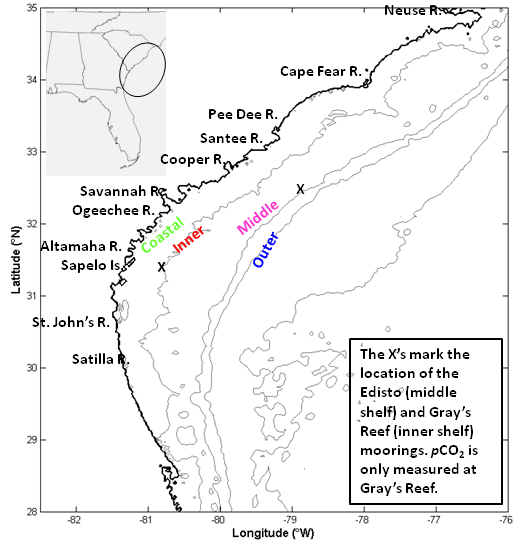
Figure 1: The South Atlantic Bight (SAB) was divided into four sections using isobaths: the coastal zone (0 to 15 m), the inner shelf (15 to 30 m), the middle shelf (30 to 60 m), and the outer shelf (60 m and beyond). The X’s indicate the locations of the Gray’s Reef mooring (southern X) and the Edisto mooring (northern X).

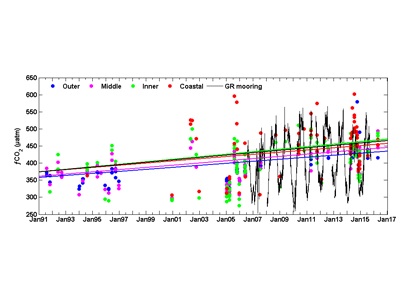
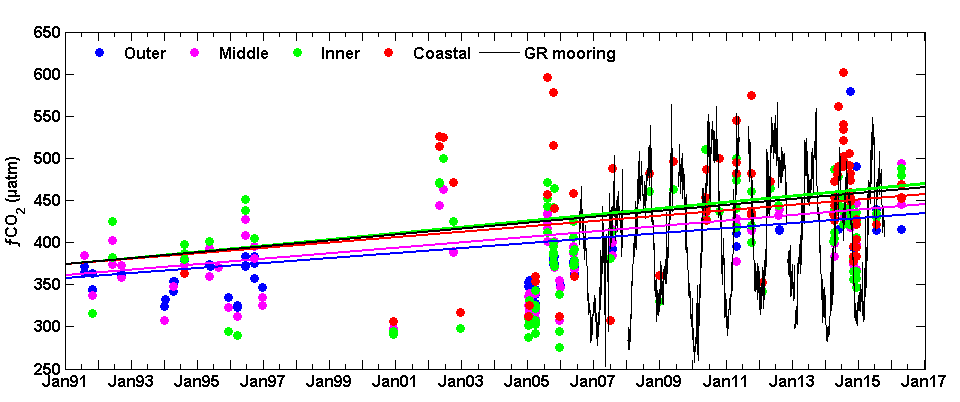
In two recent studies using mooring- and ship-based ocean CO2 system data, authors observed that pCO2 is increasing from the coastal zone to the outer shelf of the South Atlantic Bight at rates greater than the global average oceanic and atmospheric increase (~1.8 µatm y-1). In recent publications in Continental Shelf Research and JGR-Oceans, the authors analyzed pCO2 data from 46 cruises (1991-2016) using a novel linear regression technique to remove the seasonal signal, revealing an increase in pCO2 of 3.0-3.7 µatm y-1 on the outer and inner shelf, respectively. Using a Generalized Additive Mixed Model (GAMM) approach for trend analysis, authors observed that the rates of increase were slightly higher than the deseasonalization technique, yielding pCO2 increases of 3.3 to 4.5 µatm y-1 on the outer and inner shelf, respectively. The reported pCO2 increases result in potential pH decreases of -0.003 to -0.004 units y-1.

Figure 2: The time series of fCO2 in the four regions of the SAB (cruise observations) and from the Gray’s Reef mooring on the inner shelf indicate an increase across the shelf. These data are the observed values, however, the trend lines for each time series are calculated using deseasonalized values using the reference year method.

Analysis of the pCO2 time-series from the Gray’s Reef mooring (using a NOAA Moored Autonomous pCO2 system from July 2006 -July 2015) yielded a rate of increase (3.5 ± 0.9 µatm y-1) that was comparable to the cruise data on the inner shelf (3.7 ± 2.2 and 4.5 ± 0.6 µatm y-1, linear and GAMM methods, respectively). Validation data collected at the mooring suggest that underway data from cruises and the moored data are comparable. Neither thermal processes nor atmospheric dissolution (the primary driver of oceanic acidification) can explain the observed pCO2 increase and concurrent pH decrease across the shelf. Unlike the middle and outer shelves, where an increase in SST could account for up to 1.1 µatm y-1 of the observed pCO2 trend, there is no thermal influence in the coastal zone and inner shelf. While 1.8 µatm y-1 could be attributed to the global average atmospheric increase, the remainder is likely due to transport from coastal marshes and in situ biological processes.  As the authors have shown, the increasing coastal and oceanic trend in pCO2 can lead to a decrease in pH, especially if there is no increase in buffering capacity.  More acidic waters can have a long term affect on coastal ecosystem services and biota.

Also see Eos Editor’s Vox on this research by Peter Brewer https://eos.org/editors-vox/coastal-ocean-warming-adds-to-co2-burden

Authors:

Multidecadal fCO2 Increase Along the United States Southeast Coastal Margin (JGR-Oceans)
Janet J. Reimer (University of Delaware)
Hongjie Wang (Texas A &M University – Corpus Christi)
Rodrigo Vargas (University of Delaware)
Wei-Jun Cai (University of Delaware)

And

Time series pCO2 at a coastal mooring: Internal consistency, seasonal cycles, and interannual variability (Continental Shelf Research)
Janet J. Reimer (University of Delaware)
Wei-Jun Cai (University of Delaware; University of Georgia)
Liang Xue (University of Delaware; First Institute of Oceanography, China)
Rodrigo Vargas (University of Delaware)
Scott Noakes (University of Georgia)
Xinping Hu (Texas A &M University – Corpus Christi)
Sergio R. Signorini (Science Applications International Corporation)
Jeremy T. Mathis (NOAA Arctic Research Program)
Richard A. Feely (NOAA Pacific Marine Environmental Laboratory)
Adrienne J. Sutton (NOAA Pacific Marine Environmental Laboratory; University of Washington)
Christopher Sabine (University of Hawaii Manoa)
Sylvia Musielewicz (NOAA Pacific Marine Environmental Laboratory; University of Washington)
Baoshan Chen (University of Delaware; University of Georgia)
Rik Wanninkhof (NOAA Atlantic Oceanographic and Meteorological Laboratory)

Marine Snowfall at the Equator

Posted by mmaheigan 
· Thursday, July 19th, 2018 

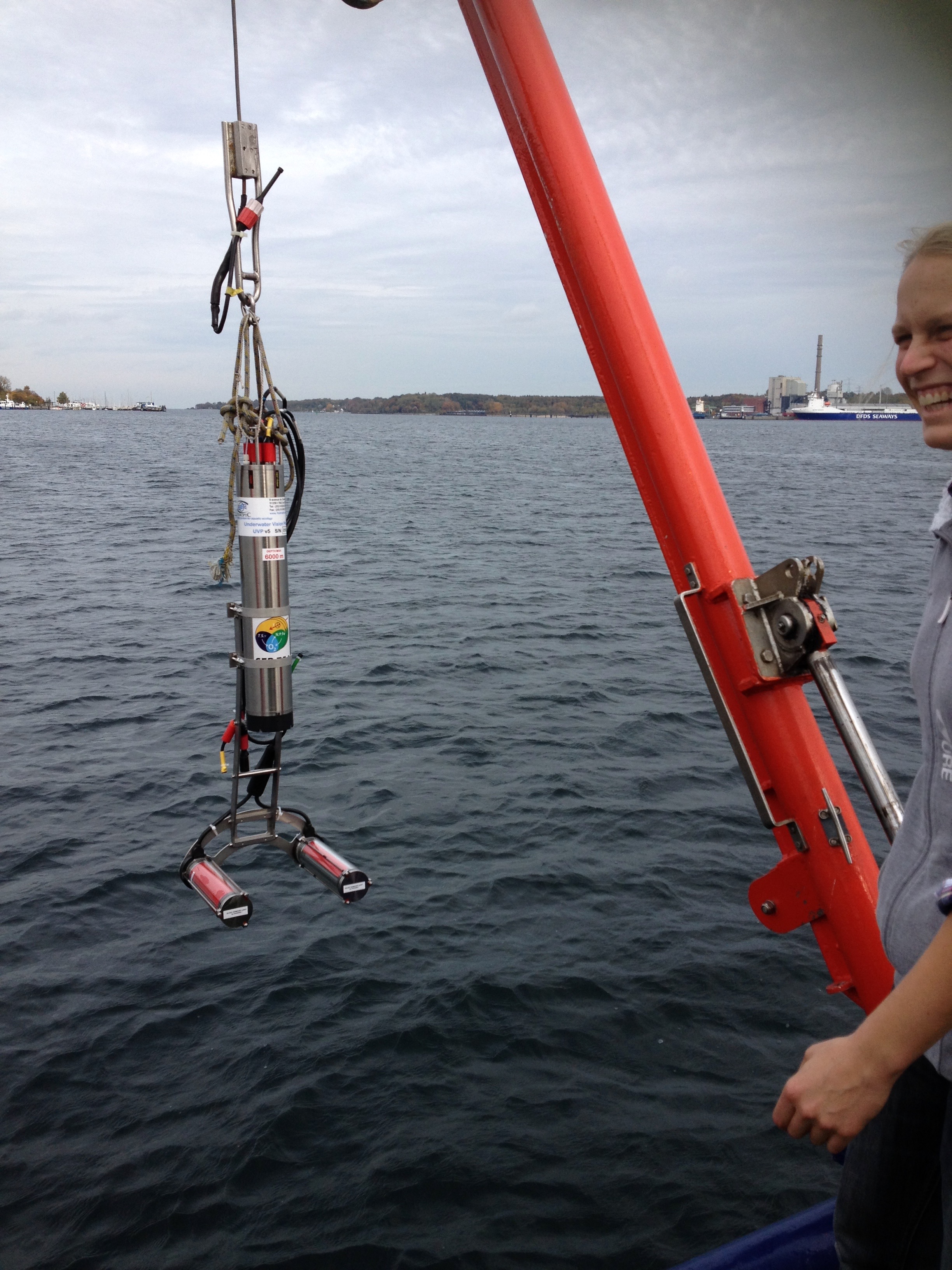
The continual flow of organic particles such as dead organisms and fecal material towards the deep sea is called “marine snow,” and it plays an important role in the ocean carbon cycle and climate-related processes. This snowfall is most intense where high primary production can be observed near the surface. This is the case along the equator in the Pacific and Atlantic Oceans. However, it is not well known how particles are distributed at depth and which processes influence this distribution. A recent study published in Nature Geoscience involved the use of high-resolution particle density data using the Underwater Vision Profiler (UVP) from the equatorial Atlantic and Pacific Oceans down to a depth of 5,000 meters, revealing that several previously accepted ideas on the downward flux of particles into the deep sea should be revisited.

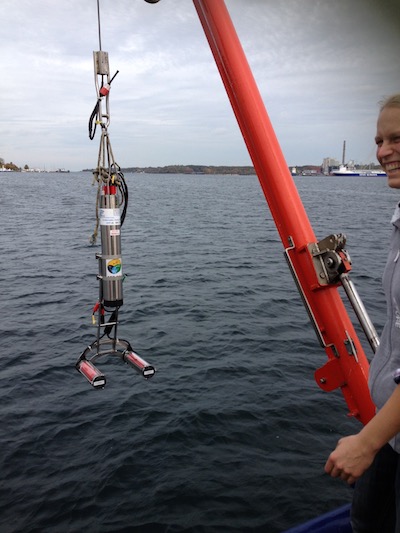
Figure 1. The Underwater Vision Profiler (UVP) during a trial in the Kiel Fjord. The UVP provided crucial data for the new study. Photo: Rainer Kiko, GEOMAR


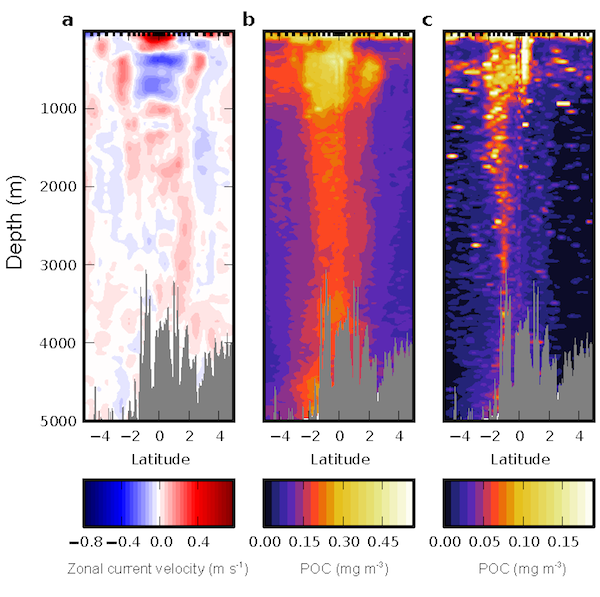
It is typically assumed that the largest particle density can be found close to the surface and that density attenuates continuously with depth. However, high-resolution particle data show that density increases again in the 300-600-meter depth range. The authors attribute this observation to the daily migratory behavior of organisms such as zooplankton that retreat to these depths during the day, contributing to the particle load via defecation and mortality.

Another surprising result is the observation of many small particles below 1,000 meters depth that contribute a large fraction of the bathypelagic particle flux. This observation counters the general assumption, especially in many biogeochemical models, that particle flux at depth comprises fast sinking particles such as fecal pellets. Diminished remineralization rates of small particles or increased disaggregation of larger particles may contribute to the elevated small particle fluxes at this depth.

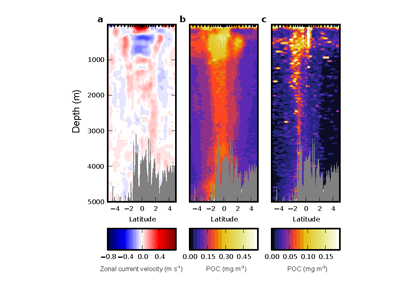
Figure 2. Zonal current velocity and Particulate Organic Carbon (POC) content across the equatorial Atlantic at 23˚W as observed in November 2012. From left to right: Zonal current velocity, POC content in small particle fraction and POC content in large particle fraction (adapted from Kiko et al. 2017).


This study highlights the importance of coupled biological and physical processes in understanding and quantifying the biological carbon pump. Further work on this important topic can now also be submitted to the new Frontiers in Marine Science research topic “Zooplankton and Nekton: Gatekeepers of the Biological Pump” (https://www.frontiersin.org/research-topics/8114/zooplankton-and-nekton-gatekeepers-of-the-biological-pump; Co-editors R. Kiko, M. Iversen, A. Maas, H. Hauss and D. Bianchi). The research topic welcomes a broad range of contributions, from individual-based process studies, to local and global field observations, to modeling approaches to better characterize the role of zooplankton and nekton for the biological pump.


Authors:
R. Kiko (GEOMAR)
A. Biastoch (GEOMAR)
P. Brandt (GEOMAR, University of Kiel)
S. Cravatte (LEGOS, University of Toulouse)
H. Hauss (GEOMAR)
R. Hummels (GEOMAR)
I. Kriest (GEOMAR)
F. Marin (LEGOS, University of Toulouse)
A. M. P. McDonnell (University of Alaska Fairbanks)
A. Oschlies (GEOMAR)
M. Picheral (Laboratoire d’Océanographie de Villefranche-sur-Mer, Observatoire Océanologique)
F. U. Schwarzkopf (GEOMAR)
A. M. Thurnherr (Lamont-Doherty Earth Observatory,)
L. Stemmann (Sorbonne Universités, Observatoire Océanologique)

Unexpected acidification of deep waters in the Sea of Japan due to global warming

Posted by mmaheigan 
· Tuesday, May 22nd, 2018 

Oceans worldwide are warming up, and thermohaline circulation is expected to slow down. At the same time, ocean acidity is increasing due to the influx of anthropogenic carbon dioxide (CO2) from the atmosphere, a phenomenon called ocean acidification that has primarily been documented in shallow waters. In general, deeper waters contain less anthropogenic CO2, but predicted reductions in ventilation of deep waters may impact deep ocean chemistry, as described in a recent study in Nature Climate Change.

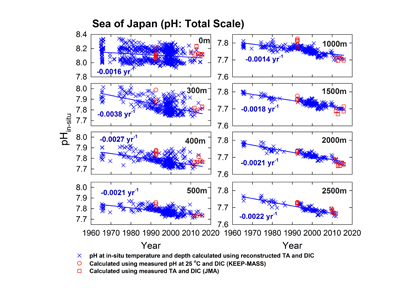
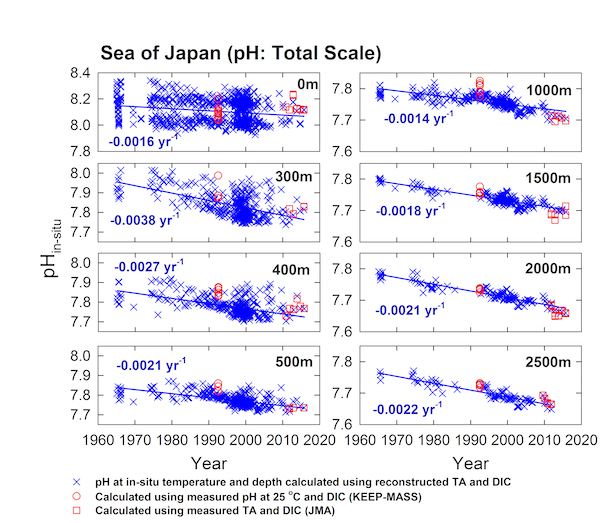
Figure caption: Secular trend of total scale pH at in-situ temperature and pressure at various depths between 1965 and 2015 in the Sea of Japan.

The Sea of Japan is a marginal sea with its own deep- and bottom-water formation that maintains relatively elevated oxygen levels. However, time-series data from 1965-2015 (the longest time-series available) reveal that oxygen concentrations in these deep waters are declining, indicating a reduction in ventilation that increases their residence time. As organic matter decomposition in these waters continues to accumulate more CO2, the pH decreases. As a result, the acidification rate near the bottom of the Sea of Japan is 27% higher than at the surface. As a miniature ocean with its own deep- and bottom-water formation, the Sea of Japan provides insight into how future warming might alter deep-ocean ventilation and chemistry.


Authors:
Chen-Tung Arthur Chen (National SunYat-sen University, Taiwan and Second Institute of Oceanography, China)
Hon-Kit Lui (National SunYat-sen University and Taiwan Research Institute)
Chia-Han Hsieh (National SunYat-sen University, Taiwan)
Tetsuo Yanagi (International Environmental Management of Enclosed Coastal Seas Center, Japan)
Naohiro Kosugi (Japan Meterological Agency)
Masao Ishii (Japan Meterological Agency)
Gwo-Ching Gong (National Taiwan Ocean University)

Sensitivity of future ocean acidification to carbon-climate feedbacks

Posted by mmaheigan 
· Thursday, May 10th, 2018 

There are vast unknowns about the future oceans, from what species or habitats may be most under threat to the continuity of earth system processes that maintain global climate. Modeling can be used to predict future states and explore the impacts of climate change, but several key uncertainties such as carbon-climate feedbacks hamper our predictive power.

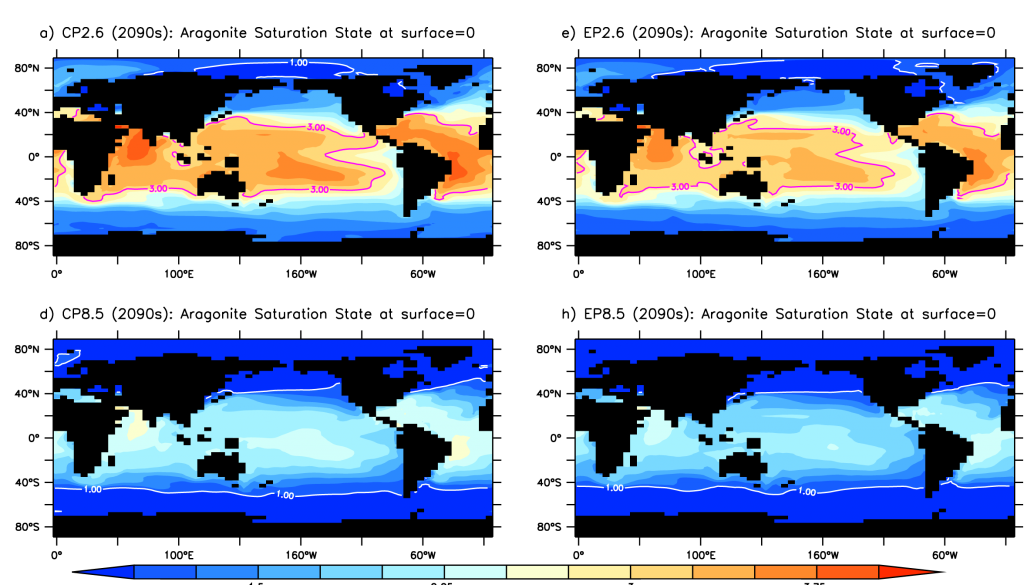
Authors of a recent study in Biogeosciences (Matear and Lenton 2018) used a global earth system model to explore the effects of carbon-climate feedbacks on future ocean acidification. Ocean acidification can have wide-ranging impacts on keystone species from reef-building corals to pteropods, a major food web species in the Southern Ocean. The study included four representative scenarios (from IPCC) comparing concentration pathway simulations to emission pathway simulations (RCP2.6, RCP 4.5, RCP6, RCP8.5) to determine carbon-climate feedbacks. The high emission scenarios (RCP8.5 and RCP6) showed surface water undersaturation a decade or more earlier than expected. Surprisingly, the medium (RCP4.5) scenario carbon-climate feedbacks showed the greatest acidification response, doubling the extent of undersaturation and subsequently halving the area that could sustain coral reefs by 2100. The low emissions scenario also showed significant declines in saturation state.

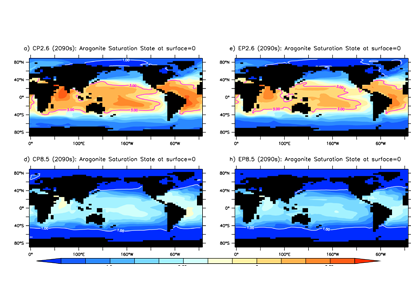
Surface ocean aragonite saturation state for the 2090s for RCP2.6 and RCP 8.5 concentration and emission pathways. The contour line delineates a saturation state of 3 (coral reef threshold), the white line a saturation state of 1, when aragonite becomes unstable and corals dissolve.

The extra atmospheric CO2 from the carbon-climate feedback resulted in accelerated ocean acidification in all emission scenarios. These feedbacks may also affect global warming and deoxygenation. This is particularly important, given that many policymakers are aiming for low emission commitments, but may still be severely underestimating the extent and timing of ocean acidification. There is a great need to improve our ability to predict carbon-climate feedbacks so we do not underestimate projected ocean acidification and its impacts on both sensitive ecosystems and the human communities that rely on them for food, coastal protection and other ecosystem services.

Authors:
Richard Matear (CSIRO Oceans and Atmosphere, Australia)
Andrew Lenton (Antarctic Climate and Ecosystems CRC, Australia)

Feedbacks mitigate the impacts of atmospheric nitrogen deposition in the western North Atlantic

Posted by mmaheigan 
· Thursday, April 12th, 2018 

How do phytoplankton respond to atmospheric nitrogen deposition in the western North Atlantic, an area downwind of large agricultural and industrial centers? The biogeochemical impacts of this ‘fertilization’ remain unclear, as direct oceanic observations of atmospheric deposition are limited and models often cannot resolve the important processes.

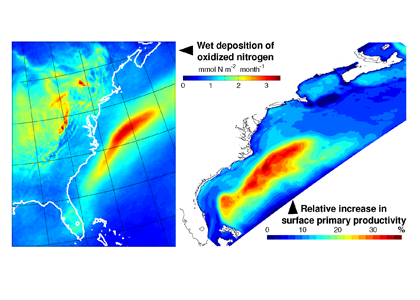
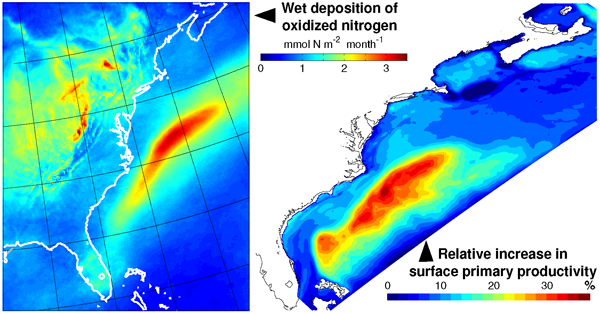
In a recent study, St-Laurent et al. (2017) simulated the biogeochemical impacts of nitrogen deposition on surface waters of the western North Atlantic by combining year-specific deposition rates from the Community Multiscale Air Quality (CMAQ) model and a realistic 3-D biogeochemical model of the waters off the US east coast. Westerly winds from the continent and large fluxes of heat and moisture over the Gulf Stream produce a ‘hotspot’ of wet nitrogen deposition along the path of the current. This nitrogen input increases the local surface primary productivity by up to 30% during the summer. However, the study also identified important processes that mitigate the impact of atmospheric nitrogen deposition in other seasons and regions. Deposition weakens vertical nitrogen gradients in the upper 20 m and thus decreases the upward transport of nitrogen to the surface layer (a negative feedback). Increases in surface phytoplankton concentrations also negatively impact light availability below the surface through shelf-shading.

Atmospheric nitrogen deposition along the US east coast. (Left) Wet deposition of oxidized nitrogen over the Gulf Stream as simulated by the Community Multiscale Air Quality model (average 2004-2008). (Right) Increase in summer surface primary productivity in response to the deposition (average 2004-2008).

These results indicate that atmospheric nitrogen deposition has important impacts on the surface biogeochemistry of the western North Atlantic but that the response is not simply proportional to the deposition. Additional research is necessary to clarify the role played by atmospheric deposition in this region in past and future centuries. While inputs of atmospheric nitrogen associated with power plants and industries have decreased since the passage of the Clean Air Act, recent studies have revealed increasing atmospheric concentrations of reduced nitrogen. Continued coordination between modeling and observing efforts (both on land and over the ocean) are needed to improve our understanding of the impacts of deposition on the biological pump in this region of the Atlantic ocean.


Authors:
Pierre St-Laurent (VIMS, College of William and Mary)
Marjorie A.M. Friedrichs (VIMS, College of William and Mary)
Raymond G. Najjar (Pennsylvania State University)
Doug Martins (FLIR Systems Inc.)
Maria Herrmann (Pennsylvania State University)
Sonya K. Miller (Pennsylvania State University)
John Wilkin (Rutgers University)

Volcanic carbon dioxide drove ancient global warming event

Posted by mmaheigan 
· Thursday, March 29th, 2018 

A study recently published in Nature suggests that an extreme global warming event 56 million years ago known as the Palaeocene-Eocene Thermal Maximum (PETM) was driven by massive CO2 emissions from volcanoes during the formation of the North Atlantic Ocean. Using a combination of new geochemical measurements and novel global climate modelling, the study revealed that atmospheric CO2 more than doubled in less than 25,000 years during the PETM.

The PETM lasted ~150,000 years and is the most rapid and extreme natural global warming event of the last 66 million years. During the PETM, global temperatures increased by at least 5°C, comparable to temperatures projected in the next century and beyond. While it has long been suggested that the PETM event was caused by the injection of carbon into the ocean and atmosphere, the source and total amount of carbon, as well as the underlying mechanism have thus far remained elusive. The PETM roughly coincided with the formation of massive flood basalts resulting from of a series of eruptions that occurred as Greenland and North America started separating from Europe, thereby creating the North Atlantic Ocean. What was missing is evidence linking the volcanic activity to the carbon release and warming that marks the PETM.

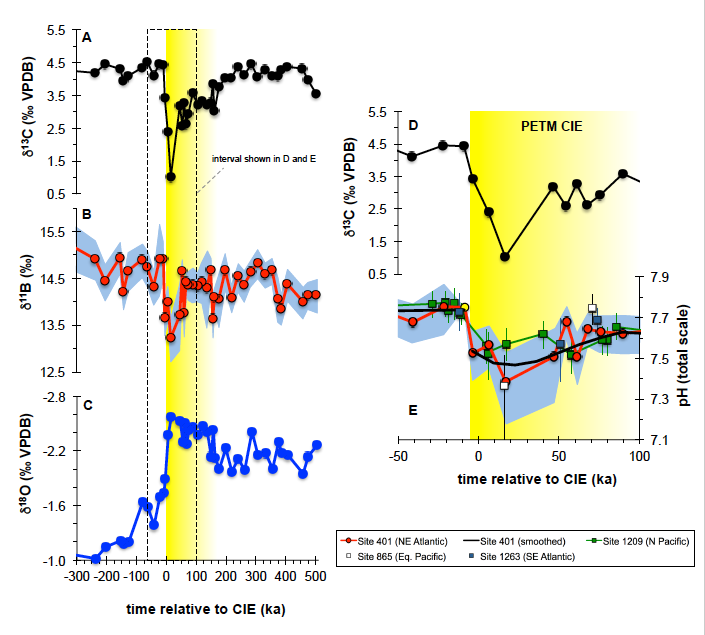
To identify the source of carbon, the authors measured changes in the balance of isotopes of the element boron in ancient sediment-bound marine fossils called foraminifera to generate a new record of ocean pH throughout the PETM. Ocean pH tells us about the amount of carbon absorbed by ancient seawater, but we can get even more information by also considering changes in the isotopes of carbon, which provide information about the carbon source. When forced with these ocean pH and carbon isotope data, a numerical global climate model implicates large-scale volcanism associated with the opening of the North Atlantic as the primary driver of the PETM.


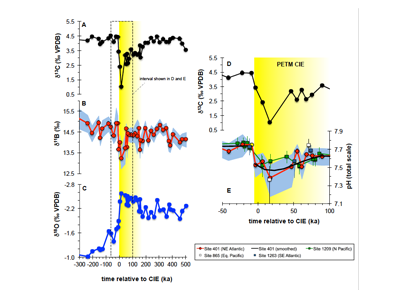
North Atlantic microfossil-derived isotope records from extinct planktonic foraminiferal species M. subbotinae relative to the onset of the PETM carbon isotope excursion (CIE). The negative trend in carbon isotope composition (A) during the carbon emission phase is accompanied by decreasing pH (decreasing δ11B, panel B) and increasing temperature (decreasing δ18O, panel C). Panels D and E zoom in on the PETM CIE, showing microfossil δ13C (D) and δ11B-based pH (E) reconstructions. Also included in E are data from Penman et al. (2014) on their original age model, with recalculated (lab-based) pH values.


These new results suggest that the PETM was associated with a total input of >12,000 petagrams of carbon from a predominantly volcanic source. This is a vast amount of carbon—30 times larger than all of the fossil fuels burned to date and equivalent to all current conventional and unconventional fossil fuel reserves. In the following Earth System Model simulations, it resulted in the concentration of atmospheric CO2 increasing from ~850 parts per million to >2000 ppm. The Earth’s mantle contains more than enough carbon to explain this dramatic rise, and it would have been released as magma poured from volcanic rifts at the Earth’s surface.

How the ancient Earth system responded to this carbon injection at the PETM can tell us a great deal about how it might respond in the future to man-made climate change. Earth’s warming at the PETM was about what we would expect given the CO2 emitted and what we know about the sensitivity of the climate system based on Intergovernmental Panel on Climate Change (IPCC) reports. However, the rate of carbon addition during the PETM was about twenty times slower than today’s human-made carbon emissions.

In the model outputs, carbon cycle feedbacks such as methane release from gas hydrates—once the favoured explanation of the PETM—did not play a major role in driving the event. Additionally, one unexpected result was that enhanced organic matter burial was important in ultimately drawing down the released carbon out of the atmosphere and ocean and thereby accelerating the recovery of the Earth system.


Authors:
Marcus Gutjahr (National Oceanography Centre Southamption, GEOMAR)
Andy Ridgwell (Bristol University, University of California Riverside)
Philip F. Sexton (The Open University, UK)
Eleni Anagnostou (National Oceanography Centre Southamption)
Paul N. Pearson (Cardiff University)
Heiko Pälike (University of Bremen)
Richard D. Norris (Scripps Institution of Oceanography)
Ellen Thomas (Yale University, Wesleyan University)
Gavin L. Foster (National Oceanography Centre Southamption)


Increased temperatures suggest reduced capacity for carbon

Posted by mmaheigan 
· Thursday, January 18th, 2018 

The ocean’s biological pump works to draw down atmospheric carbon dioxide (CO2) by exporting carbon from the surface ocean. This process is less efficient at higher temperatures, implying a possible climate feedback. Recent work by Cael et al. provides an explanation of why this feedback occurs and an estimate of its severity.

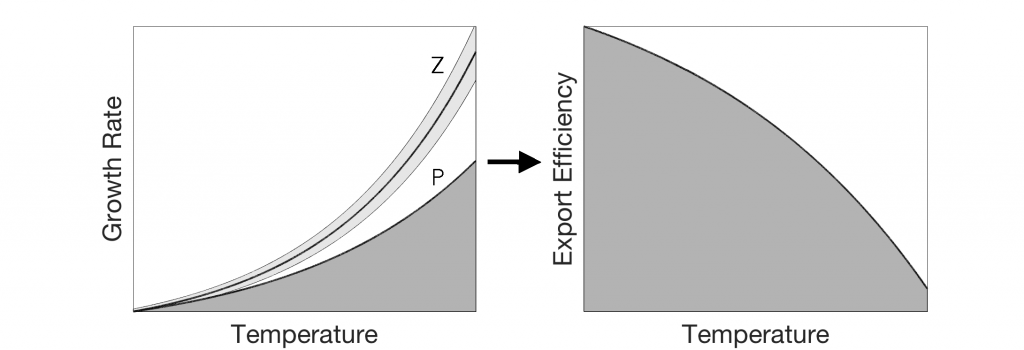
In a highly simplified view, carbon export depends on the balance between two temperature-dependent processes: 1) The autotrophic production and 2) the heterotrophic respiration of organic carbon. Cael and Follows (Geophysical Research Letters 2016) recently developed a mechanistic model based on established temperature dependencies for photosynthesis and respiration to explore feedbacks between export efficiency and climate. Heterotrophic growth rates increase more so than phototrophic rates with increasing temperature, which suggests that at higher temperatures, community respiration will increase relative to production, thereby decreasing export efficiency. Although simplistic, the model captures the temperature dependence of export efficiency observations.

Figure: Schematic of the mechanism on which the Cael and Follows (2016) model is based. (a) Photosynthesis (dark grey) and respiration (light grey) respond to temperature differently, yielding (b) a decline in export efficiency at higher temperatures.

More recently, Cael, Bisson, and Follows (Limnology and Oceanography 2017) applied this model to sea surface temperature records and estimated a ~1.5% decline in globally-averaged export efficiency over the past three decades of increasing ocean temperatures as a result of this metabolic mechanism. This ~1.5% decline is equivalent to a reduced ocean sequestration of approximately 100 million fewer tons of carbon annually, comparable to the annual carbon emissions of the United Kingdom. The model provides a framework in which to consider the relationship between climate and ocean carbon export that might also elucidate large-scale (e.g., glacial-interglacial) atmospheric CO2 changes of the past.

Authors:
B. B. Cael (MIT/WHOI)
Kelsey Bisson (UCSB)
Mick Follows (MIT)

Lasers shed light on giant larvacean filtration impact on the ocean’s biological pump

Posted by mmaheigan 
· Thursday, January 4th, 2018 

To accurately assess the impacts of climate change, we need to understand how atmospheric carbon is transported from surface waters to the deep sea. Grazers and filter feeders drive the ocean’s biological pump as they remove and sequester carbon at various rates. This pump extends down into the midwater realm, the largest habitat on earth. Giant larvaceans are fascinating and enigmatic occupants of the upper 400 m of the water column, where they build complex filtering structures out of mucus that can reach diameters greater than 1 m in longest dimension (Figure 1A). Because of the fragility of these structures, direct measurements of filtration rates require us to study them in situ. We developed DeepPIV, an ROV-deployable instrument (Figure 1B) to directly measure fluid motion and filtration rates in situ (Figure 1C).

Figure 1. (A) Traditional view of a giant larvacean illuminated by white ROV lights. (B) DeepPIV instrument is seen attached to Monterey Bay Aquarium Research Institute’s (MBARI) MiniROV. (C) DeepPIV-illuminated interior view of a giant larvacean house, where particle motion in ambient seawater serves as a proxy for fluid motion. White arrows in (A) and (C) indicate larvacean head/trunk; white arrow in (B) indicates DeepPIV.

The filtration rates we measured for giant larvaceans are far greater than for any other zooplankton filter feeder. When combined with abundance data from a 22-year time series, the grazing impact of giant larvaceans indicates that within 13 days, they can filter the total volume of water within their habitable depth range (~100-300 m; based on maximum abundance and measured filtration rates). Our results reveal that the contribution of giant larvaceans to vertical carbon flux is much greater than previously thought. Small larvaceans, which are present in the water column in even larger quantities than giant larvaceans, may also have a measurable impact on carbon fluxes. New technologies such as DeepPIV are yielding more quantitative observations of midwater filter feeders, which is improving our understanding of the roles that deep-water biota play in the long-term removal of carbon from the atmosphere.

Read the full journal article: http://advances.sciencemag.org/content/3/5/e1602374.full

Authors: (All at MBARI)
Kakani Katija
Rob E. Sherlock
Alana D. Sherman
Bruce H. Robison

Zooplankton play a key and diverse role in the ocean carbon cycle

Posted by mmaheigan 
· Thursday, December 7th, 2017 

How does the enormous diversity of zooplankton species, life cycles, size, feeding ecology, and physiology affect their role in ocean food webs and cycling of carbon?

In the 2017 issue of Annual Review of Marine Science, Steinberg and Landry review the fundamental and multifaceted roles that zooplankton play in the cycling and export of carbon in the ocean. Carbon flows through marine pelagic ecosystems are complex due to the diversity of zooplankton consumers and the many trophic levels they occupy in the food web–from single-celled herbivores to large carnivorous jellyfish. Zooplankton also contribute to carbon export processes through a variety of mechanisms (mucous feeding webs, fecal pellets, molts, carcasses, and vertical migrations).


Figure 1.  Pathways of cycling and export of carbon by zooplankton in the ocean.

Climate change and other stressors are already affecting zooplankton abundance, distribution, and life cycles, and are predicted to result in widespread changes in zooplankton carbon cycling in the future. These changes will affect both the larger marine food web that depends upon zooplankton for food (fish) or recycled products for growth (primary producers) and the amount of carbon exported into the deep sea–where far from contact with the atmosphere it no longer contributes to global warming.


Authors:

Deborah K. Steinberg, Virginia Institute of Marine Science, The College of William and Mary
Michael R. Landry, Scripps Institution of Oceanography

« Previous Page
Next Page »

FilterbyKeyword

abundance acidification additionality advection africa air-sea air-sea interactions algae alkalinity allometry ammonium AMO AMOC anoxic Antarctic Antarctica anthro impacts anthropogenic carbon anthropogenic impacts appendicularia aquaculture aquatic continuum aragonite saturation arctic Argo argon arsenic artificial seawater AT Atlantic atmospheric CO2 atmospheric nitrogen deposition authigenic carbonates autonomous platforms AUVs awb bacteria bathypelagic BATS BCG Argo benthic bgc argo bio-go-ship bio-optical bioavailability biogeochemical cycles biogeochemical models biogeochemistry Biological Essential Ocean Variables biological pump biophysics bloom blue carbon bottom water boundary layer buffer capacity C14 CaCO3 calcification calcite carbon carbon-climate feedback carbon-sulfur coupling carbonate carbonate system carbon budget carbon cycle carbon dioxide carbon export carbon fluxes carbon sequestration carbon storage Caribbean CCA CCS changing marine chemistry changing marine ecosystems changing marine environments changing ocean chemistry chemical oceanographic data chemical speciation chemoautotroph chesapeake bay chl a chlorophyll circulation clouds CO2 CO3 coastal and estuarine coastal darkening coastal ocean cobalt Coccolithophores commercial community composition competition conservation cooling effect copepod copepods coral reefs CTD currents cyclone daily cycles data data access data assimilation database data management data product Data standards DCM dead zone decadal trends decomposers decomposition deep convection deep ocean deep sea coral denitrification dense water deoxygenation depth diatoms DIC diel migration diffusion dimethylsulfide dinoflagellate dinoflagellates discrete measurements distribution DOC DOM domoic acid DOP dust DVM ecology economics ecosystem management ecosystems eddy Education EEZ Ekman transport emissions ENSO enzyme equatorial current equatorial regions ESM estuarine and coastal carbon fluxes estuary euphotic zone eutrophication evolution export export fluxes export production extreme events faecal pellets fecal pellets filter feeders filtration rates fire fish Fish carbon fisheries fishing floats fluid dynamics fluorescence food webs forage fish forams freshening freshwater frontal zone functional role future oceans gelatinous zooplankton gene transfer geochemistry geoengineering geologic time GEOTRACES glaciers gliders global carbon budget global ocean global ocean models global overturning circulation global warming go-ship grazing greenhouse gas greenhouse gases Greenland ground truthing groundwater Gulf of Maine Gulf of Mexico Gulf Stream gyre harmful algal bloom high latitude human food human impact human well-being hurricane hydrogen hydrothermal hypoxia ice age iceberg ice cores ice cover industrial onset inland waters in situ inverse circulation ions iron iron fertilization iron limitation isotopes jellies katabatic winds kelvin waves krill kuroshio lab vs field land land-ocean continuum larvaceans lateral transport LGM lidar ligands light light attenuation lineage lipids low nutrient machine learning mangroves marine carbon cycle marine heatwave marine particles marine snowfall marshes mCDR mechanisms Mediterranean meltwater mesopelagic mesoscale mesoscale processes metagenome metals methane methods microbes microlayer microorganisms microplankton microscale microzooplankton midwater migration minerals mitigation mixed layer mixed layers mixing mixotrophs mixotrophy model modeling model validation mode water molecular diffusion MPT MRV multi-decade N2 n2o NAAMES NCP nearshore net community production net primary productivity new ocean state new technology Niskin bottle nitrate nitrogen nitrogen cycle nitrogen fixation nitrous oxide north atlantic north pacific North Sea NPP nuclear war nutricline nutrient budget nutrient cycles nutrient cycling nutrient limitation nutrients OA observations ocean-atmosphere ocean acidification ocean acidification data ocean alkalinity enhancement ocean carbon uptake and storage ocean color ocean modeling ocean observatories ocean warming ODZ oligotrophic omics OMZ open ocean optics organic particles oscillation outwelling overturning circulation oxygen pacific paleoceanography PAR parameter optimization parasite particle flux particles partnerships pCO2 PDO peat pelagic PETM pH phenology phosphate phosphorus photosynthesis physical processes physiology phytoplankton PIC piezophilic piezotolerant plankton POC polar polar regions policy pollutants precipitation predation predator-prey predators prediction pressure primary productivity Prochlorococcus productivity prokaryotes proteins pteropods pycnocline python radioisotopes remineralization remote sensing repeat hydrography residence time resource management respiration resuspension rivers rocky shore Rossby waves Ross Sea ROV salinity salt marsh satellite scale seafloor seagrass sea ice sea level rise seasonal seasonal effects seasonality seasonal patterns seasonal trends sea spray seawater collection seaweed secchi sediments sensors sequestration shelf ocean shelf system shells ship-based observations shorelines siderophore silica silicate silicon cycle sinking sinking particles size SOCCOM soil carbon solubility pump southern ocean south pacific spatial covariations speciation SST state estimation stoichiometry subduction submesoscale subpolar subtropical sulfate surf surface surface ocean surface waters Synechococcus technology teleconnections temperate temperature temporal covariations thermocline thermodynamics thermohaline thorium tidal time time-series time of emergence titration top predators total alkalinity trace elements trace metals trait-based transfer efficiency transient features trawling Tris trophic transfer tropical turbulence twilight zone upper ocean upper water column upwelling US CLIVAR validation velocity gradient ventilation vertical flux vertical migration vertical transport warming water clarity water column water mass water quality waves weathering western boundary currents wetlands winter mixing zooplankton

Copyright © 2026 - OCB Project Office, Woods Hole Oceanographic Institution, 266 Woods Hole Rd, MS #25, Woods Hole, MA 02543 USA Phone: 508-289-2838  •  Fax: 508-457-2193  •  Email: ocb_news@us-ocb.org

link to nsflink to noaalink to WHOI

Funding for the Ocean Carbon & Biogeochemistry Project Office is provided by the National Science Foundation (NSF) and the National Aeronautics and Space Administration (NASA). The OCB Project Office is housed at the Woods Hole Oceanographic Institution.