Ocean Carbon & Biogeochemistry
Studying marine ecosystems and biogeochemical cycles in the face of environmental change
  • Home
  • About OCB
    • About Us
    • Scientific Breadth
      • Biological Pump
      • Changing Marine Ecosystems
      • Changing Ocean Chemistry
      • Estuarine and Coastal Carbon Fluxes
      • Ocean Carbon Uptake and Storage
      • Ocean Observatories
    • Code of Conduct
    • Get Involved
    • Project Office
    • Scientific Steering Committee
    • OCB committees
      • OCSIF – Ocean Carbonate System Intercomparison
      • Ocean-Atmosphere Interaction
      • Ocean Time-series
      • US Biogeochemical-Argo
  • Activities
    • Summer Workshop
    • OCB Webinars
    • Guidelines for OCB Workshops & Activities
    • Topical Workshops
      • CMIP6 Models Workshop
      • Coastal BGS Obs with Fisheries
      • C-saw extreme events workshop
      • 7th DMS(P) Symposium
      • Expansion of BGC-Argo and Profiling Floats
      • Fish, fisheries and carbon
      • Future BioGeoSCAPES program
      • GO-BCG Scoping Workshop
      • Lateral Carbon Flux in Tidal Wetlands
      • Leaky Deltas Workshop – Spring 2025
      • Marine CDR Workshop
      • Ocean Nucleic Acids ‘Omics
      • Pathways Connecting Climate Changes to the Deep Ocean
    • Small Group Activities
      • Aquatic Continuum OCB-NACP Focus Group
      • Arctic-COLORS Data Synthesis
      • BECS Benthic Ecosystem and Carbon Synthesis WG
      • Carbon Isotopes in the Ocean Workshop
      • CMIP6 WG
      • Filling the gaps air–sea carbon fluxes WG
      • Fish Carbon WG
      • Metabarcoding intercal WG
      • Meta-eukomics WG
      • mCDR
      • Metaproteomic Intercomparison
      • Mixotrophs & Mixotrophy WG
      • N-Fixation WG
      • Ocean Carbonate System Intercomparison Forum
      • Ocean Carbon Uptake WG
      • OOI BGC sensor WG
      • Operational Phytoplankton Observations WG
      • Phytoplankton Taxonomy WG
      • SedMIP
    • Other Workshops
    • Science Planning
      • Coastal CARbon Synthesis (CCARS)
      • North Atlantic-Arctic
    • Ocean Acidification PI Meetings
    • Training Activities
      • PACE Hackweek 2025
      • PACE Hackweek 2024
      • PACE Training Activity 2022
  • Science Support
    • OCB Activity Proposal Solicitation
    • Guidelines for OCB Workshops & Activities
    • Data management and archival
    • Early Career
    • Funding Sources
    • Jobs & Postdocs
    • Meeting List
    • OCB Topical Websites
      • Ocean Fertilization
      • Trace gases
      • US IIOE-2
    • Outreach & Education
    • Promoting your science
    • Student Opportunities
    • Travel Support
  • Publications
    • OCB Workshop Reports
    • Science Planning and Policy
    • Newsletter Archive
  • Science Highlights
  • News

Archive for modeling – Page 5

The Equatorial Undercurrent influences the fate of the Oxygen Minimum Zone in the Pacific

Posted by mmaheigan 
· Tuesday, November 12th, 2019 

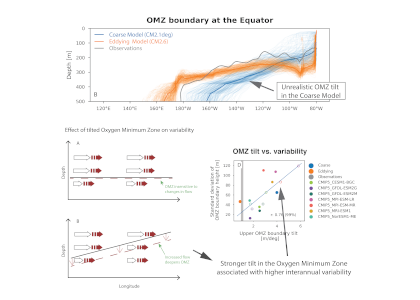
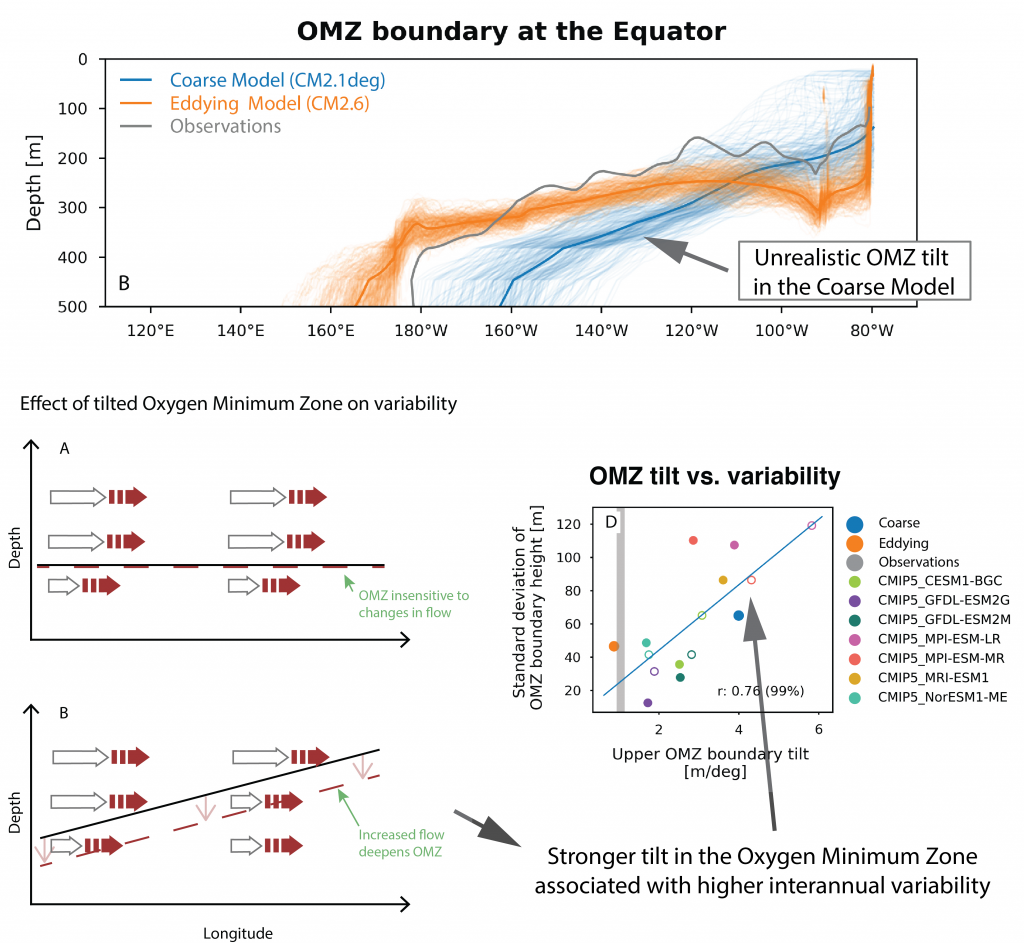
While the ocean as a whole is losing oxygen due to warming, oxygen minimum zones (OMZs) are maintained by a delicate balance of biological and physical processes; it is unclear how each one of them is going to evolve in the future. Changes to OMZs could affect the global uptake of carbon, the generation of greenhouse gases, and interactions among marine life. Current generation coarse-resolution (~1°) climate models compromise the ability to simulate low-oxygen waters and their response to climate change in the future because they fail to reproduce a major ocean current, the Equatorial Undercurrent (EUC). These shortcomings lead to an overly tilted upper oxygen minimum zone (OMZ) (Figure 1), thus exaggerating sensitivity to circulation changes and overwhelming other key processes like diffusion and biology. The EUC also plays a vital role in feeding the eastern Pacific upwelling region, connecting it to global climate variability.

Figure: Top: The boundary of the Oxygen Minimum Zone (OMZ) along the Equator is unrealistically tilted for current generation (coarse resolution) climate models, and improves with increased horizontal resolution. The tilt is due to a bad representation of the Equatorial Undercurrent in the coarse model, also seen in other coarse models. The exaggerated tilt of the OMZ boundary at the Equator leads to increased inter-annual variability of the depth of the upper OMZ boundary, via changes in the zonal flow (left). This phenomenon is found in most CMIP5 models (right) and could be responsible for the current inability to predict the change in OMZ extent for the next century.

A recent high‐resolution climate model study in Geophysical Research Letters significantly improved the representation of both the EUC and OMZ, suggesting that the EUC is a key player in OMZ variability. This study emphasizes the importance of improving transport processes in global circulation models to better simulate oxygen distribution and predict future OMZ extent. The results of this study imply that the fundamental dynamics maintaining this key ocean current could be categorically misrepresented in the current generation of climate models, potentially influencing the ability to predict future climate variability and trends.


Authors:
Julius J.M. Busecke (Princeton University)
Laure Resplandy (Princeton University)
John P. Dunne (NOAA/GFDL)

Pumped up by the cold: Increased elemental density in polar diatoms

Posted by mmaheigan 
· Monday, October 28th, 2019 

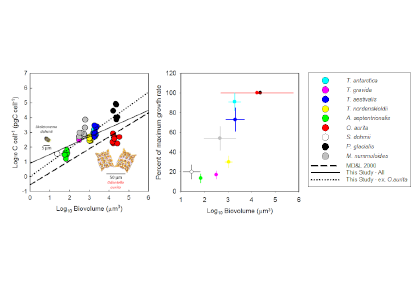
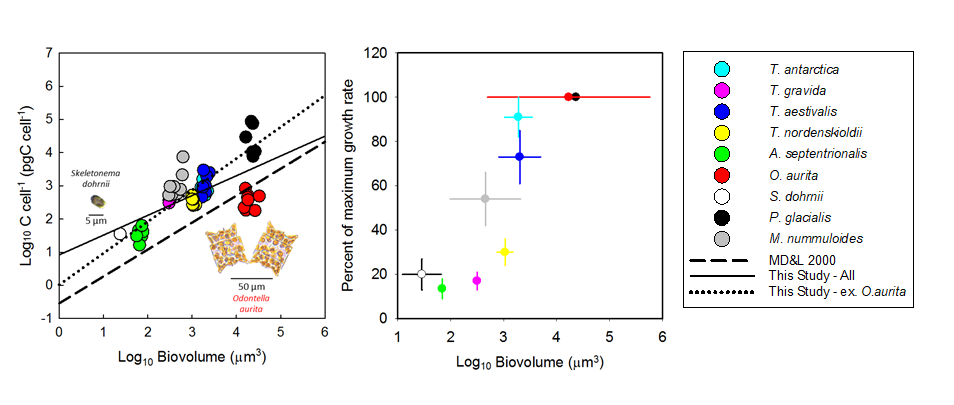
Large diatoms are common in polar phytoplankton blooms, contributing significantly to food webs and carbon export, but relatively little is known about their elemental biogeochemistry. A recent study in Frontiers in Marine Science showed that the size-dependent increase in cell nutrient content for polar diatoms was similar to published values for temperate diatoms, whereas the elemental density (mass per unit volume) of polar diatoms was substantially greater for all elements measured (carbon, nitrogen, silicon and phosphorus). Furthermore, at near freezing culture temperatures, there was a positive relationship between diatom size and realized growth rates near their theoretical maximum (Figure 1). Because of the differences in elemental density between carbon and silica, these diatoms exhibited particulate C:Si ratios that are commonly interpreted as a sign of iron limitation; yet these cultures were trace metal-replete. The observed elemental composition differences suggest that it may be important for polar biogeochemical models to include different representations of diatom biogeochemistry by accounting for the functions of size and near freezing temperature.

Figure 1. Left: Cellular carbon content for polar diatoms across four orders of magnitude in biovolume compared to the same relationship for a wide range of non-polar diatoms (MD&L = Menden-Deuer & Lessard, 2000). The y-intercept is the estimate of the baseline carbon density in these polar diatoms, and is significantly higher than the literature values reviewed in MD&L (2000). Right: Growth rate of the same polar diatoms expressed as a percent of their calculated maximum growth rate at 2°C. Error bars represent the range of values observed in the experiments. Maximum growth rate was estimated by 1) applying the growth rate/biovolume relationships published by Chisholm (1992) and Edwards et al. (2012) to the observed biovolume for each culture, and 2) scaling this growth rate to 2°C growth temperature using the relationship of Eppley (1972).

Authors:
Michael Lomas (Bigelow Laboratory for Ocean Sciences)
Steven Baer (Maine Maritime Academy)
Sydney Acton (Dauphin Island Sea Lab)
Jeffrey Krause (Dauphin Island Sea Lab and University of South Alabama)

A new tidal non-photochemical quenching model reveals obscured variability in coastal chlorophyll fluorescence

Posted by mmaheigan 
· Tuesday, October 15th, 2019 

Although chlorophyll fluorescence is widely-used as a proxy for chlorophyll concentration, sunlight exposure makes fluorescence measurements inaccurate through a process called non-photochemical quenching, limiting its proxy accuracy during daylight hours. In the open ocean, where time and space scales are large relative to variability in phytoplankton concentration, daytime chlorophyll fluorescence—necessary for satellite algorithm validation and for understanding diurnal variability in phytoplankton abundance—can be estimated by averaging across successive nighttime, unquenched values. In coastal waters, where semidiurnal tidal advection drives small scale patchiness and short temporal variability, successive nighttime observations do not accurately represent the intervening daytime. Thus, it is necessary to apply a non-photochemical quenching correction that accounts for the additional effect of tidal advection.

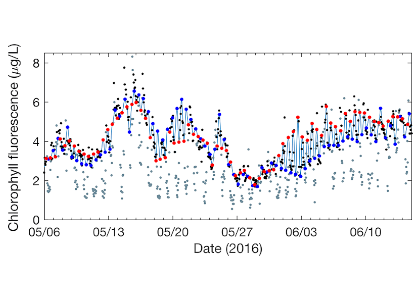
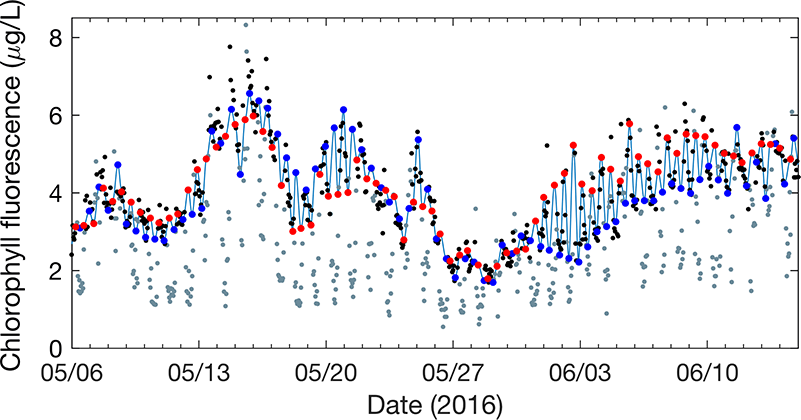
In a recent study in L&O Methods, authors developed a model that uses measurements of tidal velocity to correct daytime chlorophyll fluorescence for non-photochemical quenching and tidal advection. The model identifies high tide and low tide endmember populations of phytoplankton from tidal velocity, and estimates daytime chlorophyll fluorescence as a conservative interpolation between endmember fluorescence at those tidal maxima and minima (Figure 1). Rather than removing nearly 12 hours’ worth of hourly chlorophyll fluorescence observations (i.e., all of the daytime observations) as was previously necessary, this model recovers them. The model output performs more accurately as a proxy for chlorophyll concentration than raw daytime chlorophyll fluorescence measurements by a factor of two, and enables tracking of phytoplankton populations with chlorophyll fluorescence in a Lagrangian sense from Eulerian measurements. Finally, because the model assumes conservation, periods of non-conservative variability are revealed by comparison between model and measurements, helping to elucidate controls on variability in phytoplankton abundance in coastal waters.

Figure 1: Model (light blue line) is a tidal interpolation between high tide (blue points) and low tide (red points) phytoplankton endmembers. The model represents nighttime, unquenched chlorophyll fluorescence measurements well (black points), while daytime, quenched measurements are visibly reduced (gray points).

This result is a critical achievement, as it enables the use of daytime chlorophyll fluorescence, which increases the temporal resolution of coastal chlorophyll fluorescence measurements, and also provides a mechanism for satellite validation of the ocean color chlorophyll data product in coastal waters. The model’s capacity to accurately simulate the pervasive effect of non-photochemical quenching makes it a vital tool for any researcher or coastal water manager measuring chlorophyll fluorescence. This model will help to provide new insights on the movement of and controls on phytoplankton populations across the land-ocean continuum.

Authors:
Luke Carberry (University of California, Santa Barbara)
Collin Roesler (Bowdoin College)
Susan Drapeau (Bowdoin College)


A new roadmap of climate change driven ocean changes

Posted by mmaheigan 
· Wednesday, October 2nd, 2019 

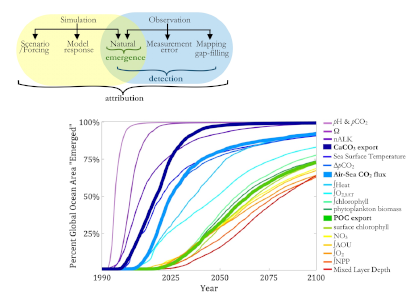
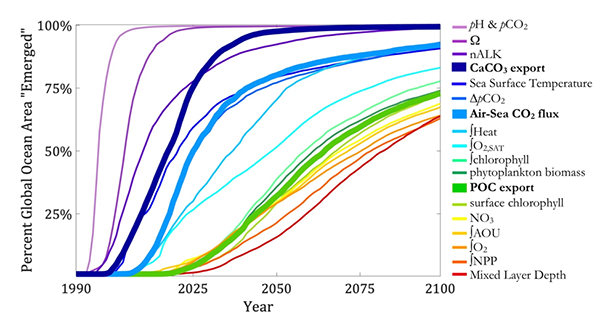
When will we see significant changes in the ocean due to climate change? A new study in Nature Climate Change confirms that outcomes tied directly to the escalation of atmospheric carbon dioxide have already emerged in the existing 30-year observational record. These include sea surface warming, acidification, and increases in the rate at which the ocean removes carbon dioxide from the atmosphere.

In contrast, processes tied indirectly to the ramp-up of atmospheric carbon dioxide through the gradual modification of climate and ocean circulation will take longer, from three decades to more than a century. These include changes in upper-ocean mixing, nutrient supply, and the cycling of carbon through marine plants and animals.

The researchers performed model simulations of potential future climate states that could result from a combination of human-made climate change and random chance (figure 1). These experiments were performed with an Earth System Model, a climate model that has an interactive carbon cycle such that changes in the climate and carbon cycle can be considered in tandem.

Figure 1: Percentage of ocean with emergent anthropogenic trends in ocean biogeochemical and physical variables. A time series of the percentage of the global ocean area with locally emergent anthropogenic trends illustrates the disparity of emergence timescales for anthropogenic changes in the ocean carbon cycle. Emergence is defined as the point in time when the LE’s signal-to-noise ratio for a linear trend referenced to the year 1990 first exceeds a magnitude of two, which represents a 95% confidence in the identification of an anthropogenic trend in the LE Ω applies to the saturation state of both the aragonite and calcite forms of calcium carbonate (CaCO3), for which the emergence times are approximately equivalent. The CaCO3 and soft-tissue pumps were calculated as the export flux at 100 m depth of CaCO3 and particulate organic carbon, respectively. The heat content was calculated as an integral over 0–700 m, whereas the oxygen (O2) inventories consider the integral 200–600 m, and chlorophyll inventories were considered over 0–500 m. NPP represents an integral over 0–100 m. All the other variables represent sea surface properties.

The finding of a 30- to 100-year delay in the emergence of effects suggests that ocean observation programs should be maintained for many decades into the future to effectively monitor the changes occurring in the ocean. The study also indicates that the detectability of some changes in the ocean would benefit from improvements to the current observational sampling strategy. These include looking deeper into the ocean for changes in phytoplankton and capturing changes in both summer and winter ocean-atmosphere exchange of carbon dioxide rather than just the annual mean.

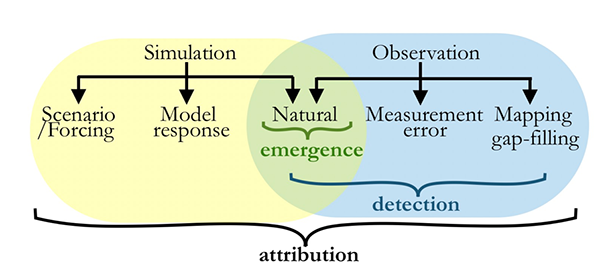
Figure 2. Venn Diagram schematic of sources of uncertainty in simulation (using Earth-System Modeling approach) and observation of changes in the Earth system. For emergence, detection or attribution of an observed or simulated signal to occur, the signal must overcome the sources of uncertainty in their respective brackets.

Many types of observational efforts, including time-series or permanent locations of continuous measurement, as well as regional sampling programs and global remote sensing platforms are critical for understanding our changing planet and improving our capacity to detect change.

Authors:
Sarah Schlunegger (Princeton University)
Keith B. Rodgers (Institute for Basic Science and Busan National University, South Korea)
Jorge L. Sarmiento (Princeton University)
Thomas L. Frölicher (University of Bern)
John P. Dunne (NOAA Geophysical Fluid Dynamics Laboratory)
Masao Ishii (Japan Meteorological Agency)
Richard Slater (Princeton University)


Where the primary production goes determines whether you catch tuna or cod

Posted by mmaheigan 
· Friday, September 6th, 2019 

Fishes are incredibly diverse, fill various roles in their ecosystems, and are an important resource—economically, socially, and nutritionally. The relationship between primary productivity and fish catches is not straightforward; fisheries oceanographers and managers have long struggled to predict abundances and fully understand the controls of cross-ecosystem differences in fish abundances and assemblages. A recent study in Progress in Oceanography modeled the relationships between fish abundances and assemblages and ecosystem factors such as physical properties and plankton productivity.

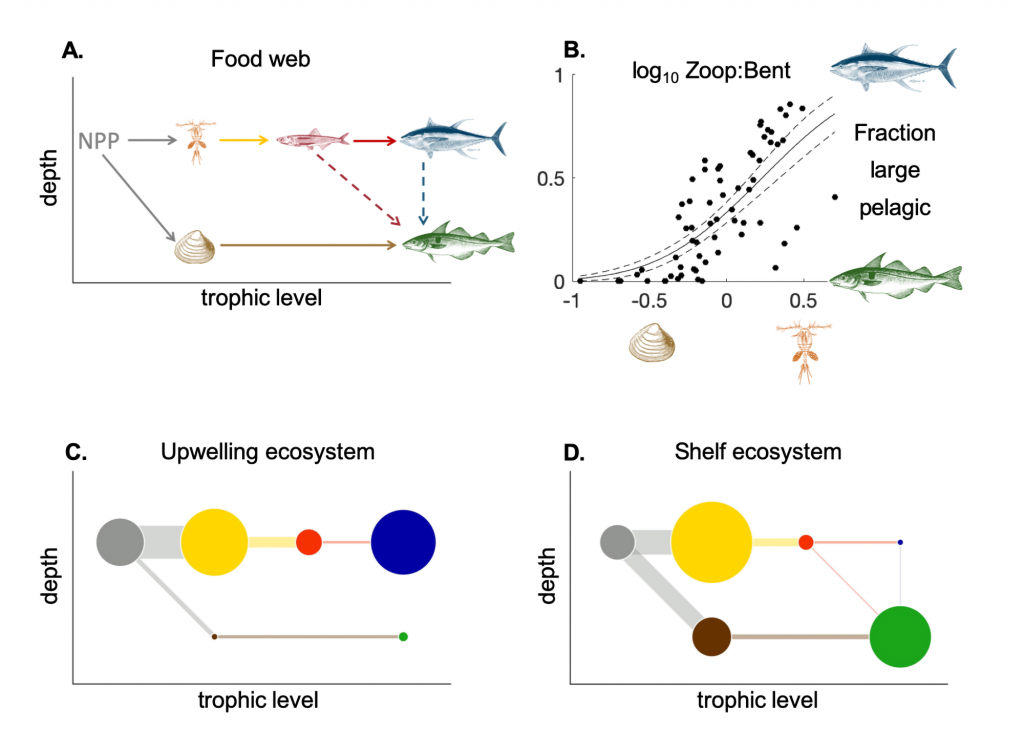
The mechanistic model simulated feeding, growth, reproduction, and mortality of small pelagic forage fish, large pelagic fish, and demersal (bottom-dwelling) fish in the global ocean using plankton food web estimates and ocean conditions from a high-resolution earth system model of the 1990s. Modeled fish assemblages were more related to the separation of secondary production into pelagic zooplankton or benthic fauna secondary production than to primary productivity. Specifically, the ratio of pelagic to benthic production drove spatial differences in dominance by large pelagic fish or by demersal fish. Similarly, demersal fish abundance was highly sensitive to the efficiency of energy transfer from exported surface production to benthic fauna.

The model results offer a systematic understanding of how marine fish communities are structured by spatially varying environmental conditions. With global climate change, the expected decrease in exported primary production would lead to fewer demersal fish around the world. This model provides a framework for testing the effect of changing conditions on fish communities at a global scale, which can also help inform managers of potential impacts on economic, social, and nutritional resources worldwide.

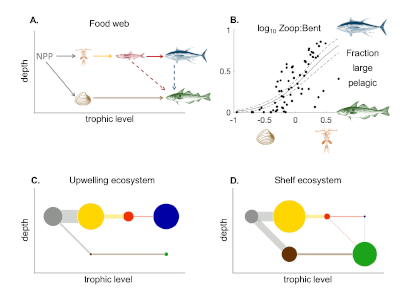
Figure 1: (A) Sample food web with three fish types, two habitats, two prey categories, and feeding interactions (arrows). Dashed arrow denotes feeding only occurs in shelf regions with depth <200 m. (B) Fraction of large pelagic vs. demersal fishes (LP/(LP+D)) as a function of the ratio of zooplankton production lost to higher predation (Zoop) to detritus flux to the seafloor (Bent) averaged over large marine ecosystems. Solid line: predicted linear model response, dashed lines: standard error. (Lower panels) Circles=mean biomasses (g m-2) and lines=fluxes of biomass (g m-2 d-1) through the pelagic (top 100m) and benthic components of the food webs at two test locations, (C) Peruvian Upwelling (PUP) ecosystem and (D) Eastern Bering Sea (EBS) shelf ecosystem. Circles and lines scale with the modeled biomasses and fluxes. Circle color key: Gray=net primary productivity (NPP); yellow=medium and large zooplankton; red=forage fish; blue=large pelagic fish; brown=benthos; green=demersal fish.


Authors:
Colleen M. Petrik (Princeton University, Texas A&M University)
Charles A. Stock (NOAA Geophysical Fluid Dynamics Laboratory)
Ken H. Andersen (Technical University of Denmark)
P. Daniël van Denderen (Technical University of Denmark)
James R. Watson (Oregon State University)


Forecasting air-sea CO2 flux variations several years in advance

Posted by mmaheigan 
· Tuesday, July 9th, 2019 

Year-to-year changes in the flux of CO2 between the atmosphere and the ocean impact the global carbon cycle and climate system, and challenge our ability to verify fossil fuel CO2 emissions. A new study published in Earth System Dynamics suggests that these air-sea CO2 flux variations are predictable several years in advance.

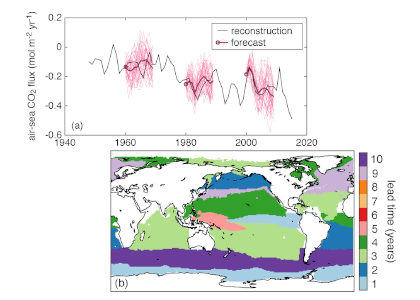
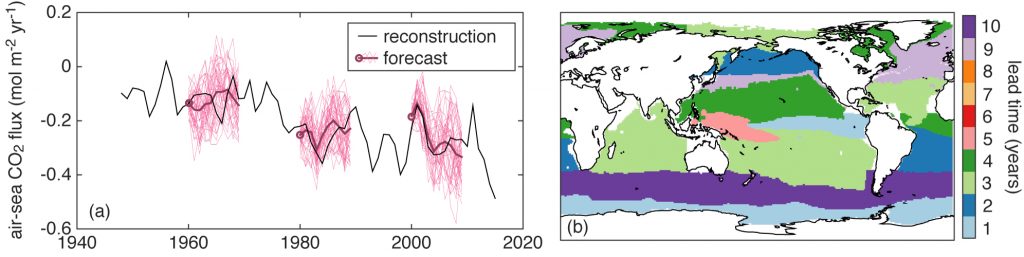
A novel set of initialized forecasts of past air-sea CO2 flux from an Earth system model (Figure 1a) confidently predicts year-to-year variations in the globally-integrated flux up to two years in advance. At regional scales, the forecast lead time increases. The predictability of CO2 flux from the initialized forecast system exceeds that obtained solely from foreknowledge of variations in external forcing (e.g., volcanic eruptions) or a simple persistence forecast (e.g., CO2 flux this year will be the same as next year). The longest-lasting forecast enhancements are in the subantarctic Southern Ocean and the northern North Atlantic (Figure 1b).

Figure 1: (a) Forecasts of the past evolution of air-sea CO2 flux in the South Pacific using an Earth System model indicate the potential to predict the future evolution of this quantity. (b) In each biome, the maximum forecast lead time in which the initialized forecast of air-sea CO2 flux beats out other forecast methods.

These results are particularly meaningful for those forecasting year-to-year changes in the global carbon budget, especially as these forecasting efforts are blind to the externally-forced variability in advance (i.e., the external forcing of the future is unknown).  In this way, forecasts of air-sea CO2 flux variations can help to inform future predictions of land-air CO2 flux and atmospheric CO2 concentration.

Authors:
Nicole Lovenduski (University of Colorado Boulder)
Stephen G. Yeager (National Center for Atmospheric Research)
Keith Lindsay (National Center for Atmospheric Research)
Matthew C. Long (National Center for Atmospheric Research)

See also the OCB Ocean-Atmosphere Interactions: Scoping directions for U.S. research Workshop to be held in October 1-3, 2019

Ocean microbes drive fluctuating nutrient loss

Posted by mmaheigan 
· Tuesday, May 28th, 2019 

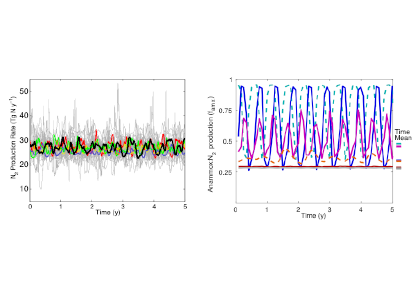
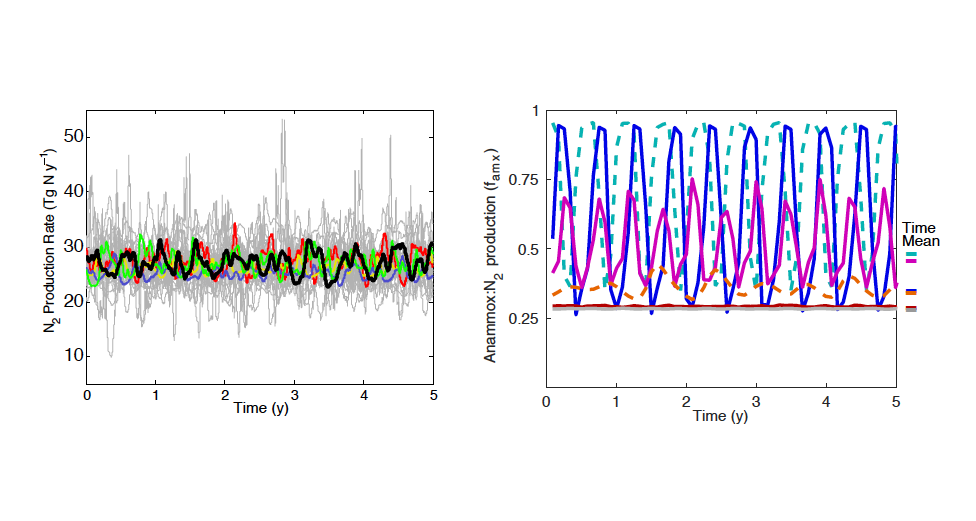
The removal of bioavailable nitrogen (N) by anaerobic microbes in the ocean’s oxygen deficient zones (ODZs) is thought to vary over time primarily as a result of climate impacts on ocean circulation and primary production. However, a recent study in PNAS using a data-constrained model of the microbial ecosystem in the world’s largest ODZ revealed that internal species oscillations cause local- to basin-scale fluctuations in the rate of N loss, even in a completely stable physical environment. Such ecosystem oscillations have been hypothesized for nearly a century in idealized models, but are rarely shown to persist in a three-dimensional ocean circulation model.

Figure caption. Ecological variability in the basin-scale rate of nitrogen loss over time (left) and in the local-scale contribution of autotrophic anammox to total N loss (right) in a model with unchanging ocean circulation. In the left panel, colors represent model simulations with different biological parameters. In the right panel, colors represent distinct locations within the ODZ in the standard model simulation.


These emergent ecosystem dynamics arise at the oxic-anoxic interface from O2-dependent resource competition between aerobic and anaerobic microbes, and leave a unique geochemical fingerprint: infrequent spikes in ammonium that are observable in nutrient measurements from the ODZ. Non-equilibrium ecosystem behavior driven by competition among aerobic nitrifiers, anaerobic denitrifiers, and anammox bacteria also generates fluctuations in the balance of autotrophic versus heterotrophic N loss pathways that help reconcile conflicting field observations.

These internally driven fluctuations in microbial community structure partially obscure a direct correspondence between the chemical environment and microbial rates, a universal assumption in biogeochemical models. Because of the fundamental nature of the underlying mechanism, similar dynamics are hypothesized to occur across wide-ranging microbial communities in diverse habitats.


Authors:
Justin L. Penn (University of Washington)
Thomas Weber (University of Rochester),
Bonnie X. Chang (University of Washington, NOAA)
Curtis Deutsch (University of Washington)


See also the OCB2019 plenary session: Anthropogenic changes in ocean oxygen: Coastal and open ocean perspectives (Monday, June 24, 2019)

Suddenly shallow: A new aragonite saturation horizon will soon emerge in the Southern Ocean

Posted by mmaheigan 
· Monday, May 27th, 2019 

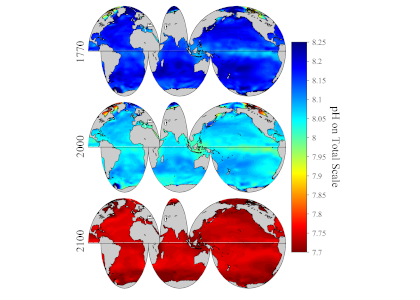
Earth System Models (ESMs) project that by the end of this century, the aragonite saturation horizon (the boundary between shallower, saturated waters and deeper, undersaturated waters that are corrosive to aragonitic shells) will shoal all the way to the surface in the Southern Ocean, yet the temporal evolution of the horizon has not been studied in much detail. Rather than a gradual shoaling, a new shallow aragonite saturation horizon emerges suddenly across many locations in the Southern Ocean between now and the end of the century (Figure 1, left), as detailed in a new study published in Nature Climate Change.

Figure 1: Maximum step-change in the depth of the aragonite saturation horizon (left), timing of the step-change (center), and cause of the change (right). Xs on the time axis (center) indicate when the shallow horizon emerges in each ensemble member. (click image to enlarge)


The emergence of the shallow aragonite saturation horizon is apparent in each member of an ensemble of climate projections from an ESM, but the step change occurs during different years (Figure 1, center). The shoaling is driven by the gradual accumulation of anthropogenic CO2 in the Southern Ocean thermocline, where the carbonate ion concentration exhibits a local minimum and approaches undersaturation (Figure 1, right).

The abrupt shoaling of the Southern Ocean aragonite saturation horizon occurs under both business-as-usual and emission-stabilizing scenarios, indicating an inevitable and sudden decrease in the volume of suitable habitat for aragonitic organisms such as shelled pteropods, foraminifers, cold-water corals, sea urchins, molluscs, and coralline algae. Widespread reductions in these habitats may have far-reaching consequences for fisheries, economies, and livelihoods.

Authors:
Gabriela Negrete-García (Scripps Institution of Oceanography)
Nicole Lovenduski (University of Colorado Boulder)


See also OCB2019 plenary session: Carbon cycle feedbacks from the seafloor (Wednesday, June 26, 2019)

Northeast Pacific time-series reveals episodic events as major player in carbon export

Posted by mmaheigan 
· Tuesday, April 16th, 2019 

Temporal fluctuations in the oceanic carbon budget play an important role in the cycling of organic matter from production in surface waters to consumption and sequestration in the deep ocean. A 29-year time-series (1989-2017) of particulate organic carbon (POC) fluxes and seafloor measurements of oxygen consumption in the abyssal northeast Pacific (Sta. M, 4,000 m depth) recently revealed an increasing proportional contribution from episodic events over the past seven years. From 2011 to 2017, 43% of POC flux arrived during high-magnitude (≥ mean + 2 σ) episodic events. Time lags between changes in satellite-estimated export flux (EF), POC flux to the seafloor, and seafloor oxygen consumption varied from 0 to 70 days among six flux events, which could be attributed to variable remineralization rates and/or particle sinking speeds. The Martin equation, a commonly used model to estimate carbon flux, predicted background fluxes well but missed episodic fluxes, subsequently underestimating the measured fluxes by almost 50% (Figure 1). This study reveals the potential importance of episodic POC pulses into the deep sea in the oceanic carbon budget, which has implications for observing infrastructure, model development, and field campaigns focused on quantifying carbon export.

Figure Caption: (A) Station M POC flux measured from sediment traps compared to Martin model estimates, from 1989 to 2017. (B) Model performance for years with >50% sampling coverage: (POC fluxMartin − POC fluxtrap)/POC fluxtrap 100.


Authors:
Kenneth Smith (MBARI)
Henry Ruhl (MBARI, NOC)
Christine Huffard (MBARI)
Monique Messié (MBARI, Aix Marseille Université)
Mati Kahru (Scripps)


See also https://www.mbari.org/carbon-pulses-climate-models/

Ocean color offers early warning signal of climate change’s impact on marine phytoplankton

Posted by mmaheigan 
· Monday, April 15th, 2019 

Marine phytoplankton form the foundation of the marine food web and play a crucial role in the earth’s carbon cycle. Typically, satellite-derived Chlorophyll a (Chl a) is used to evaluate trends in phytoplankton. However, it may be many decades (or longer) before we see a statistically significant signature of climate change in Chl a due to its inherently large natural variability. In a recent study in Nature Communications, authors explored how other metrics, in particular the color of the ocean, may show earlier and stronger signals of climate change at the base of the marine food web.

Figure 1. Computer model results indicating the year in which the signature of climate change impact is larger than the natural variability for (a) Chl a, and (b) remotely sensed reflectance in the blue-green waveband. White areas indicate where there is not a statistically significant change by 2100, or for regions that are currently ice-covered.


In this study, the authors use a unique marine physical-biogeochemical and ecosystem model that also captures how light penetrates the ocean and is reflected upward. The model shows that over the course of the 21st century, remote sensing reflectance (RRS, the ratio of upwelling radiance to the downwelling irradiance at the ocean’s surface) in the blue-green portions of the light spectrum is likely to have an earlier, more spatially extensive climate change-driven signal than Chl a (Figure 1). This is because RRS integrates not only changes to Chl a, but also alterations in other optically important water constituents. In particular, RRS also captures changes in phytoplankton community structure, which strongly affects ocean optics and is likely to be altered over the 21st century. Monitoring the response of marine phytoplankton to climate change is important for predicting changes at higher trophic levels, including commercial fisheries. Our study emphasizes the importance of 1) maintaining ocean color sensor compatibility and long-term stability, particularly in the blue-green wavebands; 2) maintaining long-term in situ time-series of plankton communities – e.g., the Continuous Plankton Recorder survey and repeat stations (e.g., HOT, BATS); and 3) reducing uncertainties in satellite-derived phytoplankton community structure estimates.


Authors:
Stephanie Dutkiewicz, Oliver Jahn (Massachusetts Institute of Technology)
Anna E. Hickman (University of Southampton)
Stephanie Henson (National Oceanography Centre Southampton)
Claudie Beaulieu (University of California, Santa Cruz)
Erwan Monier (University of California, Davis)

« Previous Page
Next Page »

FilterbyKeyword

abundance acidification additionality advection africa air-sea air-sea interactions algae alkalinity allometry ammonium AMO AMOC anoxic Antarctic Antarctica anthro impacts anthropogenic carbon anthropogenic impacts appendicularia aquaculture aquatic continuum aragonite saturation arctic Argo argon arsenic artificial seawater AT Atlantic atmospheric CO2 atmospheric nitrogen deposition authigenic carbonates autonomous platforms AUVs awb bacteria bathypelagic BATS BCG Argo benthic bgc argo bio-go-ship bio-optical bioavailability biogeochemical cycles biogeochemical models biogeochemistry Biological Essential Ocean Variables biological pump biomass biophysics bloom blue carbon bottom water boundary layer buffer capacity C14 CaCO3 calcification calcite carbon carbon-climate feedback carbon-sulfur coupling carbonate carbonate chemistry carbonate system carbon budget carbon cycle carbon dioxide carbon export carbon fluxes carbon sequestration carbon storage Caribbean CCA CCS changing marine chemistry changing marine ecosystems changing marine environments changing ocean chemistry chemical oceanographic data chemical speciation chemoautotroph chesapeake bay chl a chlorophyll circulation clouds CO2 CO3 coastal and estuarine coastal darkening coastal ocean cobalt Coccolithophores commercial community composition competition conservation cooling effect copepod copepods coral reefs cruise CTD currents cyclone daily cycles data data access data assimilation database data management data product data sets Data standards DCM dead zone decadal trends decomposers decomposition deep convection deep ocean deep sea coral denitrification dense water deoxygenation depth diatoms DIC diel migration diffusion dimethylsulfide dinoflagellate dinoflagellates discrete measurements distribution DOC DOM domoic acid DOP dust DVM ecology economics ecosystem management ecosystems eddy Education EEZ Ekman transport emissions ENSO enzyme equatorial current equatorial regions ESM estuarine and coastal carbon fluxes estuary euphotic zone eutrophication evolution export export fluxes export production extreme events faecal pellets fecal pellets filter feeders filtration rates fire fish Fish carbon fisheries fishing floats fluid dynamics fluorescence food webs forage fish forams freshening freshwater frontal zone functional role future oceans gelatinous zooplankton gene transfer geochemistry geoengineering geologic time GEOTRACES glaciers gliders global carbon budget global ocean global ocean models global overturning circulation global warming go-ship grazing greenhouse gas greenhouse gases Greenland ground truthing groundwater Gulf of Maine Gulf of Mexico Gulf Stream gyre harmful algal bloom high latitude human food human impact human well-being hurricane hydrogen hydrothermal hypoxia ice age iceberg ice cores ice cover industrial onset inland waters in situ inverse circulation ions iron iron fertilization iron limitation isotopes jellies katabatic winds kelvin waves krill kuroshio lab vs field land land-ocean continuum larvaceans lateral transport LGM lidar ligands light light attenuation lineage lipids low nutrient machine learning mangroves marine carbon cycle marine heatwave marine particles marine snowfall marshes mCDR mechanisms Mediterranean meltwater mesopelagic mesoscale mesoscale processes metagenome metals methane methods microbes microlayer microorganisms microplankton microscale microzooplankton midwater migration minerals mitigation mixed layer mixed layers mixing mixotrophs mixotrophy model modeling model validation mode water molecular diffusion MPT MRV multi-decade N2 n2o NAAMES NCP nearshore net community production net primary productivity new ocean state new technology Niskin bottle nitrate nitrogen nitrogen cycle nitrogen fixation nitrous oxide north atlantic north pacific North Sea NPP nuclear war nutricline nutrient budget nutrient cycles nutrient cycling nutrient limitation nutrients OA observations ocean-atmosphere ocean acidification ocean acidification data ocean alkalinity enhancement ocean carbon uptake and storage ocean color ocean modeling ocean observatories ocean warming ODZ oligotrophic omics OMZ open ocean optics organic particles oscillation outwelling overturning circulation oxygen pacific paleoceanography PAR parameter optimization parasite particle flux particles partnerships pCO2 PDO peat pelagic PETM pH phenology phosphate phosphorus photosynthesis physical processes physiology phytoplankton PIC piezophilic piezotolerant plankton POC polar polar regions policy pollutants precipitation predation predator-prey predators prediction pressure primary productivity Prochlorococcus productivity prokaryotes proteins pteropods pycnocline python radioisotopes remineralization remote sensing repeat hydrography residence time resource management respiration resuspension rivers rocky shore Rossby waves Ross Sea ROV salinity salt marsh satellite scale seafloor seagrass sea ice sea level rise seasonal seasonal effects seasonality seasonal patterns seasonal trends sea spray seawater collection seaweed secchi sediments sensors sequestration shelf ocean shelf system shells ship-based observations shorelines siderophore silica silicate silicon cycle sinking sinking particles size SOCCOM soil carbon solubility pump southern ocean south pacific spatial covariations speciation SST state estimation stoichiometry subduction submesoscale subpolar subtropical sulfate surf surface surface ocean surface waters Synechococcus technology teleconnections temperate temperature temporal covariations thermocline thermodynamics thermohaline thorium tidal time time-series time of emergence titration top predators total alkalinity trace elements trace metals trait-based transfer efficiency transient features trawling Tris trophic transfer tropical turbulence twilight zone upper ocean upper water column upwelling US CLIVAR validation velocity gradient ventilation vertical flux vertical migration vertical transport warming water clarity water column water mass water quality waves weathering western boundary currents wetlands winter mixing zooplankton

Copyright © 2026 - OCB Project Office, Woods Hole Oceanographic Institution, 266 Woods Hole Rd, MS #25, Woods Hole, MA 02543 USA Phone: 508-289-2838  •  Fax: 508-457-2193  •  Email: ocb_news@us-ocb.org

link to nsflink to noaalink to WHOI

Funding for the Ocean Carbon & Biogeochemistry Project Office is provided by the National Science Foundation (NSF) and the National Aeronautics and Space Administration (NASA). The OCB Project Office is housed at the Woods Hole Oceanographic Institution.