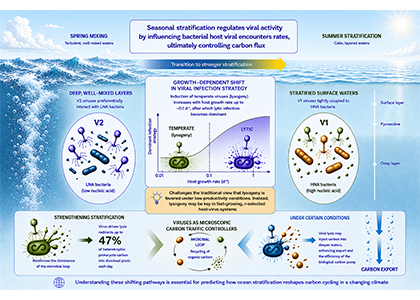
Each year, as the North Atlantic transitions from turbulent spring mixing to layered summer stratification, a key question emerges: How do these seasonal changes reshape bacterial host-virus interactions and control carbon flux?
In a recent study published in Microorganisms, researchers show that seasonal stratification regulates viral activity by modulating encounter rates between viruses and distinct bacterial hosts. They found that one viral group (V1) is tightly coupled with high nucleic acid (HNA) bacteria in stratified surface waters, whereas another (V2) preferentially interacts with low nucleic acid (LNA) cells in the deeper, well-mixed layers. These patterns indicate that physical layering structures viral dynamics by regulating host distribution and ecological traits. Importantly, the study reveals a growth-dependent shift in viral infection strategy. The induction of temperate viruses increases with host growth rate up to a metabolic threshold (~0.1 d⁻¹), then declines as lytic infection becomes dominant. This finding challenges the traditional paradigm that lysogeny is favored under low-productivity conditions, instead suggesting that lysogeny may play a key role in fast-growing, r-selected host-virus systems.
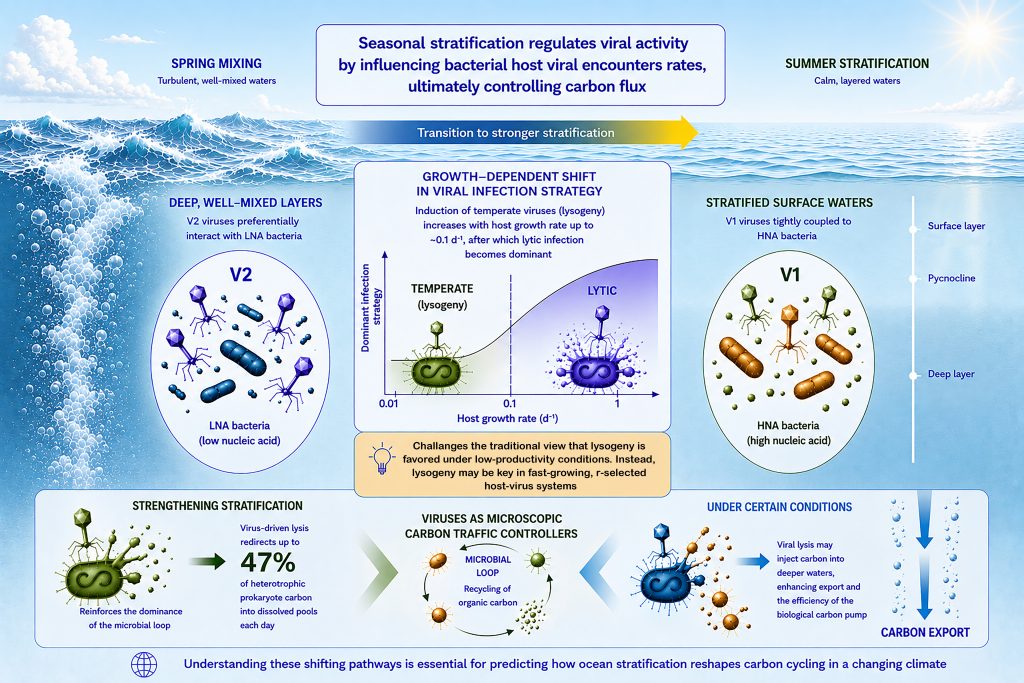
These results highlight how viruses act as microscopic carbon traffic controllers, regulating the balance between microbial recycling and carbon export across seasonal transitions. During the shift toward stronger stratification, virus-driven lysis redirects up to 47% of bacterial carbon into dissolved pools each day, reinforcing the dominance of the microbial loop. Yet, under certain conditions, viral lysis may also inject carbon into deeper waters, enhancing export and the efficiency of the biological carbon pump. It is essential to understand these shifting pathways to predict how ocean stratification reshapes carbon cycling in a changing climate.
Authors:
Yean Das (The University of Southern Mississippi)
Corina P. D. Brussaard (NIOZ Royal Netherlands Institute for Sea Research & University of Amsterdam)
Kristina D. A. Mojica (The University of Southern Mississippi)
Citation:
Das, Y., Brussaard, C. P. D, & Mojica, K. D. (2025). Heterotrophic Prokaryote Host–Virus Dynamics During Spring in the Northeast Atlantic Ocean. Microorganisms, 13(11), 2474. https://doi.org/10.3390/microorganisms13112474