Interactions among organisms shape ecological dynamics, while exchanges with the environment alter physical and chemical conditions. Examples of these include predator-prey dynamics (biotic interaction), the release of nutrients through excretion (chemical changes), or the development of coral reefs (physical changes). Together, these processes can generate feedback loops, which may amplify or buffer the impacts of environmental change. We know such processes are important in ecosystems, but do ecological feedbacks really matter at larger scales and in the wider Earth system? To address this question, authors of a recent study published in Earth’s Future, compiled what is known about how ecological feedbacks operate, drawing on examples from ecosystems in marine, terrestrial and freshwater habitats across the world.
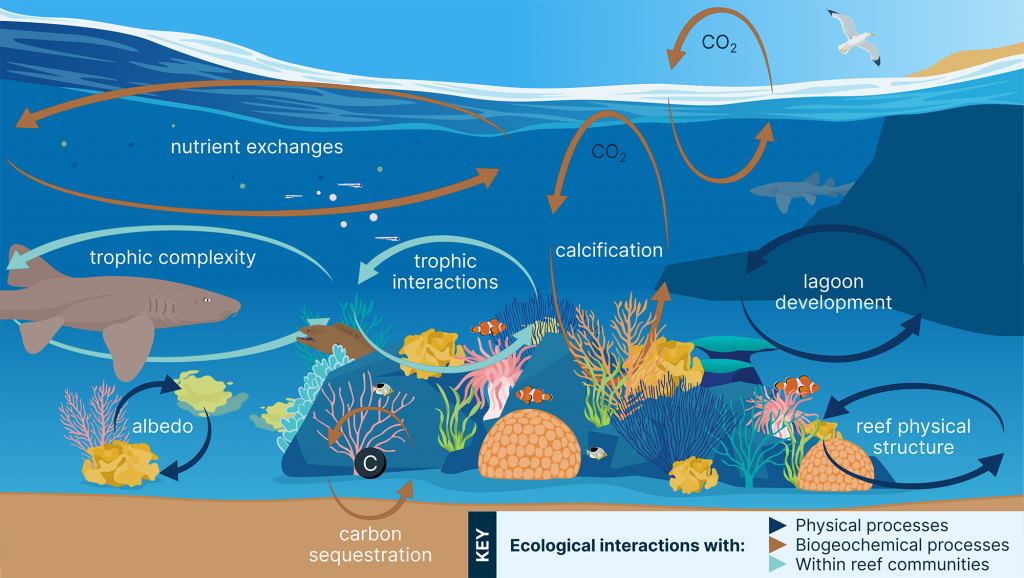
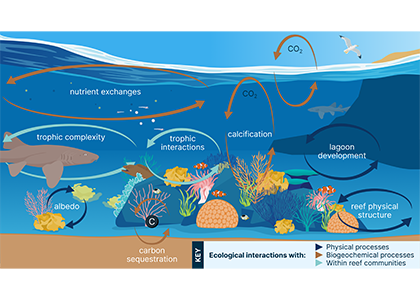
Figure caption: A wide range of ecological feedbacks influence the functioning of coral reef systems, affecting the structure and functioning of the ecosystem and associated physical and biogeochemical processes. Figure modified from Murphy et al. (2025), originally published in Earth’s Future, © The Authors, published by the American Geophysical Union under a Creative Commons license.
The synthesis highlights that ecological feedbacks are ubiquitous within and across ecosystems, yet remain a major gap in Earth system science. Ecological feedbacks can affect ecosystem structure and resilience, tipping points, global biogeochemical cycles, and the structure and dynamics of the physical environment. The study emphasises that current Earth System models often underrepresent these processes, despite their importance for carbon cycling, climate regulation, and ecosystem stability. Representing them appropriately is not trivial. Feedbacks operate across spatial (local to global) and temporal (seconds to centuries) scales, and are integral in multiple Earth system processes. A systematic approach is needed to both develop our understanding of ecological feedbacks and refine models, which will require increased integration of ecosystem and Earth system research. Overall, these findings matter because failing to account for ecological feedbacks could lead to inaccurate climate projections, misguided policy decisions, and unanticipated ecological losses.
Authors
Eugene Murphy (British Antarctic Survey)
Jessica Williams (Imperial College London)
Emma Cavan (Imperial College London)
Follow and learn more:
www.bas.ac.uk, IMBeR, ICED, SCOR, Future Earth, imber-youtube
@britishantarcticsurvey, @imber, @scor-int.bsky.social, @futureearth
https://www.bas.ac.uk/profile/ejmu/
https://profiles.imperial.ac.uk/jessica.williams15
https://profiles.imperial.ac.uk/e.cavan/about
Some extra background:
The study developed from scientific activities of the Integrating Climate Ecosystem Dynamics in the Southern Ocean (ICED) programme and the Integrated Marine Biosphere Research Project (IMBeR). ICED is a regional programme of IMBeR, which is a Large-Scale Ocean Research Project under the Scientific Committee on Oceanic Research (SCOR) and a Global Research Network under Future Earth. Improving understanding of ecological feedbacks in the Earth system was developed as an Innovation Challenge of IMBeR, with a conference session on the topic held at the Future Oceans 2 conference. Following subsequent discussions, and a recognition of the connected nature of ecosystems across the world, the study expanded to develop an integrated view encompassing marine, terrestrial and freshwater systems.
Citation: Murphy, E. J., Williams, J. J., Myers-Smith, I. H., Groner, V. P., Jacoby, D. M. P., Kwiatkowski, L., Melbourne-Thomas, J., Ransome, E., Banks-Leite, C., Bopp, L., Gehlen, M., Hofmann, E. E., Hoogakker, B., Johnston, N. M., Malhi, Y., & Cavan, E. L. (2026). Ecological Feedbacks in the Earth System. Earth’s Future, 14(2), e2025EF006478. https://doi.org/10.1029/2025EF006478