Those of us working across the land-ocean aquatic continuum (LOAC), aka the terrestrial-aquatic interface (TAI), aka estuaries and coastal waters, often note that our estuaries and coastal waters tend to get darker after large rain events. The “darkness” comes from substances that absorb and scatter light and a good portion of these materials are collectively called colored (or chromophoric) dissolved organic matter – CDOM. These observations beg the question of where the CDOM comes from and if its quality, related to its origin and its biogeochemical reactivity, varies substantially arising from storm events.
In recent work published in Limnology and Oceanography the authors looked at this question using a time series of observations from coastal North Carolina’s Neuse River Estuary, a major tributary to the Pamlico Sound, the largest lagoonal estuary in the United States. Looking at time series enabled us to translate the 2D and 3D of the LOAC into a 4D perspective and capture spatiotemporal variations that might allow us to understand different states of the estuary over time and in response to extreme weather events.
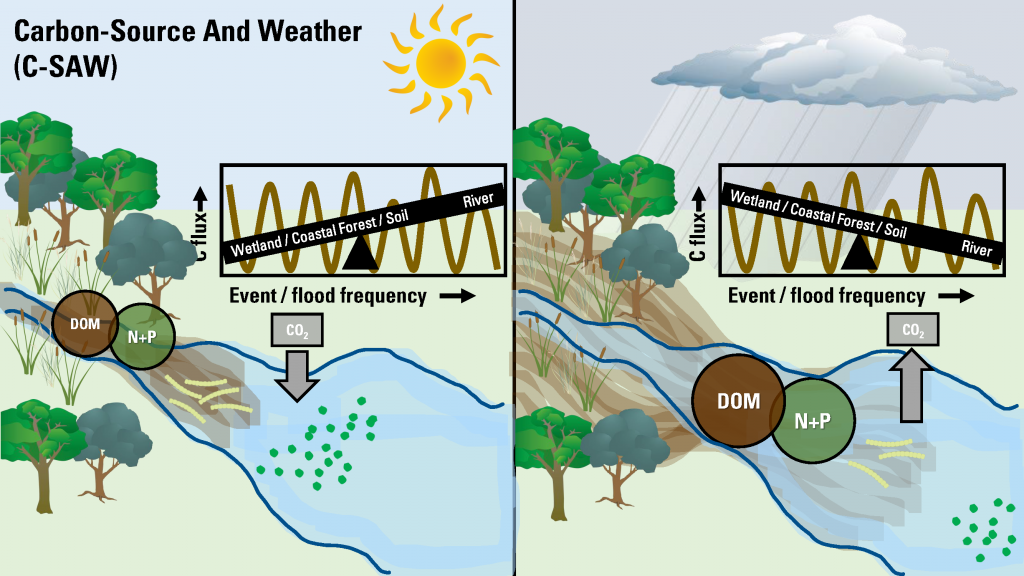
Figure caption: Conceptual model of the carbon source and weather (C-SAW) paradigm. Left panel represents dry conditions when a coastal river is not connected to its adjacent wetlands. Under wet periods (right panel), extreme rainfall floods adjacent wetlands, hydrologically connecting them to the river and leading to enhanced export of color, DOM, and nitrogen and phosphorus nutrients (N + P). Upstream river and downstream estuarine phytoplankton populations are represented as light green rods and dark green spheres, respectively.
We found both event-driven weather signals and basin-wide climate signals explained a surprisingly major shift in the quality of CDOM in the lower estuary and Pamlico Sound. Wet periods exhibited higher CDOM and dissolved organic carbon (DOC) concentrations – not unexpected – but overwhelmingly the sources shifted from an upland river dominance to a wetland dominance. This meant that climate change, creating wetter periods that saturate low-lying coastal landscapes, poises them to export tremendous amounts of CDOM and DOC stored in them during intense precipitation events. We conceptualized this paradigm as a “C-SAW”: carbon source and weather, which integrates elements of the Flood Pulse and Pulse-Shunt Concepts, linking them to estuarine and coastal biogeochemistry.
The C-SAW describes system state changes in the dynamic biogeochemical reactors that are estuaries. Overloading these systems with organic matter and nutrients from the landscape primes the reactor to process this organic matter back into CO2. However, DOM is quite diverse and arises from natural and anthropogenic sources, so questions remain surrounding how shifting climatic states might translate into shifting organic matter processing. On a global scale this can be significant in terms of exporting more carbon (and color) to coastal waters, impacting water quality and water clarity, as well as carbon cycling.
Author
Chris Osburn (North Carolina State University)
Citation: Osburn, C.L., Bianchi, T.S., Paerl, H.W., Hall, N.S., Hounshell, A.G., Rudolph, J.C., Bhattacharya, R. and Paerl, R.W. (2026), Carbon source and weather in coastal North Carolina. Limnol Oceanogr, 71: e70426. https://doi.org/10.1002/lno.70426