How do processes in the sub-surface ocean (500 – 1000 m) impact particle communities that sink into the deep ocean (> 3000 m)? We highlight two observed pathways of particle flux to the deep sea from two ocean basin-wide cruises in the Southern Ocean sampled with an Underwater Vision Profiler (UVP5), which is an underwater camera that measures particle size and takes photographs of larger particles in a recent study in GBC. The first pathway was a high-biomass event consisting of large, transparent, fluffy aggregates, likely of phytodetrital origin. The particle morphology does not change much from the surface to the deep sea (>3000 m), indicating quickly sinking particles without undergoing much transformation. However, in another region we observed a high abundance of copepods and other crustaceans in the subsurface ocean (from 500 – 1000 m), of which at least 78% of the copepods were in active posture, and presumably feeding. We observed elevated abundance of fecal pellets and degraded fecal pellets below this region, which increased with depth, particularly from 3000 – 6000 m. We posit that this mesopelagic grazing event facilitates enhanced deep carbon export by repackaging slower-sinking aggregates into denser-packed feces. We urge more study of full water column processes, rather than just surface or upper mesopelagic processes, when studying the fate of particles sinking due to the biological carbon pump. We also encourage the use of particle and plankton morphology to shed light on the ecological processes that facilitate particles reaching the deep ocean.
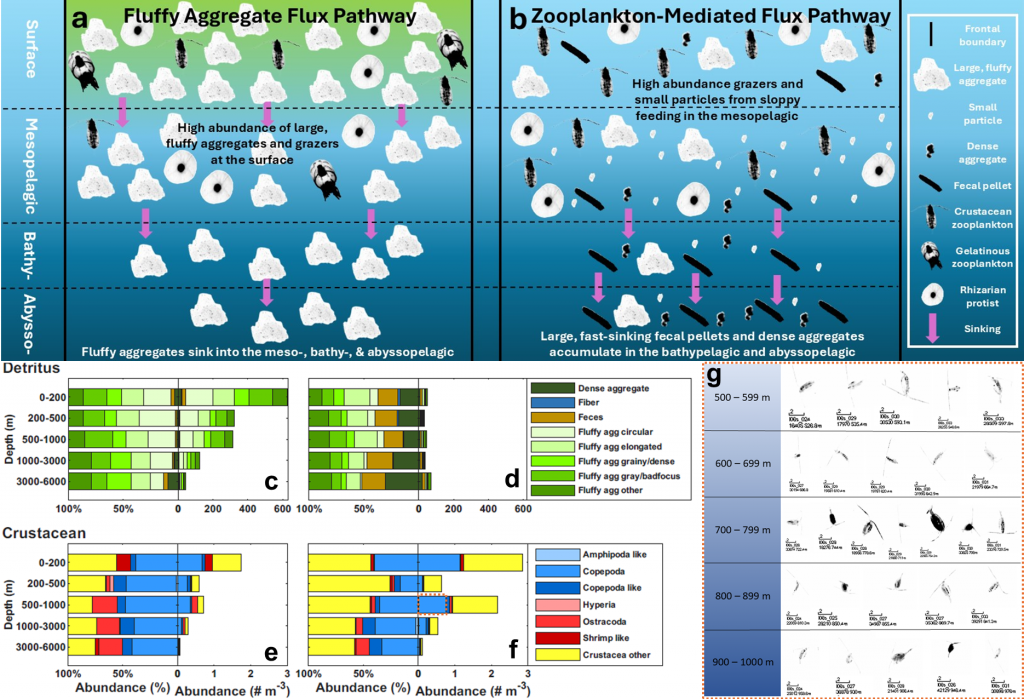
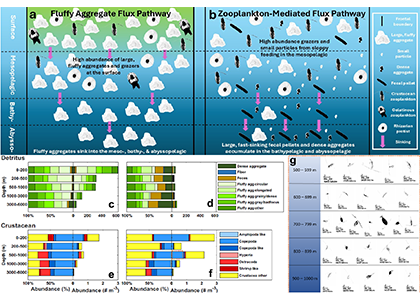
Figure 1: Conceptual diagram: (a) The fluffy aggregate flux pathway, where high surface chlorophyll-a waters show elevated abundance of large fluffy aggregates and grazers at the surface. Fluffy aggregates sink into the deeper ocean and down to the seafloor. (b) The zooplankton-mediated flux pathway, where high abundance of crustacean grazers in the lower mesopelagic also has elevated small particle abundance from sloppy feeding. An increasing abundance of fecal pellets and degraded fecal pellets was observed in the abyssopelagic zone. Relative and total abundance of different types of detrital particles averaged over different depth bins from the (c) fluffy aggregate flux pathway and (d) zooplankton-mediated flux pathway and different types of crustaceans in (e) and (f), respectively. (g) Highlights example images of copepods in actively feeding posture from 500 to 1000 m in the zooplankton-mediated flux pathway.
Author
Stephanie O’Daly, University of Washington