Ocean alkalinity enhancement (OAE) is a promising carbon dioxide removal strategy, yet evaluating its net carbon removal potential requires understanding not only seawater carbonate chemistry, but also biological feedbacks that may influence long-term carbon sequestration. While most OAE studies focus on resolving immediate responses during biomass production, much less attention is paid to processes occurring during particle sinking.
In a 39-day mesocosm experiment in the North Sea, a recent study investigated how phytoplankton bloom development and the composition of sinking particles responded to CO2-unequilibrated OAE (ΔTAmax = 1250 μmol kg-1). Although phytoplankton blooms were delayed, their overall magnitude and organic carbon export remained largely unchanged across the OAE gradient. In contrast, elevated pH (up to 9.25) enhanced the dissolution of diatom-derived silica during particle sinking, reducing silica ballasting ratios (BSi:POC) by up to 60%. This response is consistent with the well-established pH sensitivity of biogenic silica dissolution. Following bloom senescence, the degradation of protective organic coatings surrounding diatom frustules exposes biogenic silica to naturally undersaturated seawater, where elevated pH further accelerates dissolution.
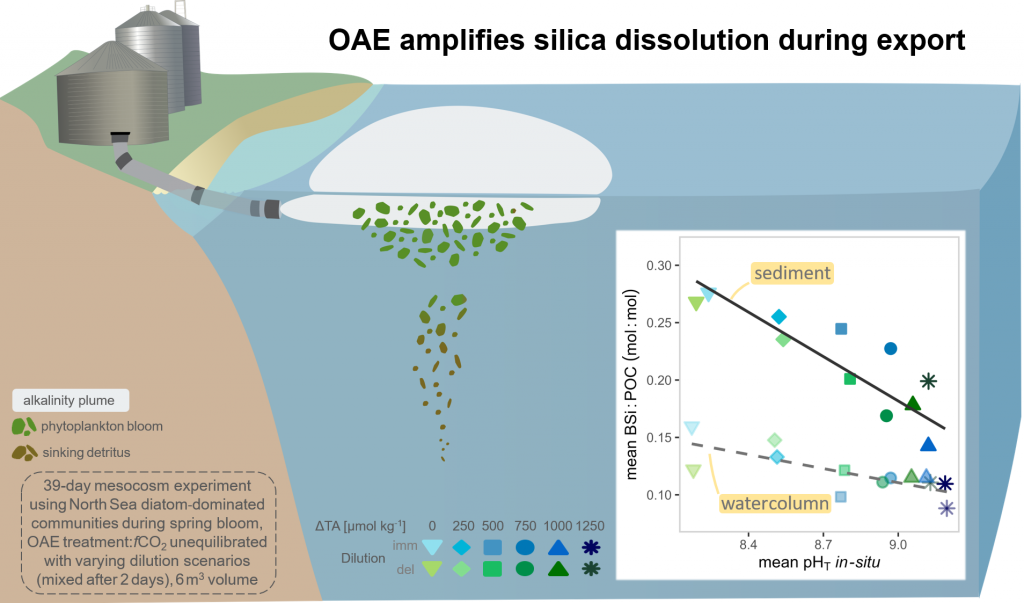
Figure caption: A conceptual illustration of the North Sea mesocosm experiment investigating CO₂-unequilibrated OAE across a broad alkalinity gradient generated through different dilution scenarios. Original treatment colours and symbols are retained for transparency, although dilution treatments were pooled for the final analysis. Elevated pH enhanced the dissolution of diatom-derived biogenic silica during particle sinking, reducing silica ballasting ratuis (BSi:POC). The inset compares bloom-averaged water column (dashed regression, R2 = 0.56, p < 0.01) and deposition-averaged sediment trap (solid regression, R2 = 0.74, p < 0.01) silica ballasting ratios, illustrating that silica loss intensified during particle sinking. Graphics adapted from Integration and Application Network, University of Maryland Center for Environmental Science, https://ian.umces.edu/symbols/.
Because silica ballasting influences the depth at which sinking organic matter is remineralized, reduced silica preservation may shoal carbon remineralization and shorten carbon sequestration timescales, even when export production remains unchanged. The study highlights an export-phase process that has received little attention in OAE research and should be considered in future field observations and Earth system models evaluating the net carbon sequestration efficacy of OAE.
Authors
Philipp Suessle (University of the Azores)
Kai Georg Schulz (Southern Cross University, Geomar Helmholtz-Centre for Ocean Research)
Joana Barcelos e Ramos (University of the Azores)
Nico Manuel Sievers (Geomar Helmholtz-Centre for Ocean Research)
Julieta Schneider (Southern Cross University, Geomar Helmholtz-Centre for Ocean Research)
Juliane Katharina Tammen (Geomar Helmholtz-Centre for Ocean Research)
Leila Kittu (Geomar Helmholtz-Centre for Ocean Research)
Laura Marín-Samper (University of Las Palmas de Gran Canaria)
Maarten Boersma (Alfred-Wegener-Institute, Helmholtz-Centre for Polar- and Marine Research)
Ulf Riebesell (Geomar Helmholtz-Centre for Ocean Research)
Citation: Suessle, P., Schulz, K. G., Barcelos e Ramos, J., Sievers, N. M., Schneider, J., Tammen, J. K., Kittu, L., Marín-Samper, L., Boersma, M., and Riebesell, U. (2026) Ocean alkalinity enhancement reduces silica ballasting during export due to amplified dissolution, Biogeosciences, 23, 4691–4710, https://doi.org/10.5194/bg-23-4691-2026.