The ocean has absorbed a quarter of anthropogenic CO2 emissions, mitigating changes. However, predicting the future fate of this ‘sink’ is challenging as marine carbon is regulated by a complex set of interacting processes that respond differently to warming. Our recent study teases apart these interactions with a novel mechanistic carbon decomposition and attribution framework applied to an ocean biogeochemical model driven by output from a climate model, to quantify the impact of changes in different forcing factors, such as warming and circulation, on marine carbon storage and the consequent feedback on atmospheric CO2.
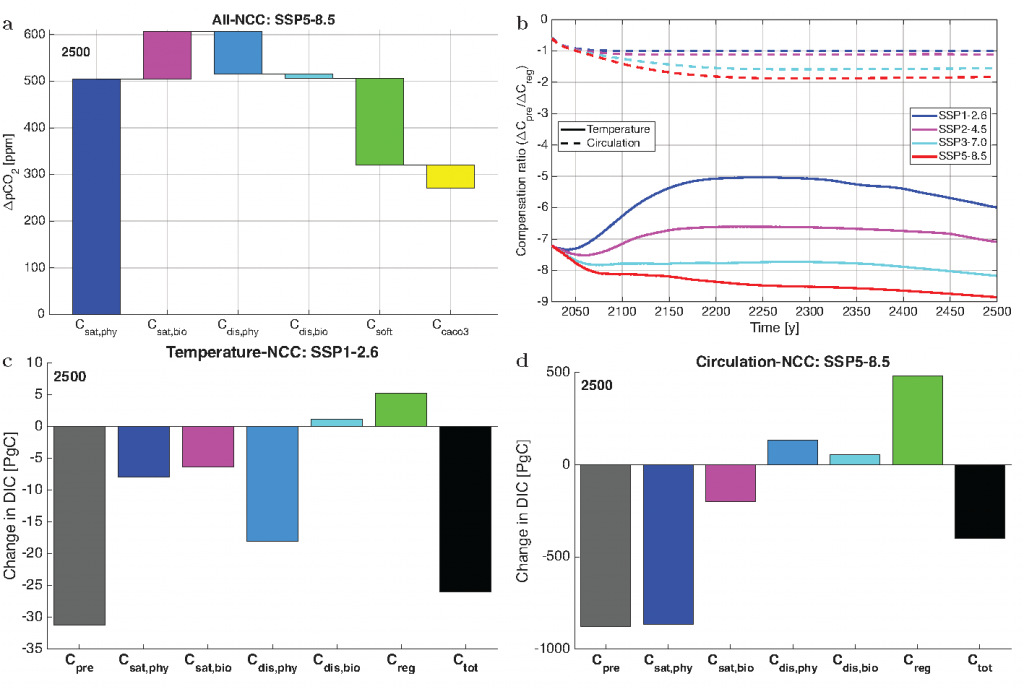
Figure: (a) Waterfall chart attributing changes in atmospheric CO2 (pCO2atm) (relative to a simulation with no climate change; NCC) to different carbon components for the SSP5-8.5 high-emission scenario. Each bar represents a component with its height corresponding to the (positive or negative) change in pCO2atm due to that component. The cumulative change in pCO2atm as successive components are added is shown from left to right. Subscripts are: sat=saturation, dis=disequilibrium, soft=soft tissue remineralization, caco3=CaCO3 dissolution, phy=physical process, and bio=biological process. (b) Compensation ratio of change (∆) in preformed to regenerated carbon with respect to NCC in the Temperature (solid lines) and Circulation (dashed lines) attribution experiments for the four emission scenarios studied as a function of time. (c) Change in carbon components with respect to NCC in year 2500 due to temperature under the SSP1-2.6 low-emission scenario. (d) Change in carbon components with respect to NCC in year 2500 due to circulation under SSP5-8.5.
We find that under a high-emission scenario, global warming reduces marine carbon storage and raises atmospheric CO2 in 2500 by ~270 ppm (Fig panel a), a positive feedback. This is due to a decrease in ocean CO2 uptake (Csat,phy), compensated in part by an increase in biologically regenerated carbon (Csoft & Ccaco3). While previous studies have also found this compensation, they have ascribed it largely to a slowdown in ocean circulation. Our attribution experiments instead show that the degree of compensation depends strongly on the process and emission scenario (Panel b). Reduced CO2 uptake due to a slower circulation is half-compensated by increased regenerated carbon under high emissions, but almost exactly compensated for under the lowest emission scenario (dashed lines). On the other hand, temperature-driven changes in uptake and regeneration are mostly uncompensated (solid lines); the direct effects of warming thus dominate under low-emission, high-mitigation scenarios, while also contributing a third of the decrease in carbon storage at the highest emissions. Air-sea disequilibrium, as revealed by the carbon decomposition, provides an explanation. Warming enhances physical disequilibrium because of an increase in the meridional sea surface temperature gradient; this is the leading cause of the decrease in carbon storage under low emissions (Panel c). In contrast, for high emissions (Panel d) a slowdown in circulation decreases physical disequilibrium, amplifying the impact of increased biological carbon sequestration in compensating for reduced CO2 uptake. In summary, temperature dominates the climate-carbon cycle feedback for low emission scenarios, and circulation for high emission scenarios. This study provides new mechanistic insights into how the marine carbon cycle responds to change, and highlights the need for accurate partitioning of carbon components in Earth System Models.
Authors:
Samar Khatiwala (Waseda University)
Olivia Strachan (Independent Researcher)
Andreas Schmittner (Oregon State University)
Citation: Khatiwala, S., O. Strachan and A. Schmittner (2026). Multi-centennial response of marine carbon pumps to global warming, Nature Climate Change, https://doi.org/10.1038/s41558-026-02686-x.
Research Briefing (accompanying the main article): Warming dominates over circulation slowdown in reducing marine carbon storage under high-mitigation scenarios, Nature Climate Change, https://doi.org/10.1038/s41558-026-02687-w.