Ocean Carbon & Biogeochemistry
Studying marine ecosystems and biogeochemical cycles in the face of environmental change
  • Home
  • About OCB
    • About Us
    • Scientific Breadth
      • Biological Pump
      • Changing Marine Ecosystems
      • Changing Ocean Chemistry
      • Estuarine and Coastal Carbon Fluxes
      • Ocean Carbon Uptake and Storage
      • Ocean Observatories
    • Code of Conduct
    • Get Involved
    • Project Office
    • Scientific Steering Committee
    • OCB committees
      • OCSIF – Ocean Carbonate System Intercomparison
      • Ocean-Atmosphere Interaction
      • Ocean Time-series
      • US Biogeochemical-Argo
  • Activities
    • 20 years of OCB Symposium – 18 November 2026
    • OCB Webinars
    • Summer Workshop
    • Guidelines for OCB Workshops & Activities
    • Topical Workshops
      • 7th DMS(P) Symposium
      • Marine Virus Workshop
      • Completed
        • CMIP6 Models Workshop
        • Coastal BGS Obs with Fisheries
        • C-saw extreme events workshop
        • Expansion of BGC-Argo and Profiling Floats
        • Fish, fisheries and carbon
        • Future BioGeoSCAPES program
        • GO-BCG Scoping Workshop
        • Lateral Carbon Flux in Tidal Wetlands
        • Leaky Deltas Workshop
        • Marine CDR Workshop
        • Ocean Nucleic Acids ‘Omics
        • Pathways Connecting Climate Changes to the Deep Ocean
    • Small Group Activities
      • BECS Benthic Ecosystem and Carbon Synthesis WG
      • Metabarcoding intercal WG
      • Meta-eukomics WG
      • Metaproteomic Intercomparison
      • SedMIP
      • Recently completed
        • Aquatic Continuum OCB-NACP Focus Group
        • Arctic-COLORS Data Synthesis
        • Carbon Isotopes in the Ocean Workshop
        • CMIP6 WG
        • Filling the gaps air–sea carbon fluxes WG
        • Fish Carbon WG
        • mCDR
        • Mixotrophs & Mixotrophy WG
        • N-Fixation WG
        • Ocean Carbonate System Intercomparison Forum
        • Ocean Carbon Uptake WG
        • OOI BGC sensor WG
        • Operational Phytoplankton Observations WG
        • Phytoplankton Taxonomy WG
    • Other Workshops
    • Science Planning
      • Coastal CARbon Synthesis (CCARS)
      • North Atlantic-Arctic
    • Ocean Acidification PI Meetings
    • Training Activities
      • PACE Hackweek 2025
      • PACE Hackweek 2024
      • PACE Training Activity 2022
  • Science Support
    • OCB Activity Proposal Solicitation
    • Guidelines for OCB Workshops & Activities
    • Data management and archival
    • Early Career
    • Funding Sources
    • Jobs & Postdocs
    • Meeting List
    • OCB Topical Websites
      • Ocean Fertilization
      • Trace gases
      • US IIOE-2
    • Outreach & Education
    • Promoting your science
    • Student Opportunities
    • Travel Support
  • Publications
    • OCB Workshop Reports
    • Science Planning and Policy
    • Newsletter Archive
  • Science Highlights
  • News

Archive for microbes – Page 3

Microbes: Gatekeepers of earth’s deep carbon?

Posted by mmaheigan 
· Tuesday, May 14th, 2019 

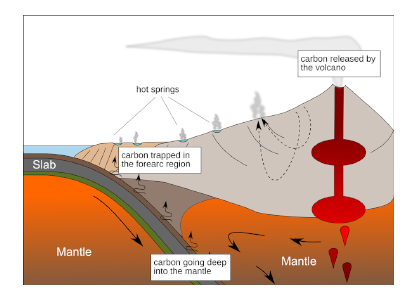
In 2017, an interdisciplinary group of early career scientists, the Biology Meets Subduction team, visited Costa Rica’s subduction zone, where the ocean floor sinks beneath the continent, to find out if subterranean microbes affect geological processes that move carbon from Earth’s surface into the deep interior.

Using carbon and helium isotope measurements of water and nearby sediments from geothermal springs in northern and central Costa Rica, the study published recently in Nature demonstrated that microbes consume and trap a small but measurable amount of the carbon sinking into the trench off Costa Rica’s Pacific coast. The microbes may also be involved in chemical processes that pull out even more carbon, leaving cement-like veins of calcite in the crust.

Figure 1: Schematic of deep carbon cycle subduction at the forearc region and into the mantle.

The team discovered that low temperatures in the forearc support microbial life and water-rock interactions that divert the down-going carbon from the subducting slab and trap it in the crust. The study estimates that about 94 percent of that redirected carbon transforms into calcite minerals and microbial biomass.

Figure 2: Biofilm in a natural seep in Costa Rica. Credit: Peter Barry.

These unexpected findings have important implications for how much carbon moves from Earth’s surface into the interior, especially over geological timescales. If these biological and geochemical processes occur worldwide, they would translate to 19% less carbon entering the deep mantle than previously estimated.

Authors:
PH Barry
JM de Moor
D Giovannelli
M Schrenk
D Hummer
T Lopez
CA Pratt
Y Alpízar Segura
A Battaglia
P Beaudry
G Bini
M Cascante
G d’Errico

M di Carl
D Fattorini
K Fullerton
E Gazel
G González
SA Halldórsson
K Iacovino
JT Kulongoski
E Manini
M Martínez
H Miller
M Nakagawa
S Ono

S Patwardhan
CJ Ramírez
F Regoli
F Smedile
S Turner
C Vetriani
M Yücel
CJ Ballentine
TP Fischer
DR Hilton
KG Lloyd
Physics shed new light on microbial filter-feeding

Posted by mmaheigan 
· Wednesday, September 26th, 2018 

Microbial filter-feeders actively filter water for bacteria-sized prey, but hydrodynamic theory predicts that their filtration rate should be one order of magnitude lower than what they realize.   What is missing in our knowledge and modeling of these key components of aquatic food webs?

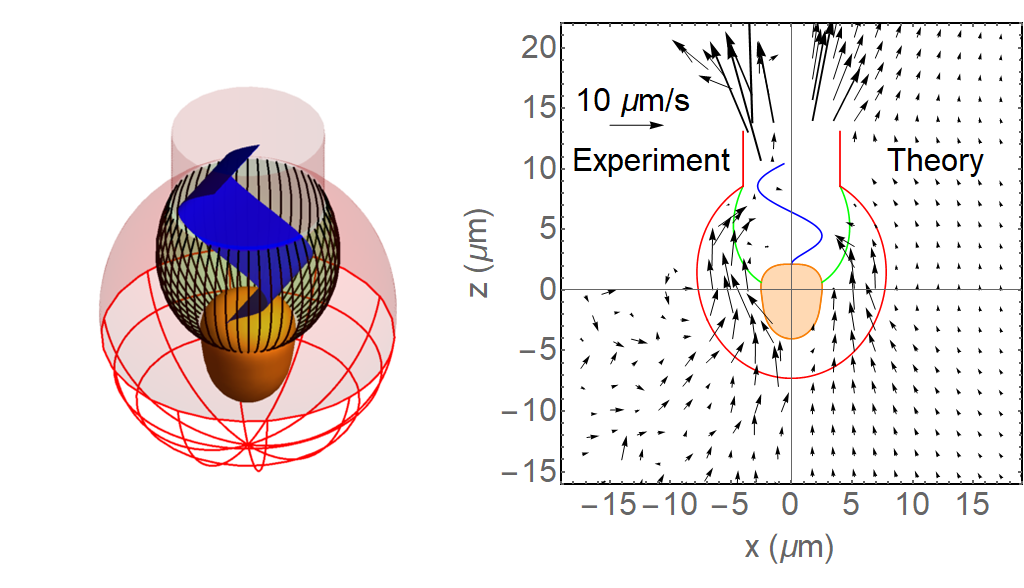
In a recent study published in PNAS, Nielsen et al. (2017) used a combination of microscopy observations, particle tracking, and analytical and computational fluid dynamics (CFD) to shed light on the physics of microbial filter-feeding. They found that analytical and computational fluid dynamic estimates agree that the observed filtration rate cannot be realized given the known morphology and flagellum kinematics. The estimates consistently fall one order of magnitude short of observed filtration rates. This led the authors to suggest that their study organism, the choanoflagellate Diaphanoeca grandis, has a so-called ‘flagellar vane’, a sheet-like extension of the flagellum seen in some members of the choanoflagellate sister group, the marine sponges. This structure would fundamentally change the physics of the filtration process, and the authors found that both the analytical and the computational estimates match observed filtration rates when such a structure is included.

Left: Choanoflagellate model morphology showing the protoplast (cell) in orange, the filter comprised of microvilli (black), the lorica and chimney (red) and the flagellum with vane (blue). Right: Experimentally observed near-cell flow field vs. flow field modelled using computational fluid dynamics including a flagellar vane. The filter cross-section is here shown in green. The modelled flow field provides a good match with the observed flow field. Without a flagellar vane, the model flow field is at least an order of magnitude weaker. This leads to the suggestion that a flagellar vane is needed to account for the observed flow field and clearance rate.


The new insights allow the authors to generalize about the trade-offs involved in microbial filtering, which is important to our understanding of the microbial loop in planktonic food webs. The results are of even wider interest since choanoflagellates are believed to be the evolutionary ancestors of all multicellular animals, many of which include cells that are fundamentally identical to choanoflagellates (e.g., the simple cuboidal epithelium cells of kidneys). Thus, microscale filtering not only happens in every single drop of seawater, it also happens inside most animals.

Learn more here.

Authors:
Lasse Tor Nielsen (National Institute of Aquatic Resources and Centre for Ocean Life, Technical University of Denmark)
Seyed Saeed Asadzadeh (Department of Mechanical Engineering, Technical University of Denmark)
Julia Dölger (Department of Physics and Centre for Ocean Life, Technical University of Denmark)
Jens H. Walther (Department of Mechanical Engineering, Technical University of Denmark, Denmark and Swiss Federal Institute of Technology Zürich, ETH Zentrum)
Thomas Kiørboe (National Institute of Aquatic Resources and Centre for Ocean Life, Technical University of Denmark)
Anders Andersen (Department of Physics and Centre for Ocean Life, Technical University of Denmark)

The sea surface microlayer in a future ocean

Posted by mmaheigan 
· Tuesday, November 28th, 2017 

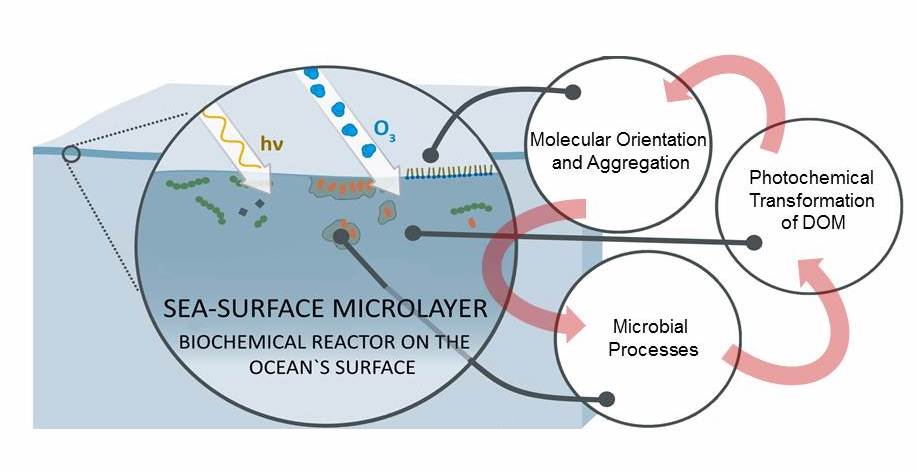
The sea surface microlayer (SML) is the boundary interface between the atmosphere and ocean, spanning the uppermost ~1 mm of the ocean. Covering 70% of the Earth’s surface, the SML supports a rich diversity of life, serving as an incubator for eggs and larvae. The SML controls air-sea interactions  and serves as an important hotspot of microbially mediated biochemical activity. A recent review paper by Wurl et al. highlights the important role of the SML in climate and ecosystem function and how it might change in the future.

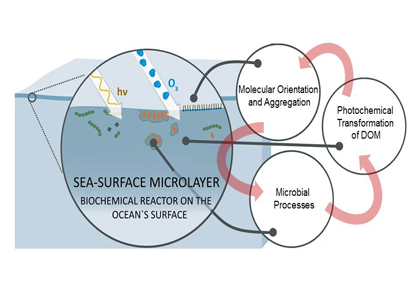
Figure Caption: The sea surface microlayer comprises a complex biofilm and serves as a biochemical micro-reactor with distinct microbial communities and short-term carbon accumulation.


The SML is directly exposed to meteorological forces such as UV radiation, precipitation, and diurnal warming. Since these forces will be impacted by climate change, the SML is also likely to experience changes in the future. For example, projected increases in primary productivity in the upper sunlit layer of the ocean may enhance the supply of surface-active organic material to the SML with accompanying feedbacks on the molecular diffusion and conduction processes that drive exchange of heat and climate-relevant gases such as CO2 between the ocean and atmosphere. Furthermore, changes in UV flux may enhance the SML’s role as a biochemical reactor in which unique microbial communities and photochemical reactions occur, including the transformation of deposited atmospheric particles like dust into bioavailable nutrients like iron to fuel phytoplankton production. Increasing levels of manmade pollutants such as pharmaceuticals and micro-plastics are accumulating in the SML. These and other pollutants have the potential to disrupt biochemical and photochemical processes in the SML, as well as the unique and diverse food webs it supports.

Moving forward, novel techniques and a holistic approach will be needed to improve our understanding of highly complex  SML dynamics. Multidisciplinary data sets that link microbial community structure and function with biogeochemistry will be needed, and eventually, the SML should be included in computer models used to forecast future changes in climate, marine ecosystems, and biogeochemistry.


Authors:
Oliver Wurl (Carl von Ossietzky Universität Oldenburg, Institute for Chemistry and Biology of the Marine Environment)
Werner Ekau (Leibniz Centre for Tropical Marine Research, Bremen)
William M. Landing (Florida State University, Department of Earth, Ocean, and Atmospheric Science)
Christopher J. Zappa (Lamont-Doherty Earth Observatory, Columbia University)

The Ross Sea deep microbial community’s role in sequestering CO2

Posted by mmaheigan 
· Thursday, November 9th, 2017 

Antarctic shelf systems generate the densest waters in the world. These shelf waters are the building blocks of Antarctic Bottom Water, the ocean’s abyssal water mass. These bottom waters have the potential to sequester carbon out of the atmosphere for millennia. One such form of marine carbon is dissolved organic carbon (DOC). DOC is produced in the surface ocean via primary production and is the global ocean’s largest standing stock of reduced carbon.

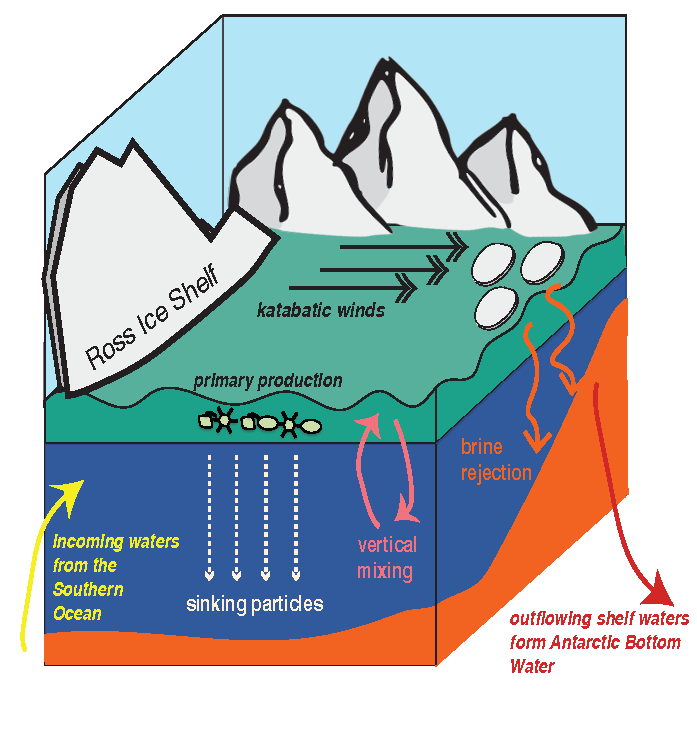
In a recent study, Bercovici et al (2017) used hydrographic and biogeochemical measurements to assess the mechanism that brings DOC into the shelf waters of the Ross Sea, the shelf system in the Pacific sector of Antarctica. These mechanisms include sinking particles, brine rejection caused by katabatic winds in the Terra Nova Bay polynya, and vertical mixing. This study revealed that DOC is primarily introduced into the deeper shelf waters via convective overturning and deep vertical mixing upon the onset of austral winter. Substantial DOC enrichment of shelf waters suggests that this carbon is exported off the shelf into Antarctic Bottom Water. However, this study finds much of the excess Ross Sea shelf DOC is actually consumed and remineralized to CO2 by deep microbial communities at the slope of the Ross Sea shelf, ultimately sequestering this carbon into the ocean’s interior.

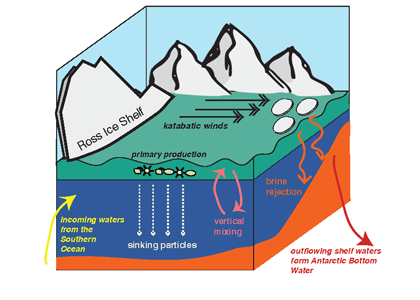
Physical and biological processes have the potential to introduce carbon into the dense shelf waters (blue) in the Ross Sea. Incoming waters (yellow) are modified from the Southern Ocean’s circumpolar waters. At the onset of winter, cooler temperatures and katabatic winds cause brine rejection. The rejection of brine, sinking particles and vertical mixing are all potential mechanisms for bringing DOC to the dense shelf waters. At the shelf slope, outflowing shelf waters ultimately contribute to Antarctic Bottom Water formation. This research furthers our understanding of global carbon cycling through demonstrating that Antarctic shelf systems have the potential to sequester organic carbon into the abyssal ocean.

Authors:
Sarah K. Bercovici (Rosenstiel School of Marine and Atmospheric Science, University of Miami)
Bruce A. Huber (Lamont Doherty Earth Observatory, Columbia University)
Hans B. Dejong (Stanford University)
Robert B. Dunbar (Stanford University)
Dennis A. Hansell (Rosenstiel School of Marine and Atmospheric Science, University of Miami)

Role for iron in controlling microbial phosphorus acquisition in the ocean

Posted by mmaheigan 
· Thursday, October 12th, 2017 

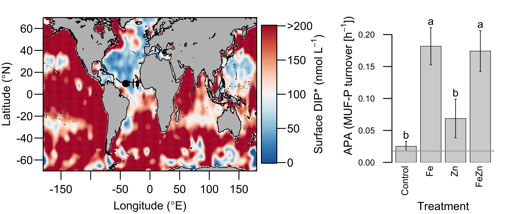
In the subtropical North Atlantic, dissolved inorganic phosphorus (DIP) concentrations are depleted and might co-limit N2 fixation and microbial productivity. There are relatively large pools of dissolved organic phosphorus (DOP), but microbes need an enzyme to access this P source. One such alkaline phosphatase (APase) enzyme requires zinc (Zn) as its activating cofactor. This has been known for almost 30 years. However, recent crystallography studies revealed that two other widespread APase enzymes contain Fe. Via this requirement, Fe availability could regulate microbial access to the DOP pool.

As detailed in a recent publication in Nature Communications (Browning et al. 2017), this hypothesis was tested on a cruise across the tropical North Atlantic by adding Fe and Zn to incubated seawater and monitoring changes in bulk APase using a simple fluorescence assay. Adding Fe significantly increased APase activity in seawater samples collected in areas that were far-removed from coastal and aerosol Fe sources. Despite seawater Zn concentrations being much lower than Fe, it appeared not to be limiting.


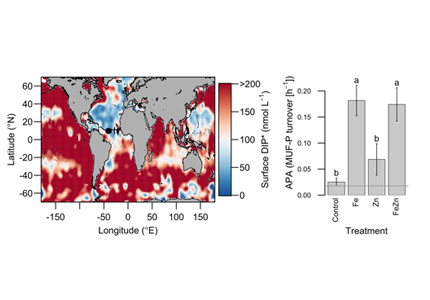
Iron (Fe) and zinc (Zn) enrichment experiments conducted in the DIP-depleted tropical North Atlantic suggested that Fe, not Zn, could limit alkaline phosphatase activity (APA). DIP*=DIP–DIN/16, and represents excess DIP availability assuming a 16-fold higher microbial N requirement. Results in the bar chart represent a subset of treatments from one experiment (out of eight conducted).

DIP is depleted in surface waters of the tropical North Atlantic because inputs of North African aerosol Fe stimulates N2 fixation and leads to microbial drawdown of DIP. If the modern ocean is a good analog for the past, the lack of APase stimulation following experimental Zn addition could reflect limited evolutionary selection for Zn-containing APase. In general, DIP is only substantially depleted where there is enhanced Fe input fueling N2 fixation; it therefore follows that any significant requirement for APases might be restricted to these relatively high-Fe, low-Zn waters.

On a shorter timescale, growing anthropogenic nitrogen input to the ocean relative to phosphorus could result in more prevalent oceanic phosphorus deficiency. Corresponding iron inputs might then serve as an important control on phosphorus availability for microbes in these regions.


Authors:

Tom Browning (GEOMAR Helmholtz Centre for Ocean Research, Kiel, Germany)
Eric Achterberg (GEOMAR) 
Jaw Chuen Yong (GEOMAR)
Insa Rapp (GEOMAR)
Caroline Utermann (GEOMAR) 
Anja Engel (GEOMAR)
Mark Moore (Ocean and Earth Science, University of Southampton, Southampton, UK)


Sinking particles as biogeochemical hubs for trace metal cycling and release

Posted by mmaheigan 
· Thursday, September 14th, 2017 

The extent to which the return of major and minor elements to the dissolved phase in the deep ocean (termed remineralization) is decoupled plays a major role in setting patterns of nutrient limitation in the global ocean. It is well established that major elements such as phosphorus, silicon, and carbon are released at different rates from sinking particles, with major implications for nutrient recycling. Is this also the case for trace metals?

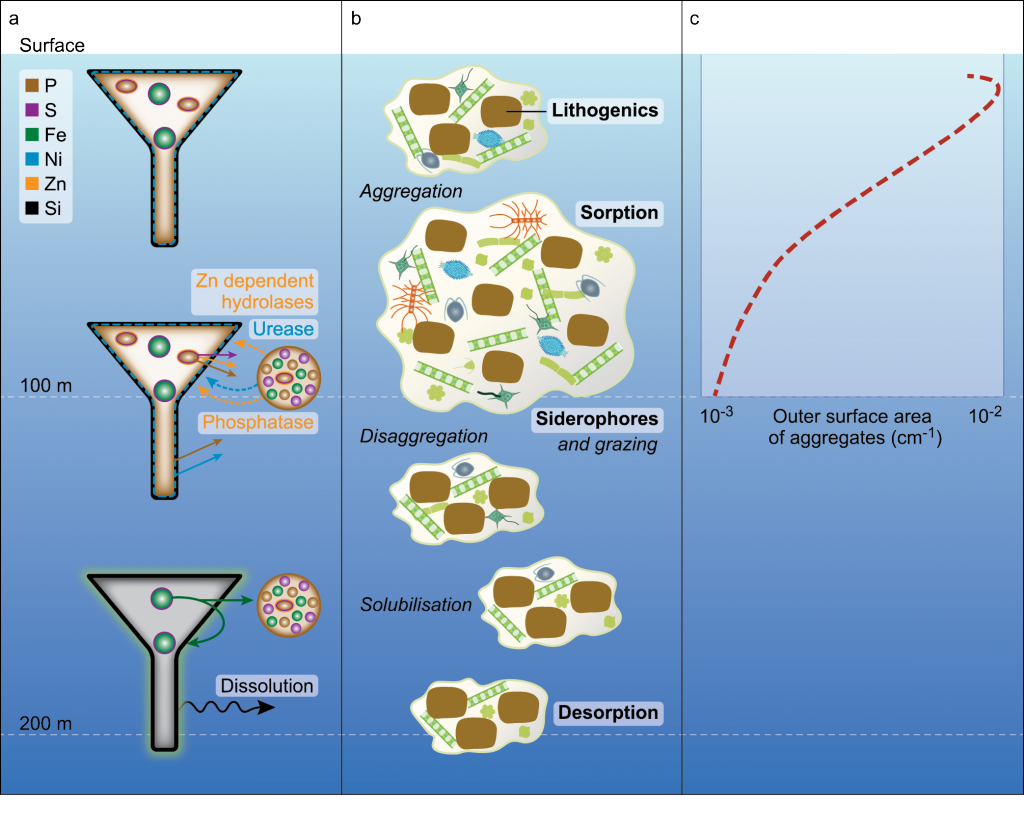
A recent publication by Boyd et al. in Nature Geoscience provides new insights into the biotic and abiotic processes that drive remineralization of metals in the ocean.  Particle composition changes rapidly with depth with both physical (disaggregation) and biogeochemical (grazing; desorption) processes leading to a marked decrease in the total surface area of the particle population. The proportion of lithogenic metals in sinking particles also appears to increase with depth, as the biogenic metals may be more labile and hence more readily removed.

Findings from GEOTRACES process studies revealed that release rates for trace elements such as iron, nickel, and zinc vary from each other. Microbes play a key role in determining the turnover rates for nutrients and trace elements. Decoupling of trace metal recycling in the surface ocean and below may result from their preferential removal by microbes to satisfy their nutritional requirements. In addition, the chemistry operating on particle surfaces plays a pivotal role in determining the specific fates of each trace metal. Teasing apart these factors will take time, as there is a complex interplay between chemical and biological processes. Improving our understanding is crucial, as these processes are not currently well represented by state-of-the-art ocean biogeochemical models.

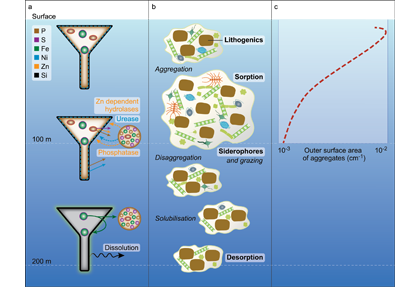
Figure caption: Rapid changes in the characteristics of sinking particles over the upper 200 m as evidenced by: a) differential release of trace metals from sinking diatoms; b) changes in proportion of lithogenic versus biogenic materials; and c) ten-fold decrease in total particle surface area.


Authors:
Philip Boyd (IMAS, Australia)
Michael Ellwood (ANU, Australia)
Alessandro Tagliabue (Liverpool, UK)
Ben Twining (Bigelow, USA)


Relevant links:
GEOTRACES Digest: Iron Superstar

Joint workshop with GEOTRACES in August 2016: Biogeochemical Cycling of Trace Elements within the Ocean

A New Explanation for the Marine Methane Paradox

Posted by mmaheigan 
· Thursday, February 2nd, 2017 

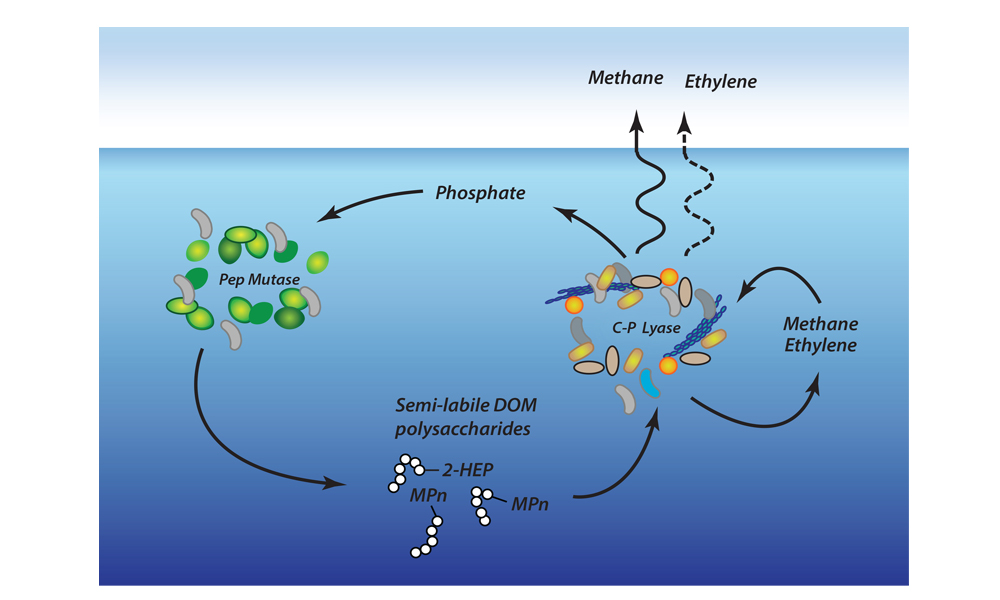
A large fraction of the ocean-to-atmosphere flux of methane occurs in well-oxygenated, open ocean oligotrophic gyres, a phenomenon seemingly at odds with well-known pathways of archaeal methane production under strictly anaerobic conditions. Nearly a decade ago, David Karl and colleagues at the University of Hawaii proposed that water column methane could arise from bacterial metabolism of methylphosphonate, a simple organic compound with reduced phosphorus bonded directly to carbon. However, evidence for this pathway in the environment was lacking. In a recent study published in Nature Geoscience, Repeta et al. (2016) were able to test Karl’s hypothesis using a combination of microbial incubations, genomic analyses, and in-depth chemical analyses of marine dissolved organic matter (DOM). The study revealed that polysaccharides decorated with methyl- and hydroxyethylphosphonate esters are abundant throughout the water column, and that methane and ethylene were quickly produced by natural consortia of bacteria exposed to DOM-amended seawater. Companion knock-out experiments of bacteria isolates further showed that the C-P lyase metabolic pathway was responsible for methane production. Daily cycling of only 0.25% DOM polysaccharide can easily support measured fluxes of marine methane to the atmosphere. Figure from Repeta et al. (2016).

« Previous Page

FilterbyKeyword

abundance acidification additionality advection africa air-sea air-sea interactions albedo algae alkalinity allometry amendments ammonium AMO AMOC anoxic Antarctic Antarctica anthro impacts anthropogenic carbon anthropogenic impacts appendicularia aquaculture aquatic continuum aragonite saturation arctic Argo argon arsenic artificial seawater assumptions AT Atlantic atmospheric CO2 atmospheric nitrogen deposition authigenic carbonates autonomous platforms AUVs awb bacteria bathypelagic BATS BCG Argo benthic bgc argo bias bio-go-ship bio-optical bioavailability biogeochemical biogeochemical cycles biogeochemical models biogeochemistry Biological Essential Ocean Variables biological pump biomass biophysics bloom blue carbon bottom water boundary layer buffer capacity C14 CaCO3 calcification calcite carbon carbon-climate feedback carbon-sulfur coupling carbon 14 carbonate carbonate chemistry carbonate chemistry OAE carbonate system carbon budget carbon cycle carbon cycling carbon dioxide carbon export carbon fluxes carbon removal carbon sequestration carbon storage Caribbean CCA CCS changing marine chemistry changing marine ecosystems changing marine environments changing ocean chemistry chemical oceanographic data chemical speciation chemoautotroph chesapeake bay chl a chlorophyll circulation climate clouds CO2 CO3 coastal and estuarine coastal darkening coastal ocean cobalt Coccolithophores commercial community community composition competition conservation cooling effect copepod copepods coral reefs cruise CTD currents cyclone daily cycles data data access data assimilation database data management data product data sets Data standards DCM dead zone decadal trends decomposers decomposition deep convection deep ocean deep sea coral deep water deepwater horizon denitrification dense water deoxygenation depth diatoms DIC diel migration diffusion dimethylsulfide dinoflagellate dinoflagellates discrete measurements disequilibrium distribution DOC DOM domoic acid DOP dust DVM earth system ecological feedbacks ecology economics ecosystem management ecosystems eddy Education EEZ Ekman transport emissions ENSO enzyme equatorial current equatorial regions ESM estuarine and coastal carbon fluxes estuary euphotic zone eutrophication evolution export export fluxes export production extreme events faecal pellets fecal pellets filter feeders filtration rates fire fish Fish carbon fisheries fishing float floats fluid dynamics fluorescence food webs forage fish forams framework freshening freshwater frontal zone fronts functional role future oceans gelatinous zooplankton gene transfer geochemistry geoengineering geologic time GEOTRACES glaciers gliders global carbon budget global oceam global ocean global ocean models global overturning circulation global warming go-ship gradient grazing greenhouse gas greenhouse gases Greenland ground truthing groundwater Gulf of Maine Gulf of Mexico Gulf Stream gyre harmful algal bloom heat waves high latitude human food human impact human well-being hurricane hydrogen hydrothermal hypoxia ice age iceberg ice cores ice cover industrial onset inland waters in situ inverse circulation ions iron iron fertilization iron limitation isotopes jellies katabatic winds kelvin waves krill kuroshio lab vs field lagoon land land-ocean continuum larvaceans lateral transport LGM lidar ligands light light attenuation lineage lipids low nutrient machine learning mangroves marine carbon cycle marine heatwave marine particles marine snow marine snowfall marshes mCDR mechanisms Mediterranean meltwater mesocosm mesopelagic mesoscale mesoscale processes metagenome metals methane methods microbes microlayer microorganisms microplankton microplastics microscale microzooplankton midwater migration minerals mitigation mixed layer mixed layers mixing mixotrophs mixotrophy model modeling modeling atmosphere model validation mode water molecular diffusion MPT MRV multi-decade N2 n2o NAAMES NCP nearshore net community production net primary productivity new ocean state new technology Niskin bottle nitrate nitrogen nitrogen cycle nitrogen fixation nitrous oxide north atlantic north pacific North Sea NPP nuclear war nutricline nutrient budget nutrient cycles nutrient cycling nutrient limitation nutrients OA observations ocean-atmosphere ocean acidification ocean acidification data ocean alkalinity enhancement ocean carbon uptake & storage ocean carbon uptake and storage ocean color ocean interior ocean modeling ocean observatories ocean warming ODZ oil oligotrophic omics OMZ open ocean optics organic carbon organic particles oscillation outwelling overturning circulation oxidizing oxygen oxygen-deficient pacific paleoceanography PAR parameter optimization parasite particle flux particles partnerships pCO2 PDO peat pelagic perturbation PETM pH phenology phosphate phosphorus photosynthesis physical processes physiology phytoplankton PIC piezophilic piezotolerant plankton POC polar polar regions policy pollutants precipitation predation predator-prey predators prediction pressure primary productivity Prochlorococcus productivity prokaryotes proteins pteropods pycnocline python radioisotopes redox remineralization remote sensing repeat hydrography residence time resource management respiration resuspension rivers rocky shore Rossby waves Ross Sea ROV salinity salt marsh satellite scale seafloor seagrass sea ice sea level rise seasonal seasonal effects seasonality seasonal patterns seasonal trends sea spray sea surface seawater collection seaweed secchi sediments sensor sensors sequestration shelf ocean shelf system shells ship-based obs ship-based observations shorelines siderophore silica silicate silicon cycle sink sinking sinking particles size SOCCOM soil carbon solubility pump southern ocean south pacific spatial covariations speciation spring mixing SST state estimation stoichiometry stratification subduction submesoscale subpolar subtropical sulfate surf surface surface ocean surface water surface waters Synechococcus technology teleconnections temperate temperature temporal covariations thermocline thermodynamics thermohaline thorium tidal time time-series time of emergence titration top predators total alkalinity trace elements trace metals trait-based transfer efficiency transient features trawling Tris trophic interactions trophic transfer tropical turbulence twilight zone upper ocean upper water column upwelling US CLIVAR validation velocity gradient ventilation vertical flux vertical migration vertical transport viruses warming water clarity water column water mass water quality waves weathering western boundary currents wetlands winter mixing zooplankton

Copyright © 2026 - OCB Project Office, Woods Hole Oceanographic Institution, 266 Woods Hole Rd, MS #25, Woods Hole, MA 02543 USA Phone: 508-289-2838  •  Fax: 508-457-2193  •  Email: ocb_news@us-ocb.org

link to nsflink to noaalink to WHOI

Funding for the Ocean Carbon & Biogeochemistry Project Office is provided by the National Science Foundation (NSF) and the National Aeronautics and Space Administration (NASA). The OCB Project Office is housed at the Woods Hole Oceanographic Institution.